Most states are using the Every Student Succeeds Act as an opportunity to measure student growth, not just straight-up performance on tests. And states are broadening their accountability systems to include factors beyond reading and math to comply with a requirement in the law, with many choosing to rate schools in part on whether or not they prepare kids for college and the workplace, according to a review of state plans commissioned by the Collaborative for Student Success and Bellwether Education Partners. The review is aimed in part at helping to pinpoint promising practices in state plans so that states can learn from one another.
The 30 experts including former state chiefs, policy wonks, and civil rights advocates who reviewed plans for Bellwether and the Collaborative also found that five of the 17 states who have submitted ESSA plans so far considered the performance of historically overlooked groups of students in school ratings.
And they found that, with the exception of New Mexico and Tennessee, states aren’t doing a great job of explaining how they plan to intervene in low-performing schools. In fact, the review gave New Mexico whose state chief, Hannna Skandera, departed after the plan was submitted high marks overall. But reviewers found that states such as Arizona and Michigan were lacking in information…
By: Michelle Croft and Richard Lee ACT Research and Policy
Despite (or because of) the federal requirement that all students in certain grades participate in statewide achievement testing, stories of parents opting their student out of the testing gained national attention in the media in the spring of 2015. Ultimately, twelve states—California, Colorado, Connecticut, Delaware, Idaho, Maine, New York, North Carolina, Oregon, Rhode Island, Washington, and Wisconsin—received a notice from the U.S. Department of Education that they needed to create a plan to reduce opt-outs due to low participation rates.
When statewide testing came in spring 2016, there were more stories of opt-outs, and information about districts failing to meet participation requirements will follow in the coming months.3 Early reports from New York indicate that 21% of students in grades 3–8 opted out in 2016, which was slightly more than the prior year. (See attached PDF below for reference information.)
Participation Rate Requirements
The Elementary and Secondary Education Act (both the No Child Left Behind and the Every Student Succeeds authorizations) requires that all students annually participate in statewide achievement testing in mathematics and English in grades 3–8 and high school as well as science in certain grade spans. Ninety-five percent of students at the state, district, and school level must participate; otherwise there is a range of consequences.
Under the No Child Left Behind authorization, the school would automatically fail to meet Adequate Yearly Progress if the school—or subgroups of students within the school—did not meet the participation rate requirement. The Every Student Succeeds Act (ESSA) provides states with greater flexibility to determine how to incorporate the participation rate into the state’s accountability system. However, in proposed regulations, the state will need to take certain actions such as lowering the school’s rating in the state’s accountability system or identifying the school for targeted support or improvement, if all students or one or more student subgroups do not meet the 95% participation rate.
Michelle Croft is a principal research associate in Public Affairs at ACT. Richard Lee is a senior analyst in Public Affairs at ACT.
This report highlights significant investments made by both Republican and Democratic policymakers in state-funded pre-k programs for the fourth year in a row. In the 2015-16 budget year, 32 states and the District of Columbia raised funding levels of pre-k programs. This increased support for preschool funding came from both sides of the aisle–22 states with Republican governors and 10 states with Democratic governors, plus the District of Columbia.
In contrast, only five states with Republican governors and three states with Democratic governors decreased their pre-k funding.
Overall, state funding of pre-k programs across the 50 states and the District of Columbia increased by nearly $755 million, or 12 percent over 2014-15. While this progress is promising, there is still work to be done to set children on the path to academic success early in life. Still, less than half of preschool-aged students have access to pre-k programs.
Increasing the number of students in high-quality preschool programs is broadly viewed as a way to set young learners on a path to a secure economic future and stable workforce. This report includes several state examples and an overview of the pre-k programs they have in place. Data tables on total state pre-K funding and state pre-kindergarten funding by program are appended. [Megan Carolan contributed to this publication.]
Education Commission of the States. ECS Distribution Center, 700 Broadway Suite 1200, Denver, CO 80203-3460. Tel: 303-299-3692; Fax: 303-296-8332; e-mail: ecs@ecs.org; Web site: http://www.ecs.org
Seventeen state plans to implement the Every Student Succeeds Act have passed the U.S. Department of Education’s initial completeness check and are ready for peer review, the next step in the approval process, the department announced Friday.
“Today’s announcement is a big win for ESSA implementation. I am committed to returning decisionmaking power back to states and setting the department up to serve the support and monitoring roles intended by Congress,” U.S. Secretary of Education Betsy DeVos in a statement. “The department worked with states to ensure their plans included all statutorily required components laid out in the…
Brian Calley, Michigan’s lieutenant governor, says the U.S. Department of Education should send back the state’s plan created under the Every Student Succeeds Act because it doesn’t have high enough standards for students with disabilities.
Michigan is among 12 states that submitted their ESSA plans to the Education Department earlier this month.
Calley, a Republican and rumored candidate for governor, posted on his Facebook page April 20 a letter he sent to Education Secretary Betsy DeVos. In the letter, he noted that the state has set inconsistent standards for the minimum number of students needed for accountability purposes, also known…
Read the full article here: May require an Education Week subscription.
If it feels as if Michigan schools are being tugged in multiple directions, that’s because they are. And while all the attention to improving outcomes of the state’s schools is positive, the dearth of a comprehensive vision will render these efforts useless.
The governor, Legislature, State Board of Education, Michigan Department of Education and the School Reform Office are all involved with creating and implementing school policy in this state, and that has led to a confusing mix of proposals and benchmarks for schools.
And as we’ve said before, without clear direction, accountability goes out the window.
Exhibit A is the state’s education plan recently submitted by state Superintendent Brian Whiston to the U.S. Department of Education, a requirement for states to receive federal education dollars. In most states, this accounts for 8 percent of the total school budget. That’s sizable in Michigan, which spends roughly $14 billion a year on K-12 education.
The move, announced Monday, came after Gov. Rick Snyder signed off on the plan but expressed support for more discussion on “greater transparency in the school accountability portion of the plan,” MDE said in a news release.
“Given Michigan’s historically low performance nationally, we must ensure that our accountability system is transparent, honest, and works for every student in the state,” Snyder said in a statement. “Parents have a right to know their schools are providing a quality education for their child.”
U.S. Secretary of Education Betsy DeVos has 120 days to review and approve state ESSA plans, according to MDE.
The accountability system has been the most controversial element within Michigan’s ESSA plan. At issue has been how the department would show school performance.
Snyder’s administration has expressed support for a report card that assigns each school an overall A-F grade based upon several factors, including performance on state tests and graduation rates.
Members of the State Board of Education don’t want an A-F system. Instead, they favor a dashboard that would show performance in several areas but would not include an overall grade or rating for schools.
MDE’s ESSA plan includes both options, as well as a system that would assign a school a grade for each of the following six categories: student proficiency, student growth, graduation rate, assessment participation, school quality/student success, and English Learning Progress. This option would not include an overall A-F grade for the school.
The state’s ESSA plan says if the Legislature does not implement a new accountability system by June 30, the default system will be the transparency dashboard. Committees in the state House and Senate are currently discussing the creation of a new accountability system.
Besides accountability, other elements in the plan include how Michigan will work to support struggling schools, educator quality and the creation of a new assessment system geared toward measuring “within-year” student growth as well as proficiency
“I said from the beginning of this work that we are going to put forward a plan that is best for the students in Michigan,” state Superintendent Brian Whiston said. “This is how we move forward, and I want to thank all of the passionate people who provided input and helped inform this plan. Let’s all work together now to put the plan into action.”
Here’s some of the main components of MDE’s ESSA plan:
“Defining the purpose of school accountability as providing direct supports to the districts, rather than labeling and sanction.”
“A differentiated response to schools based on their academic need, with the most intensive interventions and supports being provided to those most in need.”
“A true focus on the whole child and the aspects of a well-rounded education, including not only academic subjects like fine arts and physical education, but also areas related to safety, health, school culture and climate, food and nutrition, early childhood, postsecondary transitions, and social-emotional learning.”
“Flexibility in the interventions and actions taken by districts and schools, rather than prescribed certain models or interventions. This plan helps local districts diagnose their needs across the whole child spectrum, identify evidence-based practices, and implement a plan that is tailored to their needs.”
Integration and focus on alignment with early childhood initiatives and goals.
“Educator quality that goes beyond a focus on “highly qualified” (which was required under NCLB), to supporting teachers and leaders throughout their careers.”
“Assessment systems that are designed to measure within-year student growth in addition to proficiency on rigorous content standards.”
“An accountability system that provides clear information to all stakeholders, based on areas that relate to the progress toward being a Top 10 education state in 10 years.”
Earlier this week, the Brookings Institution released the fifth annual Education Choice and Competition Index, which ranks school choice in the largest school districts in the U.S.
During her address, Secretary of Education Betsy Devos claimed that “parents are the primary point of accountability.” When asked about policies that ensure that schools of choice are actually improving student performance, she answered that “the policies around empowering parents and moving the decision-making to the hands of parents on behalf of children is really the direction we need to go.” She later repeated the idea that transparency and information, coupled with parental choice, equated to accountability.
While it is indeed important to communicate information on school choice, transparency and information are only part of the accountability puzzle. In addition to these components, states also use accountability to ensure that schools that fail to meet academic or financial standards are improved or closed.
This is of particular importance for public charter schools, who have been given the authority to operate independently of school districts and many state rules or regulations. Accountability rules assure that students are learning and that public funds are spent responsibly.
While the accountability measures used for charter schools to demonstrate quality performance vary from state to state, they do exist, and they include more than just reporting information to parents.
Forty-three states had charter school laws in place when we completed this analysis (not including Kentucky, which passed a bill in March 2017 to allow charter schools). We examined four points of accountability within the charter school policies as recorded by the Education Commission of the States: annual reporting, specifications for termination, performance-thresholds, and technical assistance.
Annual Reporting
Most states require charter schools to submit annual reports as a part of their accountability obligations. Some annual reporting requirements include annual report cards, education progress reports, curriculum development, attendance rates, graduation rates, and college admission test scores. Many states that do not require annual reports still require financial reports, which speaks to the other side of accountability, appropriate usage of funds.
Some states, such as Washington, require charter schools to provide the same annual school performance reports as non-charter schools.
In Ohio, each charter is required to disseminate the state Department of Education’s school report card report to all parents.
North Carolina requires its charter schools to publish their report performance ratings, awarded by the State Board of Education, on the internet. If the rating is D or F, the charter school must send written notice to parents. North Carolina also requires specific data reporting related to student reading.
State Specification for Termination
Forty-two states specify the grounds for terminating a charter school, fostering accountability by establishing standards and consequences of failure to adhere to those standards. Failure to demonstrate academic achievement and failure to increase overall school performance are among the terms cited as grounds of termination among some states.
These state specifications for termination do not only apply to performance levels; they can be applied to a violation of any part of the charter law or agreement, such as fraud, failure to meet audit requirements, or failure to meet standards set for basic operations.
State Threshold
In addition to state specifications for termination, some states have set a threshold marking the lowest point where a school can perform before it is closed. Some states without a clearly communicated low-performance threshold have set other standards which specifically mark the lowest point of acceptable performance.
Setting a minimum threshold for performance for the automatic closure of failing schools may increase charter school accountability, and encourage high performance.
State-Provided Technical Assistance
Technical assistance to charter schools included leadership training or mentoring charter school leaders, or assistance with grant and application writing and other paperwork related to charter school operation.
In addition to holding charter schools accountable for high performance, several states offer technical assistance to ensure that charter school administrators understand how requirements are measured, and can be directed to resources to assist them with achieving performance goals, especially if they are at risk of closure due to failing to meet previously established standards.
These are clear displays of school accountability policies that help to ensure that parents have truly good schools from which to schools. Accountability relies not only on information for parents, but also consequences for schools that fail to educate students or use taxpayer dollars responsibly.
[1] The following states also require annual financial audits with their annual performance reports: Arkansas, Arizona, DC, Georgia, Hawaii, Oregon, Michigan, Texas, Utah
[2]Utah requires the most comprehensive technical assistance offerings, provided by the state charter school board which includes: assistance with the application and approval process for charter school authorization, locating private funding and support sources, and understanding and implementing charter requirements.
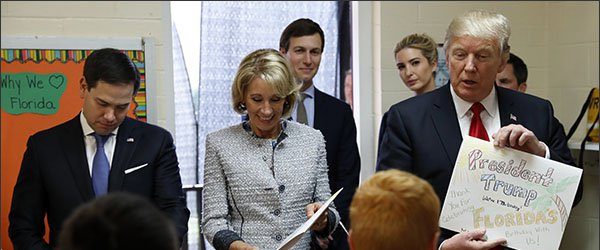
Secretary of Education Betsy DeVos made big news twice the first time she visited a school in her new job. Ever since then, educators, advocates, and others have expressed keen interest in keeping close tabs on each time she visits a school to see how things go, and what she says during and after her visit.
Now you can easily keep up with DeVos’ visits to schools: Click here to use our handy interactive map and tracking tool. Each time she stops by a school, you’ll see a slide with the name and location of the school, along with any other pertinent information and coverage we have of her trip. The interactive tool also adds up not just the number of times she’s visited schools, but the types of schools she’s visited: traditional public, private, and charter schools. You can also check out an embedded version of the tracker below:
School visits and the accompanying photo ops for education secretaries are part of the job, of course. Former Secretary of Education William Bennett, for example, the nation’s third education secretary, visited 75 schools from 1985 to 1987. And it was one of his favorite parts of the job…






 Brian Calley, Michigan’s lieutenant governor, says the U.S. Department of Education should send back the state’s plan created under the Every Student Succeeds Act because it doesn’t have high enough standards for students with disabilities.

![[ESSA] State Plan Versions That Have Been Released So Far](https://nnpa.org/essa/wp-content/uploads/2017/04/essa-posts-featured_0060_iStock-460421987-1-1080x600.png)