How a Supreme Court Ruling on Playground Covering May Pave the Way for School Vouchers

How a Supreme Court Ruling on Playground Covering May Pave the Way for School Vouchers
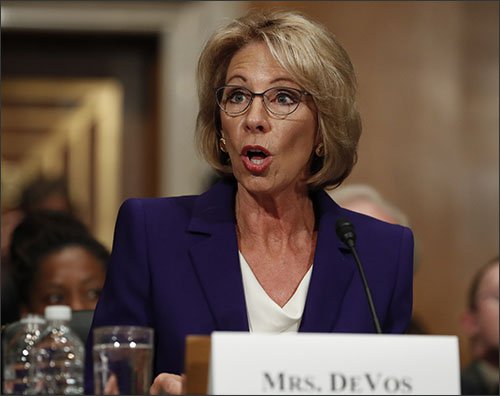
blaine amendmentBefore she was appointed U.S. Secretary of Education, Betsy DeVos spent the better half of two decades on an expensive, dogged crusade to bring school vouchers to her home state of Michigan. Bankrolled by the limitless financial resources of the DeVos Family Foundation, her efforts helped fuel other school choice initiatives – namely lifting caps on charter school expansion – but no amount of political contributions or slick marketing campaigns was enough to do the same for vouchers.

So what got in the way?

Aside from the fact that the idea of funneling public taxpayer money to pay tuition for private schools, including religious institutions, is an enormously unpopular and harmful idea, a sizeable share of the credit has to go to a provision in Michigan’s constitution.

Michigan is one of 38 states that has strict state constitutional prohibitions against state or local financial assistance to non-public schools. In most of those states, the prohibition is specifically against aid to religious institutions, including schools. These prohibitions were adopted in many of these states in the nineteenth century as part of the common school movement and were intended to prevent public funding of religious schools.

In recent years, opponents of these provisions have sought to recast them as anti-Catholic provisions and tagged them as “Blaine amendments” after a failed 1875 effort by Congressman James G. Blaine to amend the federal constitution to prohibit governmental aid to religious organizations.

While the federal Blaine amendment effort was clouded by anti-Catholic bias, the state constitutional prohibitions against aid to religion were not and cannot be dismissed summarily, as voucher proponents would have it, by tarring them as mini “Blaine amendments.”

The Supreme Court will soon weigh in on the strength of such state “No Aid” provisions. By June of this year the Supreme Court  – particularly if it is joined by a ninth member  – could decide that interpreting these provisions to prevent religious institutions from receiving public funds violates the federal Constitution. This could push the door open for school vouchers on a national scale, giving an enormous and timely boost to Donald Trump’s and Betsy DeVos’ ambitious school privatization agenda.

It’s an agenda, says NEA President Lily Eskelsen García, that siphons off taxpayer dollars from public schools for private and for-profit schools – all at the expense of students.

“For too long, these schemes have experimented with our children’s education without any evidence of real, lasting positive results.”
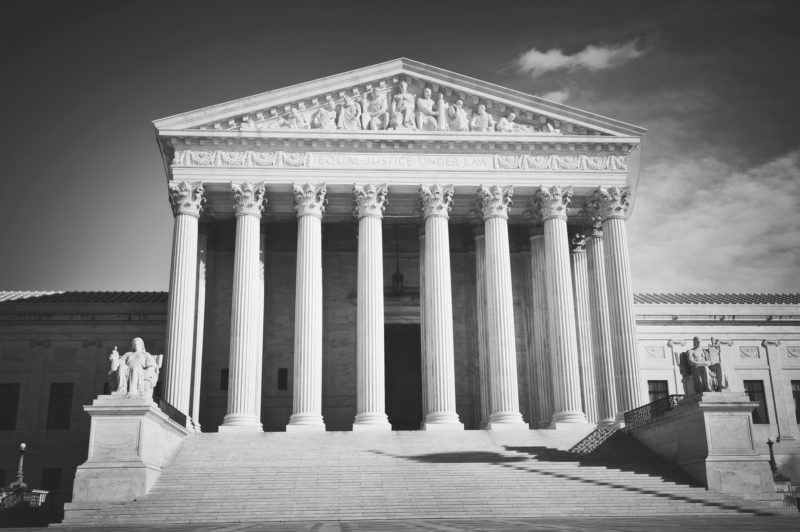
In 2017, the U.S. Supreme Court may issue a decision that could push the door open for school vouchers on a national scale.

What Do Recycled Tires Have to Do With School Vouchers?

The case the Court will consider this year doesn’t actually involve a school at all. Trinity Lutheran Church of Columbia, Inc. v. Pauley centers around a statewide aid program in Missouri that helps organizations turn used tire scraps into rubber surfacing material for playgrounds. Supply is limited, so the state selects who receives the aid.

The Trinity congregation, which runs a daycare center for children, applied for a grant, but was turned down by state officials given the Missouri constitution’s “No Aid” provision.

Trinity Lutheran sued, arguing that the state constitutional prohibition is inherently “hostile” to religion because it violates the neutrality principle of the Free Exercise Clause of the First Amendment. The church asserts that a government program – in this case, a grant for playground covering – that treats a religious organization different from a secular organization is unconstitutional.

But Richard Katskee, legal director at Americans United for Separation of Church and State, says the prohibition against direct financial aid to churches “stands at the very heart of the First Amendment’s Establishment Clause.”

In a post on ScotusBlog, Katskee writes: “Whether to adhere to a particular faith and pay to support a church, or to support none at all, was seen [by the Framers] as the fundamental right of every individual. State financial support for churches is still forbidden by the First Amendment – out of respect for religious freedom.”

Indeed, state constitutional prohibitions against government aid to religion support religious freedom rather than undermining it, says Alice O’Brien, General Counsel at the National Education Association, which filed an amicus brief in support of the Missouri Department of Natural Resources, the respondent in the case.

“They prevent the government from forcing individuals of one religion to support another religion, and prevent the government from appearing to favor one religion over another. They also protect the independence of religious institutions, given that government grants inevitably go hand-in-hand with government regulation. ” O’Brien explains.
Audio: NEA President on School Vouchers
On March 6, NEA President Lily Eskelsen García was interviewed on the “Maggie Linton Show” on SiriusXM to talk about how voucher schemes pray on the nation’s most disadvantaged students.

A ruling in Trinity Lutheran that prohibits states from enforcing their own constitutional prohibitions against state aid to religion, says O’Brien, “could open the door to significantly expanded state school voucher programs including ones that fund pervasively sectarian schools.”

But the Court may issue a narrower decision that is limited to the facts of the case before it, leaving to another day the question of how far states may go in prohibiting aid to religious schools.
School voucher advocates may have a clearer shot at such state constitutional prohibitions with Colorado State Board of Education v. Taxpayers for Public Education.

In 2015, the Colorado Supreme Court struck down a voucher program created by Douglas County, a suburban district of 67,000 students just outside of Denver, that used a shell charter school to transfer funds to private schools. The State and school district have now asked the Supreme Court to review the case. The outcome of the Douglas County case may hinge on how the justices rule on the Trinity Lutheran case.

The Fifth Vote

How this plays out may well depend on if, and when, Neil Gorsuch, Trump’s nominee to fill the ninth seat on the Supreme Court, is confirmed by the U.S. Senate. Most experts see him as the ideological heir to Antonin Scalia, although Gorsuch during his years as a federal appeals court judge hasn’t ruled in any cases involving state “No Aid” provisions or school voucher programs.

However, a red flag can be found in a 2005 article he wrote for the conservative magazine National Review, which included the following criticism of so-called judicial activism:

“American liberals have become addicted to the courtroom, relying on judges and lawyers rather than elected leaders and the ballot box, as the primary means of effecting their social agenda on everything from gay marriage to assisted suicide to the use of vouchers for private-school education.” (emphasis added)

A ruling in Trinity Lutheran that prohibits states from enforcing their own constitutional prohibitions against state aid to religion, says O’Brien, “could open the door to significantly expanded state school voucher programs including ones that fund pervasively sectarian schools.”

On so-called “religious liberty” cases, Gorsuch very much falls in line with other conservative justices. For example, in 2013, he voted to allow privately-held for-profit corporations both to claim religious beliefs as entities, and to use those beliefs to deny contraceptive coverage to employees – the famous “Hobby Lobby” case that eventually made it to the Supreme Court.

Gorsuch’s potential vote to strike down state constitutional prohibitions against religious aid could remove a significant obstacle to school vouchers and is just one of the many ways the next Court could impact public education in the United States

As the Trump administration ramps up its efforts to push school vouchers nationwide, a decision in the Trinity Lutheran case that eliminates a constitutional safeguard against using taxpayer money for private and religious school tuition will have an immediate and troubling impact.

School privatization advocates will undoubtedly celebrate such a ruling, but that doesn’t change the fact that vouchers are nothing more than a scheme to take public money and hand it over to private schools that have little or no accountability to taxpayers, says Eskelsen García.

“Private and for-profit schools that receive taxpayer-funded vouchers have almost complete autonomy on how they operate. They don’t have to follow academic standards, don’t have to hire qualified teachers and don’t have to disclose financial decisions to the public.

“A child’s success should not depend on a gamble.”

The Supreme Court is scheduled to hear arguments in Trinity Lutheran Church of Columbia, Inc. v. Pauley in April, and is expected to issue a decision by late June.

ILLINOIS | MICHIGAN: We must fight for our public schools, universities

ILLINOIS | MICHIGAN: We must fight for our public schools, universities

by Stephanie Bontemps, Illinois Federation of Teachers

Public education is a great equalizer and compulsory in the United States. Hence, we view public school education as a right and this system allows our children to fulfill their potentials.

Today the right for all American children to be educated is threatened by the efforts of Betsy DeVos, the Secretary of Education. She has no experience in education as a teacher, administrator, or school board member, and poses a danger to public education. How? By her unending efforts to undermine public school funding in favor of funding voucher schools and for-profit schools that receive tax monies but face no accountability standards.

The DeVos family spent millions of dollars in Michigan to promote charter schools. This lobbying has left Michigan with the largest number of low-performing charter schools in the United States.

It is very upsetting that the administration has selected such a nominee to run our public schools, a position designed to fortify and improve our system’s achievements.

Mrs. DeVos’ efforts are designed to strip our schools of crucial funding for children who need extra help in reading and math. Instead, she wants those monies to go to charter schools.

We do not need an unqualified nominee to be in charge of our children’s education. We must stand together to fight for our public schools and universities.

Betsy DeVos Sees Choice-Friendly Florida as a K-12 Model for the Nation

Betsy DeVos Sees Choice-Friendly Florida as a K-12 Model for the Nation

By Alyson Klein and Andrew Ujifusa

U.S. Secretary of Education Betsy DeVos may have helped to create the charter sector in her home state of Michigan. But in a recent interview she singled out another state—Florida—as offering a great blueprint for the country.

“I would point to Florida as being one that has had a variety of options for the longest period of time,” DeVos told Frank Beckmann, a conservative radio talk show host on WJR, based in Michigan. She said the state, which has charters, also offers both a tax credit scholarship, something DeVos and company may push in Washington, potentially through legislation previously introduced by Florida Sen. Marco Rubio, a Republican, and vouchers for students in special education.

Michigan hasn’t been able to offer the same kind of voucher program as Floridabecause its state constitution prohibits public funds from being used for religious purposes. By contrast, Florida’s vouchers for special needs students can be used at schools affiliated with religious institutions. Michigan, which also has charters, recently started experimenting with Education Savings Accounts, which allow parents and students to “put [their] own customized plan together” for education, DeVos said…

Read the full article here. May require an Education Week subscription.

Democrats Press Betsy DeVos for Details on Possible Education Department Cuts

Democrats Press Betsy DeVos for Details on Possible Education Department Cuts

By Andrew Ujifusa on February 28, 2017 12:13 PM

The top two Democratic lawmakers on education issues in Congress are asking for more details from Secretary of Education Betsy DeVos about her stated plans to look for ways to trim the U.S. Department of Education.

In a Feb. 24 letter to DeVos, Rep. Bobby Scott of Virginia and Sen. Patty Murray of Washington express concerns about DeVos’ comments to a Michigan radio talk show earlier this month that she would be auditing the department’s programs, and that she was confident there were unnecessary programs at the department. Those comments, the two lawmakers say, “raise questions” about what DeVos hopes to accomplish by such a review. (Scott and Murray are the top Democrats on the House and Senate education committees, respectively.)

“In fact, previous department budget requests have noted that current staff levels fall significantly short, endangering the department’s capacity to fulfill and enforce legal obligations” in several areas, from civil rights protections to data security, the joint letter states…

Read the full article here. May require an Education Week subscription.


See Betsy DeVos’ Responses to a Key Democrat on Common Core, ESSA, Civil Rights

See Betsy DeVos’ Responses to a Key Democrat on Common Core, ESSA, Civil Rights

The Senate education committee is meeting Tuesday to vote on President Donald Trump’s nominee for education secretary, Betsy DeVos, a billionaire school choice advocate, best known for her work chairing the American Federation for Children.


A broad contingent of civil rights organizations, educators, and advocates have come out against DeVos’ nomination.There’s a huge social media campaign to defeat her, and in-person protests across the country. At the same time, she has the support of Republican policymakers, like former GOP presidential nominee Mitt Romney, and even some Democrats and former Democratic Vice Presidential candidate Sen. Joseph Lieberman of Connecticut.

After a bumpy confirmation hearing, committee Democrats asked DeVos about 800 questions to flesh out her views on key K-12 issues. The top Democrat on the committee, Sen. Patty Murray, of Washington, asked DeVos some 140 questions, and made the answers public. (You can read them here.)…

Read the full article here. May require an Education Week subscription.

Exit Interview: Ed. Sec. John B. King Jr. Talks Legacy and Election Aftermath

Exit Interview: Ed. Sec. John B. King Jr. Talks Legacy and Election Aftermath

U.S. Secretary of Education John B. King Jr. only served in his job for about a year. But in that time he’s helped lay the groundwork for implementation of the Every Student Succeeds Act, the first reauthorization of the Elementary and Secondary Education Act in more than a decade.

And he’s traveled to more than 30 states, used his bully pulpit to argue for equitable access to education, and butted heads with education groups and Republicans in Congress over a wonky—but important—spending provision in ESSA.

In a sit-down interview, King and I talked about everything from the Obama…

Read the full article here. May require an Education Week subscription.

Which GOP Senators Could Reject DeVos? Look to Rural, Anti-Voucher Republicans

Which GOP Senators Could Reject DeVos? Look to Rural, Anti-Voucher Republicans

UPDATED

Betsy DeVos’ nomination for education secretary is headed to the full Senate for a vote. Republicans outnumber Democrats in the chamber by 52 to 48, so on a party line vote DeVos should be safe. But where could anti-DeVos forces pick up a crucial third vote against the nominee and overcome the tiebreaker vote held by Vice President Mike Pence? They could look to senators who’ve expressed skepticism about a crucial education policy priority for DeVos: school choice.

We know that two GOP lawmakers on the Senate education committee, Sen. Susan Collins of Maine and Sen. Lisa Murkowski of Alaska, have said they’re concerned about DeVos and haven’t committed to voting for her in the full Senate.

First, let’s assume all 48 Democrats vote against DeVos. Let’s also assume, solely for the sake of argument, that Collins and Murkowski ultimately vote against DeVos. (They very well may not.) That makes it 50-50. So one more vote against DeVos eliminates Pence as a tiebreaker vote and dooms DeVos’ nomination. Sen. Jeff Sessions, R-Ala., has been confirmed by the Senate judiciary committee to be attorney general, but he hasn’t been confirmed by the full Senate. So as of now, he can still vote on DeVos…

Read the full article here. May require an Education Week subscription.

Six Education Policy Areas Where Betsy DeVos’ Views Still Aren’t Clear

Six Education Policy Areas Where Betsy DeVos’ Views Still Aren’t Clear

Betsy DeVos gave education policy and politics watchers lots to talk about after her confirmation hearing for education secretary on Tuesday. She provided detailed arguments about Michigan charter schools and school accountability in that state, and for how she’d be a “crusader” for parents and students rather than the education establishment. DeVos also made waves for her comments on special education law and states’ responsibilities in that area.

But there were also areas of K-12 policy where DeVos gave general or somewhat limited answers to senators’ question. Perhaps it’s not surprising that in several respects, DeVos didn’t want to spell out detailed views on every issue raised, in part because she might have worried that she would come across as prejudging certain situations. And sometimes, senators left notable issues out of their lines of questioning.

Still, DeVos’ comments at the hearing leave some interesting questions about her positions. Here are some areas where questions about DeVos might be lingering…

Read the full article here. May require an Education Week subscription.


Democrats Press Betsy DeVos on Privatization, ESSA, and LGBT Rights

Democrats Press Betsy DeVos on Privatization, ESSA, and LGBT Rights

By Alyson Klein and Andrew Ujifusa

WASHINGTON — Betsy DeVos, Donald Trump’s pick to lead the U.S. Department of Education, sought to use her confirmation hearing to beat back the notion that she would undermine public education as head of the department, as Democrats pressed her on everything from her views on the civil rights of gay and lesbian students, to states’ responsibilities for students in special education, and guns in schools.

“If confirmed, I will be a strong advocate for great public schools,” DeVos said. “But, if a school is troubled, or unsafe, or not a good fit for a child—perhaps they have a special need that is going unmet—we should support a parent’s right to enroll their child in a high-quality alternative.” She also noted that her mother, Elsa Prince, was a public school teacher.

But those assurances didn’t seem to quell the anxieties of Democrats on the committee, including Sen. Patty Murray of Washington, the ranking member. “I have major concerns with how you have spent your career and fortune fighting to privatize public education and gut investments in public schools,” she said.

In the early stages of a tense hearing that lasted three and a half hours, Murray asked DeVos if she would be willing to commit not to “cut a penny from public education” or use her perch at the department to privatize public schools. DeVos said she would seek to give parents and children the best educational options possible, which Murray essentially took as a no.

DeVos didn’t delve into the specifics on many of the big questions on the table, like whether she would rein in the department’s office of civil rights, or how she would handle key details of the federal student lending program. And at times she seemed unclear on key policy details, including during a pair of exchanges with Democratic senators on whether federal special education laws should apply to all schools. (More here.)…

Read the full story here. May require an Education Week subscription.


Betsy DeVos’ Confirmation Hearing: What to Watch for

Betsy DeVos’ Confirmation Hearing: What to Watch for

It’s finally happening: Betsy DeVos, President-elect Donald Trump’s pick to lead the U.S. Department of Education, is set to testify before the U.S. Senate Health, Education, Labor, and Pensions Committee at her confirmation hearing Tuesday.

In the past, confirmation hearings for an education secretary have typically been bipartisan love fests. But that’s not going to be the case this time around.

DeVos’ background as a voucher supporter who has never worked in a government, in a school district, or attended or sent her kids to public school has generated big backlash from educators and civil rights groups. In fact, 38 groups who don’t always see eye-to-eye on K-12 issues—including Democrats for Education Reform and the teachers’ unions—sent a letter Tuesday to Senate education committee leaders expressing big concerns about DeVos’ background and support for vouchers…

Read the full article here. May require an Education Week subscription.