Public school systems throughout the nation will now be required to be a lot more transparent when it comes to school funding.
According to the federal Every Student Succeeds Act (ESSA), signed into law by President Barack Obama in 2015, all public schools nationwide, will be required to give fully-detailed reports on how and where they spend institutional funding.
The ESSA reporting requirement for school funding begins in December 2019, and supporters of the rule, including the NAACP, believe it will help to encourage greater educational equity, particularly among schools serving large numbers of Black and Hispanic students in low-income neighborhoods.
“We need more equitable and adequate funding for all schools serving students of color,” said Victor Goode, the education director for the NAACP. “Why? Because education funding has been inadequate and unequal for students of color for hundreds of years. Second, privatization forces are working to eliminate our public schools and, with it, transparency, public accountability and access to all.”
Goode said that ESSA requires a breakdown of how student need is met with a focus on equity over equal distribution for funding.
Goode continued: “That explains the reason behind the school-by-school, per pupil spending report. This kind of public transparency is a good thing and can help provide more meaningful parental and community engagement, which is also essential to accountability and achieving educational equity.”
According to the Brookings Institution, a nonprofit public policy organization, based in Washington, D.C., that conducts research on solving societal problems locally, nationwide and globally, to date minority students are still far more less likely than White students to have adequate school resources.
In addition, the Brookings Institution reported that schools with predominantly Black and Hispanic children, on average, are nearly twice as large as White schools—reaching an estimated 3,000 students or more in most cities, with lower-quality curriculum offerings and less qualified teachers (in terms of levels of education, certification, and training in the fields they teach), all of which George H. Lambert, Jr., president and CEO of the Greater Washington Urban League, believes can be rectified through adequate funding.
“Through the availability of [ESSA] data, Black and [Hispanic] educators can begin to prove that Black and [Hispanic] students suffer from funding disparities and the lack of teachers in the classroom who look like them or represent their perspective,” Lambert said. “We need better, more transparent data on school funding. The availability of such data and our ability to access it forces greater urgency on what is, arguably the most important issue of our time.”
Lambert said that any discussion on educational equity should acknowledge the enormous achievement gaps that still plague Black and Hispanic students.
“If these gaps aren’t closed, our community doesn’t have much of a future,” Lambert said.” Even though high school graduation rates are better now than 30 years ago, we still face a situation where more than a quarter of Black students, for example, are dropping out. Most Black students in the largest U.S. cities are attending schools with high concentrations of poverty. Over half of our young, Black men are either dropping out or finishing K-12 late, hence 1 in 3 end up trapped in some fashion in the criminal justice system.”
Despite high approval from many civil rights organizations, school district administrators, like Robert Lowry, the deputy director of the New York State Council of School Superintendents still believe that the new law might shine light on imbalanced revenue and create the perception that some students are being shortchanged, even when this may not be the case.
“We question whether the state officials would even have the expertise and the capacity to evaluate spending levels between schools,” Lowry told Education Week.
Though Lowry’s concerns may be valid, Lambert believes that full transparency is a plus.
“This is a good way to learn about flaws in the system and how those flaws are aggravated by a lack of Black and [Hispanic] expertise and perspective in the curriculum, the classroom and the leadership office,” Lambert said. “We can also find out if school districts with a larger number of Black and [Hispanic] educators are experiencing high levels of funding disparities and uneven attention from policymakers.”
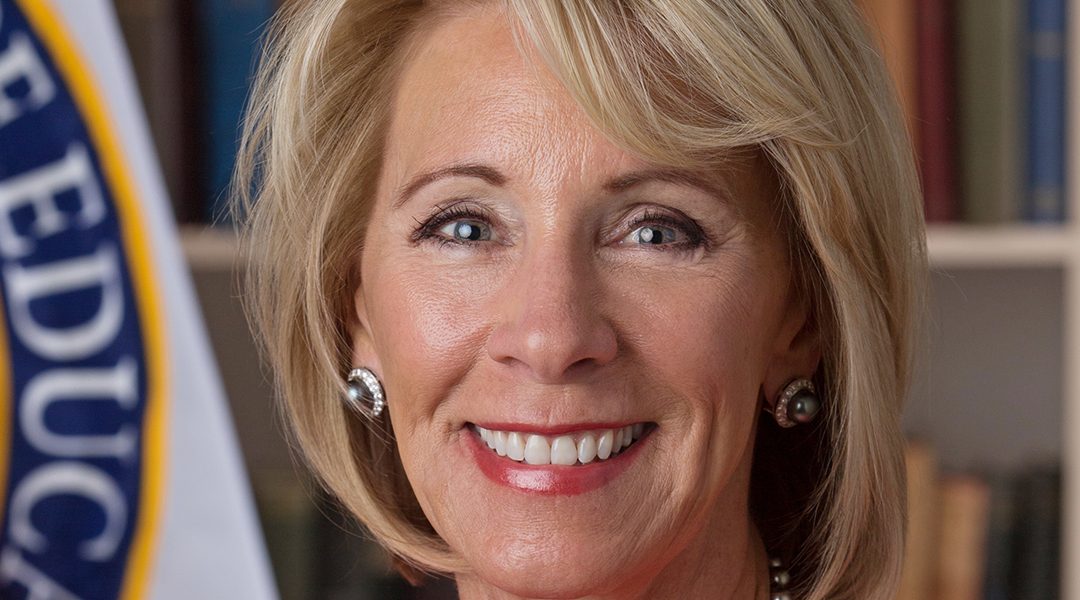
U.S. Secretary of Education Betsy DeVos hasn’t testified before the House or Senate education committees since becoming secretary more than a year ago—and Democrats aren’t happy about that.
For one thing, it’s a departure from the record of her recent predecessors, each of whom had appeared before the two education committees at least once—and in many cases, more often—by this point in their tenures. And even when you widen the lens to look at other committees on Capitol Hill, DeVos is still behind the pace of her predecessors.
All in all, DeVos has testified before Congress just four times so far, including her confirmation hearing in January of last year, and three education spending committee appearances.
That’s not to say DeVos is dodging lawmakers. The party in control of Congress—in this case, the GOP—gets to decide when a cabinet secretary appears before Congress. “Every time the Secretary has been called up to testify she has made herself available to do so,” said Elizabeth Hill, a spokeswoman for the department.
Still, top Democrats on the House and Senate education committees—Rep. Bobby Scott of Virginia and Sen. Patty Murray of Washington—are not happy that they haven’t gotten a chance to hear from DeVos directly. They have big concerns about the way DeVos is implementing the Every Student Succeeds Act, her school choice agenda, and what they see as her rollback of Obama-era civil rights protections. They want to question her about those issues in person.
House Republicans say they fully intend to have DeVos speak to the committee, they’ve just run into scheduling conflicts.
Read the full article here: May require an Education Week subscription.
The deadline has passed for states to submit final Every Student Succeeds Act (ESSA) plans. Now it’s up to school districts to figure out how to capture and report data about student performance. While the additional reporting can seem like a burden, buried in that task is a great opportunity to boost strategic decision-making capabilities. District administrators just need a simple method to look at student data in a new way.
ESSA reporting requirements include the need to publish specific educational data sets separated by student subgroups and categories. School districts are challenged to rethink how they collect, analyze, and present…
Read the full article here: May require registration with eSchool News.
U.S. Secretary of Education Betsy DeVos is approving plans that fly in the face of the Every Student Succeeds Act’s protections for vulnerable children, according to more than a dozen civil rights groups, including the Leadership Conference on Civil and Human Rights.
The groups sent a letter Tuesday to Democratic and Republican leaders on the House and Senate education committees asking them to tell DeVos to stop approving “unlawful” plans.
“We call on you to fulfill your role in ESSA’s implementation and to correct the Department of Education’s flawed approval of state plans that do not comply core equity provisions of the law,” the groups wrote to Sens. Lamar Alexander, R-Tenn., and Patty Murray, D-Wash., as well as Reps. Virginia Foxx, R-N.C., and Bobby Scott, D-Va.
This is far from the first time that the civil rights community—and Democratic lawmakers—have questioned DeVos’ approach to plan approval. The Alliance for Excellent Education, one of the 17 groups that signed off on the letter, put together a legal brief questioning whether some of the plans that DeVos has approved meet ESSA’s requirements. And both Murray and Scott have written letters to DeVos saying she is flouting the law.
A long-awaited report on access to digital learning hit the newsstands this week with a familiar headline: a digital divide, known as the homework gap in education circles, persists, especially for students of color, students from low-income families, and students in rural areas.
Released by Institute of Education Sciences (IES), an arm of the National Center for Education Statistics, on April 4, 2018, Student Access to Digital Learning Resources Outside of the Classroom found large gaps in both connectivity and access depending on the racial and ethnic background, economic status, and location of a students’ family.
The report was required under the Every Student Succeeds Act (ESSA) and was supposed to be released in June 2017. When the deadline was missed, the Alliance for Excellent Education joined the Consortium for School Networking (CoSN) and 18 other organizations in a coalition letter calling for it to be released as soon as possible, given the critical information it reveals about home access to high-speed broadband internet, especially for historically underserved students.
Lack of Access in Rural Areas
According to the report, students in suburban areas had more access to fixed broadband at home, 84 percent, than did students in rural areas, 71 percent. Unsurprisingly, students in remote rural areas had less access to fixed broadband, at 65 percent, than their peers in other geographic areas.
Adding the lens race and ethnicity amplifies even larger gaps in access for students in these rural areas. Higher numbers of students of color in rural areas had either no internet access or only dial-up access (41 percent of African American students and 26 percent of Latino students), compared to their white (13 percent) and Asian (11 percent) peers.
Breakdown by Race and Ethnicity
Regardless of locale, students of color and students from low-income families had less internet access than their peers. As demonstrated by the figure below, there’s an 18-percentage-point gap in fixed broadband access between white students and their African American peers. A similar difference of 16 percentage points exists for Latino students and an even larger gap of 28 percentage points for American Indian/Alaska Native students when compared with their white peers.
The National School Boards Association is committed to helping ensure each and every student has, not just equal, but equitable opportunities and access to a high quality education. “Equity Matters” shines a spotlight on the importance of educational equity. “Equity Matters” was released at the National School Boards Association’s 2018 Annual Conference in San Antonio, TX.
Curious to explore where American education stands 35 years after the “A Nation at Risk” report that warned of dire consequences for the workforce if schools didn’t shape up? The Ronald Reagan Presidential Foundation and Institute has an event on April 12 in Washington, D.C., that will explore that question.
The Reagan Institute Summit on Education will feature seven former secretaries of education, including Bill Bennett, who served under President Ronald Reagan; Lamar Alexander, who served under President George H.W. Bush; Richard Riley, who served under President Bill Clinton; Margaret Spellings, and Rod Paige, who served under President George W. Bush; Arne Duncan and John King, who served under President Barack Obama.
Condoleezza Rice, who served as President George W. Bush’s secretary of state, and Janet Napolitano, who served as President Barack Obama’s Homeland Security Secretary, will also be speaking.
State chiefs will be there, too, including John White of Louisiana and Carey Wright of Mississippi. In addition, Ras Baraka, the mayor of Newark, N.J., will attend…
Read the full article here: May require an Education Week subscription.


 By Lauren Poteat
 U.S. Secretary of Education Betsy DeVos hasn’t testified before the House or Senate education committees





 Live and recent hosted webcasts of the California Collaborative for Educational Excellence (CCEE) meetings.