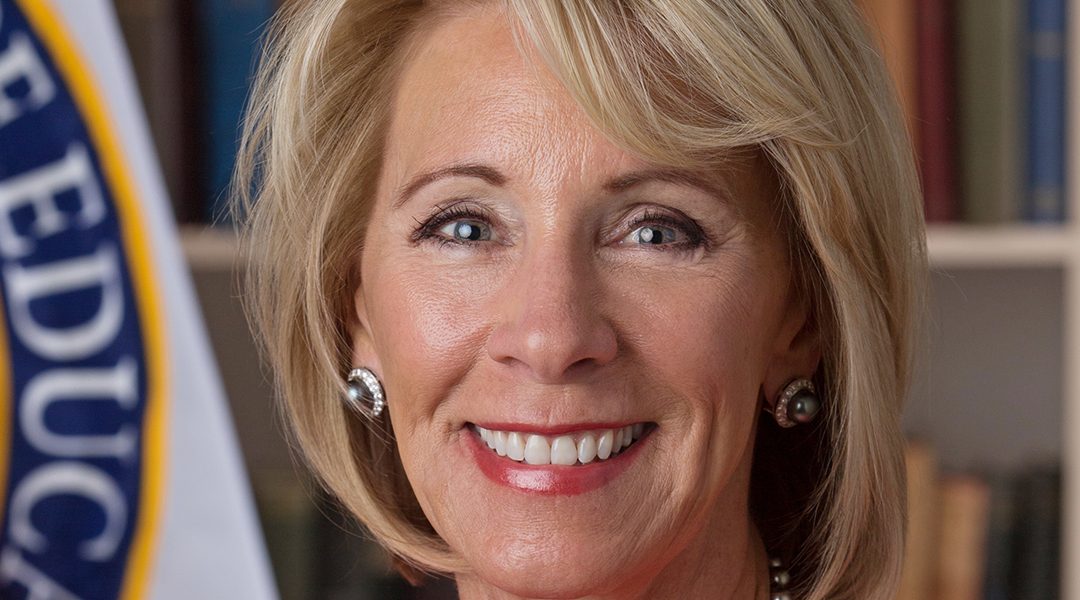
When the best educators in America traveled to Washington, D.C. for a series of events celebrating innovation in the classroom and to share best practices in K-12 education, they let officials at the Department of Education and the White House know exactly how they felt about the Trump Administration’s current push for school choice programs.
According to edchoice.org, school choice programs allow, “public education funds to follow students to the schools or services that best fit their needs—whether that’s to a public school, private school, charter school, home school.”
In April 2018, the Department of Education (ED) hosted the “Honoring Martin Luther King Jr.’s Drum Major Legacy: Innovative Pathways to Success” celebration; the event was sponsored by the White House Initiative on Educational Excellence for African Americans in collaboration with the Center for Faith-Based and Neighborhood Partnerships.
The Education Department’s MLK Legacy event honored individuals who perform extraordinary acts of service in their communities, specifically those individuals who support high-quality education for children of color. Many of the awardees work with parents or community groups that provide primary care for children; some even provide educational support services outside of the traditional public school model.
School choice became a hot topic during the event, as several attendees were visibly disgruntled at the mention of the controversial approach.
The Trump Administration has proposed to decrease funding to authorized investments for public schools while increasing funding opportunities for school choice programs and private school vouchers. Ninety percent of children in America attend public schools. Increased funding to school choice programs, while reducing funding to public schools is a strategy that leaves behind our most vulnerable students.
Secretary of Education Betsy DeVos has repeatedly said that she’s committed to uphold the intentions of the Every Student Succeeds Act (ESSA), the education law signed by President Barack Obama. However, the prioritization of school choice programs in the proposed FY2019 budget contradicts one of the original intentions of the law: to promote equity and increase access to high-quality education for all students. Furthermore, prioritization of school choice isolates homeless children, migrant children, youth in foster care and children from military families. In fact, ESSA requires that school districts report student outcomes for these groups for the very first time.
The 2018 Teacher of the Year awardees echoed similar concerns during their annual White House visit in April. The top teachers in the country reported that they did not approve of funding private schools at the expense of their most vulnerable, at-risk students.
Every child should be entitled to high-quality education in the United States of America. Every neighborhood school should be equipped to provide high-quality courses and curriculum. Every student should have highly-qualified teachers and a menu of extra-curricular activities to choose from. Until the administration prioritizes the equitable improvement of all schools, their verbal commitment to uphold the original intent of ESSA is just another “alternative fact.”
Learn more about the Every Student Succeeds Act at nnpa.org/essa.
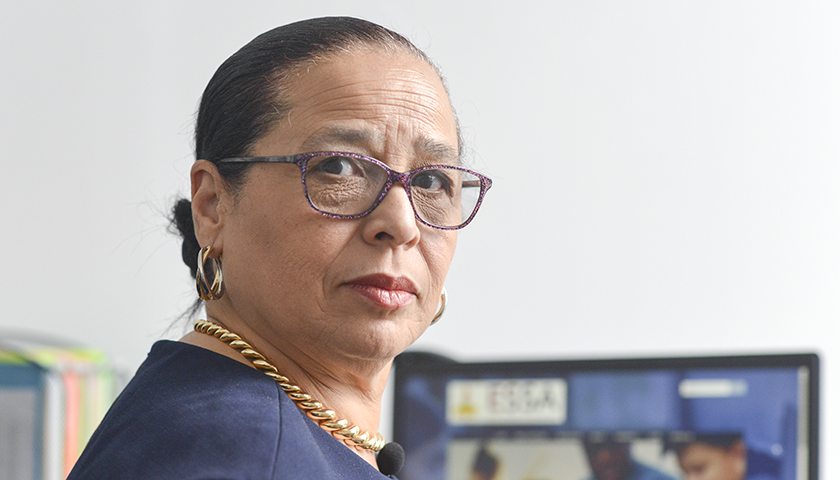
Dr. Elizabeth Primas is an educator, who spent more than 40 years working towards improving education for children of diverse ethnicities and backgrounds. Dr. Primas is the program manager for the NNPA’s Every Student Succeeds Act Public Awareness Campaign. Follow Dr. Primas on Twitter @ElizabethPrima3.
In a post about teaching techniques, Maryellen Weimer cautioned readers about loving techniques for the wrong reasons. When I talk about formative assessment or formative instructional practice, I do share information about strategies and techniques to use that support the pedagogy. But for me, formative assessment goes far beyond the use of strategies and is more about a way of being in the classroom. It is about the engagement of both the teacher and the learners in gathering the evidence of learning to see where “they” (the entire classroom learning team) are in relation to the learning target or goals and using that evidence to make adjustments (on-the-fly) to both learning and teaching to get closer to where the members of the team want or need to be.
Dr. Weimer shares that…
…a collection of techniques has got to be monitored and managed, and that requires a lot more sophisticated skills than those needed to acquire a collection. Even a good technique doesn’t work well for all teachers all the time. There are no cure-all solutions that function effectively with all kinds of content and for all kinds of students. No technique is going to be implemented equally well by all teachers. Our thinking about what a technique can accomplish needs to be a bit less optimistic.
I couldn’t agree more. Over the past 15 years, I have watched teachers embrace the idea of formative assessment, become more mindful of strategies they were using, gather strategies to add to their toolkit, and work hard in their classrooms to implement and integrate those strategies. Where efforts sometimes fall short is in using the results and data gathered from using the strategies.
As part of a process, planning when to use formative assessment within a lesson is valuable, as is being able to use a formative instructional strategy in-the-moment – both of which take practice. The key is using the results and teaching students to use the results. Eliciting and gathering evidence of learning is work for both the teacher and the learners. It is the use of the data that make it formative. Let’s talk about three ideas to consider when it comes to making the use of the data formative.
The use of formative assessment has to be such that the data collected allows the teacher to differentiate the levels of understanding among the learners.
Both learners and teachers need to be able to use the results to see what the level of understanding actually is, and when the learner can make adjustments independently or may need assistance.
When the learner’s understanding is deep enough, the skills and knowledge transfer to new situations. The evidence gathered should provide information about that transfer. This data gathered and used formatively informs the decisions learners and teachers make regarding next steps…
It seems pretty likely that the Trump administration will revise or rescind an Obama-era directive intended to address racial disparities in school disciplinary actions. The “Dear Colleague” letter in question, issued by the U.S. Departments of Education and Justice in 2014, has been the subject of much debate of late. It stated that school districts could be investigated and found guilty of violating students’ civil rights when doling out punishments, even if the discipline policies were race-neutral and implemented in even-handed ways (in other words, even if there was no evidence of discriminatory treatment of students).
Yet, the latest federal discipline data, released earlier this month, show that African-American students continue to be disciplined at higher rates than white students. While U.S. Secretary of Education Betsy DeVos held roundtable meetings with lawmakers in April to hear debates about the guidance from both sides, there is no timeline for the administration’s final decision.
But school discipline reform did not begin with President Barack Obama, and it won’t end with President Donald Trump. Efforts for change have been gaining steam for years, which legislatures and school boards have increasingly codified into laws and practices at state and local levels.
Read the entire article here. May require a subscription to Education Week.
U.S. Secretary of Education Betsy DeVos, who has had difficulty selling her school choice agenda in Washington, railed against state constitutional prohibitions on public funds going to faith-based institutions, in a recent speech to a Roman Catholic organization.
The target of DeVos’ wrath: so-called “Blaine” amendments to state constitutions that prohibit public funds from being used for religious purposes. DeVos said those amendments, many of which originated in the late 1800s, began as “bigoted” against Catholics.
“These Blaine provisions prohibit taxpayer funding of ‘sectarian’—a euphemism at that time for ‘Catholic’—activities, even when they serve the public good,” DeVos said, according to prepared remarks of the speech to the Alfred E. Smith Foundation, which is affiliated with the Archdiocese of New York. “Activities like addiction recovery, hospice care, or—the amendments’ primary target—parochial education.”
NEW YORK – The Harlem-based media arts organization Black Public Media (BPM) has been awarded an Art Works grant of $40,000 by the National Endowment for the Arts (NEA). The allocation, one of more than $80 million in approved grants by National Endowment for the Arts Chairman Jane Chu as part of the NEA’s second major funding announcement for fiscal year 2018, will help fund BPM’s signature public television series, AfroPoP: The Ultimate Cultural Exchange.
Art Works is the NEA’s largest funding category and supports projects that focus on the creation of art that meets the highest standards of excellence, public engagement with diverse and excellent art, lifelong learning in the arts and/or the strengthening of communities through the arts.
“The variety and quality of these projects speaks to the wealth of creativity and diversity in our country,” said Chu. “Through the work of organizations such as Black Public Media in New York, NEA funding invests in local communities, helping people celebrate the arts wherever they are.”
“NEA’s support for the AfroPoP series reinforces our belief that authentic stories about the African Diaspora are important to keeping the American public informed and engaged about diversity of the African-American and global African experience,” said BPM Executive Director Leslie Fields-Cruz.
For 10 years AfroPoP: The Ultimate Cultural Exchange has been bringing stories about people of African descent around the world to television. Produced by Black Public Media and distributed by American Public Television (APT), AfroPoP is the nation’s only public television series of documentaries on contemporary life, art and culture across the African Diaspora.
Hosts of the series have included Idris Elba, Anika Noni Rose, Gabourey Sidibe, Wyatt Cenac, Anthony Mackie, Yaya DaCosta, Jussie Smollett, Nikki Beharie and Nicholas L. Ashe.
For more information on projects included in the NEA grant announcement, visit arts.gov/news. For more information on Black Public Media, visit www.blackpublicmedia.org, or follow it on Twitter @BLKPublicMedia or on Facebook.
About Black Public Media:
Black Public Media (BPM), formerly the National Black Programming Consortium (NBPC), is committed to enriching our democracy by educating, enlightening, empowering and engaging the American public. The nonprofit supports diverse voices by developing, producing and distributing innovative media about the Black experience and by investing in visionary content makers. BPM provides quality content for public media outlets, including, among others, PBS and PBS.org and BlackPublicMedia.org, as well as other platforms, while training and mentoring the next generation of Black filmmakers. Founded in 1979, BPM produces the AfroPoP: The Ultimate Cultural Exchange documentary series and manages the 360 Incubator + Fund, a funding and training initiative designed to accelerate the production of important Black serial and interactive content.
About The National Endowment For The Arts:
Established by Congress in 1965, the National Endowment for the Arts (NEA) is the independent federal agency whose funding and support gives Americans the opportunity to participate in the arts, exercise their imaginations, and develop their creative capacities. Through partnerships with state arts agencies, local leaders, other federal agencies, and the philanthropic sector, the NEA supports arts learning, affirms and celebrates America’s rich and diverse cultural heritage, and extends its work to promote equal access to the arts in every community across America.
House Democrats are inviting students affected by school shootings to participate in an internship program on Capitol Hill, where they will work on issues related to violence prevention.
House Democratic Caucus Chairman Joe Crowley from New York announced the Gun Safety Internship Program on Thursday.
“My colleagues and I are thrilled to invite these young men and women to intern on Capitol Hill this summer and bring their energy and dedication to Congress,” he tweeted.
The Congressman is working with Vice Chair Linda Sánchez from California, Chair of the House Gun Violence Prevention Task Force Mike Thompson from California and Rep. Ted Deutch from Florida to lead the effort.
What do you think of when you hear the word “gateway?” Is it a promising image, perhaps an invitation to a lush garden? Is it a forboding one, conjuring up the image of a heavy lock on a rusting door?
That’s the double-edged nature of gateways, and in this special report, Education Week aims to explore both facets as they relate to students’ progression through science, technology, engineering, and math in K-12 schools and into their futures.
Gateways can swing open, giving students opportunities to master the ability to think logically, reason, model solutions to problems, and troubleshoot, all of which are in demand among employers both in STEM fields and, increasingly in non-STEM ones.
Or gateways can shut and lock, cutting off the ability to acquire those skills and putting students at a disadvantage, perhaps for the rest of their lives.
STEM Education: Opening Gateways to Learning & Careers
Despite its reputation as a field flush with opportunity, even STEM can pose dead ends for students, such as the traps of remedial math education or course sequences that don’t lead to high-paying, satisfying careers.
In one sense, the problem with defining high-quality, flexible STEM pathways in K-12 education begins with the looseness of the term STEM itself. Too many advocates use it glibly, implicitly giving it the suggestion of limitless promise and opportunity. But a close look at labor-market data suggests it’s not as simple as that…
Read the full article here: May require an Education Week subscription.
U.S. Secretary of Education Betsy DeVos used a speech at the American Federation for Children’s national summit in Indianapolis on Monday to rally states behind the cause of expanding school choice, even though the Trump administration won’t force them to do so.
In the speech before the school choice advocacy group that DeVos used to lead, the education secretary said President Donald Trump soon will propose “the most ambitious expansion of education choice in our nation’s history.”
She didn’t provide any details on how those choice programs would work as the Trump administration prepares to release its fiscal 2018 budget. But DeVos did say that while Washington won’t force states into expanding choice programs and will leave states a lot of flexibility, those states that decline to do so will be held accountable by their constituents.
“If a state doesn’t want to participate, that would be a terrible mistake on their part,” DeVos said. “They will be hurting the children and families who can least afford it. If politicians in a state block education choice, it means those politicians do not support equal opportunity for all kids…”
Read the full article here: May require an Education Week subscription.
I’ve never been good at remembering special dates – Memorial Day, my girl’s birthday – most dates besides Christmas, Fourth of July and Thanksgiving get past me. So when Democratic gubernatorial candidate Phil Noble’s press coordinator on May 17 called me about a press conference to discuss he and running mate Dr. Gloria Bromell Tinubu’s position on education and segregation, it didn’t sink in that May 17 commemorated the 64th anniversary of the U.S. Supreme Court’s ruling against public schools segregation.
Maybe it’s not so hard to forget that racial segregation in public schools is supposed to be against the law because schools still are racially segregated. Heck, America still is racially segregated! Electing a Black president was monumental, but did little to change the reality of racism in America. Most recently I’ve been thinking there is no real desire to end segregation, racism and discrimination in America.
According to one source, the NAACP since the 1930s had been fighting to end racial segregation in public schools. A lawsuit that began in South Carolina’s ‘Corridor of Shame’ in Clarendon County led to the 1954 Supreme Court decision. Clarendon County’s public schools today still are shamefully segregated, unequal and discriminated against.
In 1954 the Supreme Court gave America a way out of the order to end segregation, racism and discrimination. The Supreme Court’s decision did not spell out any method for ending racial segregation in schools. It only ordered states to desegregate “with all deliberate speed”. That’s the same rouse South Carolina’s Supreme Court used to make the 20-year-old Corridor of Shame lawsuit go away. And neither the state’s legislature nor the people who elect it have moved an inch otherwise.
The race disparities in Charleston County report released last year by the Avery Research Center for African American History and Culture at the College of Charleston documented some things most of us know. Despite having some schools that are racially integrated, racial disparities in educational attainment still are blatant. In 2008 about 74,000 whites in the county had attained a Bachelor’s or higher degree compared to about 7,000 Blacks.
In the 2015-2016 school year, the five schools with the highest poverty indicator were predominantly Black schools and those with the lowest poverty indicator were predominantly white. In 2015 of the students taking and passing advance placement tests about 78 percent of Asian students passed AP tests, about 76 percent of White students passed the tests while only about 25 percent of Black student passed the tests.
During the 2014-2015 school year there were about 8,000 suspensions in Charleston County schools. Black males accounted for about 4,500 of those suspensions. Black females accounted for another 2,000 suspensions. Among elementary school students, Black students accounted for about 1,900 of the 2,200 suspensions. Black males accounted for about 1,400 of those suspensions.
In December I talked with former Charleston County School Board Chair Hillery Douglas who said those disparities exist because some residents in the county are “hell-bent” on insuring that progress for Black citizens is limited. That effort is played out in every aspect of daily life, including public education, he said.
“It may be hard to believe those people exist in these times, the 21st century. But there are those who would limit our gains in politics, economics, education – you name it. It’s not so pervasive in other parts of the state. But here, it’s blatant. To overcome that we must ask ourselves whether our progress will be determined more by us or that group. Do we put forth the effort to guide our children to become successful? We have kids who are smart. Will we invest more in them or in our iPhones, hair and nails? It’s a hard job to get people to be engaged. Some of our people are fighting, but so many don’t know how to fight. They don’t know how to instill in their children the things that make them successful. And there are those among us who let a few dollars influence whether or not we do the right things. We’ve got some politicians who shouldn’t be in office,” Douglas said.
The 64th anniversary of the Supreme Court decision against segregated public schools – by some estimates counted in 20-year intervals – that’s more than three generations. I applaud Noble’s willingness to address racism and inequality, to put those issues on the table as he campaigns to become S.C. governor. But then, that’s who Phil Noble is. It’s not just a discussion with him: it’s a life philosophy. I first came to know of Noble because of his positions on race and racism in our community.
The sad part is, for far too many it is just a matter of discussion. For politicians it’s a talking point. The laws and legislation they introduce and enact however says something different. Meaningful change can occur in 100 years – that’s if you mean to change. Obviously few mean to change the segregation and inequality that exists in our schools. I think the sooner we make that admission, the sooner we can move on. A definition of crazy is doing the same thing the same way and expecting a different result. We’re all not crazy. So when it comes to segregated unequal education, quit spittin’ on me and callin’ it rain.
We’re all not crazy. So when it comes to segregated unequal education, quit spittin’ on me and callin’ it rain.
In a Mobile, Ala., elementary school, students regularly don hard hats, goggles, and lab coats to conduct science experiments. They design ramps for toy cars, observe the process of chicks hatching in an incubator, and build beaver dams by using materials from nature and design.
“I don’t want them to pretend to be scientists,” said Julie Neidhardt, the instructor and founder of the Nurturing Engineering, Science, and Technology (N.E.S.T) lab at Hutchens Elementary School, which serves grades pre-K-2. “I talk to them like they are scientists.”
That sort of inquiry-based, hands-on instruction in science, technology, engineering, and mathematics is rare in elementary grades, experts say—despite the fact that young children can be sponges for the kind of information taught in those subjects.
STEM Education: Opening Gateways to Learning & Careers
“Young kids are, all on their own, completely committed to being excited and interested in STEM topics,” said David Evans, the executive director of the National Science Teachers Association. “The sad thing is, if there isn’t good support in schools, they lose that by the time they get to middle school.”

 By Dr. Elizabeth Primas


 By Michael J. Petrilli