CHICAGO — There’s no doubt that foundational knowledge of science, technology, engineering, and math will help tomorrow’s job seekers to excel in the future of work. However, much of this success depends on the level of STEM instruction they receive while still in elementary, middle and high school.
While we often assume that STEM programs are being initiated by classroom teachers, new research suggests that librarians and media specialists are increasingly taking the lead in bringing new, innovative tools into their school programs.
Join us at 1 p.m. Eastern on Monday, June 11 for “Librarians’ Insights on How to Integrate STEM and Coding into Makerspaces,” a free, 60-minute webinar led by Dr. Azadeh Jamalian, head of education strategy at littleBits. Dr. Jamalian will talk about how school libraries are bringing STEM into their curriculum and the leading role that librarians and media specialists are taking to make this a reality.
Whether you’re an educator inspiring the next generation of problem solvers, a stakeholder involved in developing programs for your community, or a librarian interested in facilitating maker activities in your school or library setting, you will benefit from attending this session. Be sure to bring your questions!
Azadeh (Azi) Jamalian, PhD, is the head of Education Strategy at littleBits, an award-winning platform of easy-to-use electronic building blocks that is empowering kids everywhere to create inventions, large and small. Dr. Jamalian has a PhD in Cognitive Studies in Education from Teachers College Columbia University, and has published journal articles and book chapters on a broad range of topics such as designing learning platforms for children, emerging educational tech, game design, mathematical education, and cognition. Dr. Jamalian has received numerous awards including “IES Prize for Excellence in Research on Cognition and Student Learning” and “The Cooney Center’s certificate of innovation in Children’s Learning.”
This American Libraries Live webinar is sponsored by littleBits.
littleBits is an award-winning 21st century tool for invention-based learning. The easy-to-use electronic building blocks snap together with magnets empowering everyone to create inventions, large and small. Each color-coded Bit has a specific function (e.g. lights, sensors, internet connectivity) and is reusable. With endless inventions, guides, and resources, educators and students can engage in increasingly complex challenges and grow their TECHNOLOGY LITERACY, CRITICAL THINKING, CREATIVE CONFIDENCE, CODING and STEAM SKILLS.
American Libraries Live is an immediate and effective way to get to the heart of the real issues in our industry. Each program lasts 60 minutes. With the help of real-time technology, it’s like having your own expert on hand. We look forward to you joining us. To receive e-mail reminders, register here. If you’re unable to attend live, this event will be recorded and available at americanlibrarieslive.org/al-live shortly after it concludes.
For information about advertising or sponsoring an AL Live event, contact: Carrie Smith, American Libraries magazine, casmith@ala.org, (312) 280-4216. For general information or press inquiries about AL Live, contact: Colton Ursiny, Administrative Assistant, cursiny@ala.org, (312) 280-5100.
Two Birmingham city high school student-athletes recently won $500 to plant trees around the metro area.
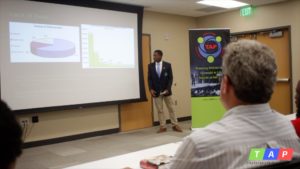
Jordan Embry of Ramsay High School and Kobe Howard of Wenonah High School won for their presentation on the importance of mitigating deforestation in Alabama which impressed a panel of judges at the Together Assisting People (TAP) Business Pitch Competition.
“I think it’s brilliant for them to come up with a concept talking about tree deforestation,” said Chris Rogers, founder and CEO of TAP. “They want to take the (prize) money (of $500) to do that. They want to get their teammates and TAP to plant more.”
The students want to start out by planting five trees in two Birmingham neighborhoods this summer but hope to plant more.
Embry, who is a junior and a running back at Ramsay, and Howard, who is a senior with the culinary program at Wenonah, provided statistical information about deforestation in their communities.
Embry said he came up with the idea of planting trees because he wanted to do something that makes a difference. “I feel like trees are a necessity in life,” Embry said. “They help with oxygen and it has so many benefits for everyday life. When you cut down a tree I feel like you should also replant a tree.”
Howard said he was surprised by the number of trees cut in every year.
About 3.5 billion trees are cut every year around the world including about 500,000 acres of trees a year in the United States, he said. “We don’t cut down as much as Brazil, but they also have a rainforest,” Howard said. “So we don’t have as many trees . . . but we’re still losing a lot of the benefits that trees provide us.”
Howard said he learned a lot about research while working on the project.
“If you have the right people, the right materials, the right information, you can go far and do a lot,” he said.
Embry agreed.
“I think our idea was pretty good,” he said. “We learned about creating a budget plan for the project. For silver maple seeds (to plant the trees) it’s $20 for 100 seeds. We’re not going to plant over 300 seeds or anything, but we do hope it will make a difference.”
The students said they hope their project inspires others to take notice of issues like deforestation.
“If they want to help in another area and plant trees there, they should go for it,” Embry said.
Jordan Embry presents information about deforestation to a panel of judges during Together Assisting People’s first Business Pitch event. (Provided photo)
Rogers acknowledged that the topic wasn’t one that many athletes would care about.
“You’d never think that athletes would be into that kind of stuff,” he said. “Jordan is a kid who gets it. Kobe is looking to go to the University of South Alabama and major in business, but he has dreams of being a chef. He actually caters our events. So, we’re letting him fine-tune his skills by catering our events. He’s getting the opportunity to get real-life skills and we’re putting money in his pockets.”
Other pitches as part of the competition included ways to improve customer service. Students Lee Witherspoon of Parker High School and Jayst Dorion of Spain Park High School are trying to come up with an app to improve customer service, Rogers said.
“They said they see a difference between how you’re treated at Wal-Mart and Whole Foods,” he said.
This is the first Business Pitch, but Rogers wants it to become an annual event.
“We have some . . . guys doing exceptional work,” Rogers said. “To have them . . . researching and pitching. I think long term they all won. They’ve got something invaluable.”
In the late 1980s and early 1990s, our community was under a full-fledged attack. Crack was in our streets, it was in our schools, it was in our parks, it was in our playgrounds, and for some, it was in our homes. The epidemic wasn’t just affecting one part of the community; this impacted the entire community, leaving sons without fathers, daughters without mothers, and parents, ultimately, alone.
But the carnage didn’t stop there. Policies enacted during the crack epidemic exacerbated the destruction. Children in South Los Angeles were ripped away from their parents and shipped off into the child welfare system, some to never see their parents, or their families, again. It was at the height of the crack epidemic when the number of kids in foster care exploded and the percentage of Black youth in the system skyrocketed.
Now, the country, not just our community, faces a new epidemic. Our child welfare system is already becoming increasingly populated due to the consequences of the opioid epidemic. The current crisis is starting to devastate families and our already over-worked and under-resourced child welfare system. This time, we must apply the lessons learned from the crack epidemic: if you want successful policy, you must include the affected communities in the formulation of new policy. We cannot afford to turn our backs on those impacted again.
At the end of this month, the Congressional Caucus on Foster Youth will host its 7th annual Foster Youth Shadow Day, a program that brings foster youth from all over the country to meet and shadow the very Members of Congress who represent them in Washington, D.C.
No one knows more about the pitfalls of our nation’s child welfare system than those who grew up in it. These young people are travelling thousands of miles to come to D.C. to share their stories—both their challenges with abuse, trafficking, overmedication, or homelessness—as well as their successes with mentorship, adoption, family reunification, community activism and independent living.
The result of these visits is a better understanding of how to improve the child welfare system and fight against this epidemic. The FY 2018 omnibus bill that was passed earlier this year had the single biggest increase in investment in child welfare funding history along with a large investment in funds to combat the opioid crisis. Despite this progress, there will always be more work to be done and this month, I look forward to continuing this fight. National Foster Care Month is a month to honor the successes and challenges of the more than 400,000 foster youth across the country and to acknowledge the tireless efforts of those who work to improve outcomes for children in the child welfare system.
Making sure that all children have a permanent and loving home is not a Democrat or Republican issue – it should be an American priority. Our society is judged on how we treat the most vulnerable amongst us. We must invest in life improving foster care services, praise foster families, caregivers, and relatives for their selflessness to others, and continue to provide a hand up so that foster youth can realize their full potential.
Congresswoman Karen Bass represents California’s 37th Congressional District. She is the 2nd Vice Chair of the Congressional Black Caucus and the co-chair of the Congressional Caucus on Foster Youth. Follow her on Twitter at @RepKarenBass.
Nearly three months—and six school shootings—since President Donald Trump created a commission to seek solutions to school violence, the Cabinet-level panel is being slammed for what critics see as its slack pace, lack of transparency, and limited representation.
Advocates, parents, and educators note that the commission, which is led by U.S. Secretary of Education Betsy DeVos, has met only once since it was set up in the wake of February’s massacre at Marjory Stoneman Douglas High School in Parkland, Fla. They say there’s been very little outreach to the education community. And they worry that the commission seems to have already made up its mind about where to go on school safety.
“It really begs the question of how seriously they are taking this situation,” said Myrna Mandalowitz, the director of government relations at the School Social Work Association of America. “It’s past time for this commission to meet and get the ball rolling.”
Besides DeVos, the commission includes Attorney General Jeff Sessions, Secretary of Health and Human Services Alex Azar, and Secretary of Homeland Security Kirstjen Nielsen. It has had one organizational meeting, on March 28. Since the commission was first announced on March 11, there have been six school shootings resulting in death or injury, according to Education Week tracking of such incidents…
Read the full article here: May require an Education Week subscription.
By Dr. Elizabeth Primas, Program Manager, NNPA/ESSA Public Awareness Campaign
When the best educators in America traveled to Washington, D.C. for a series of events celebrating innovation in the classroom and to share best practices in K-12 education, they let officials at the Department of Education and the White House know exactly how they felt about the Trump Administration’s current push for school choice programs.
According to edchoice.org, school choice programs allow, “public education funds to follow students to the schools or services that best fit their needs—whether that’s to a public school, private school, charter school, home school.”
In April 2018, the Department of Education (ED) hosted the “Honoring Martin Luther King Jr.’s Drum Major Legacy: Innovative Pathways to Success” celebration; the event was sponsored by the White House Initiative on Educational Excellence for African Americans in collaboration with the Center for Faith-Based and Neighborhood Partnerships.
The Education Department’s MLK Legacy event honored individuals who perform extraordinary acts of service in their communities, specifically those individuals who support high-quality education for children of color. Many of the awardees work with parents or community groups that provide primary care for children; some even provide educational support services outside of the traditional public school model.
School choice became a hot topic during the event, as several attendees were visibly disgruntled at the mention of the controversial approach.
The Trump Administration has proposed to decrease funding to authorized investments for public schools while increasing funding opportunities for school choice programs and private school vouchers. Ninety percent of children in America attend public schools. Increased funding to school choice programs, while reducing funding to public schools is a strategy that leaves behind our most vulnerable students.
Secretary of Education Betsy DeVos has repeatedly said that she’s committed to uphold the intentions of the Every Student Succeeds Act (ESSA), the education law signed by President Barack Obama. However, the prioritization of school choice programs in the proposed FY2019 budget contradicts one of the original intentions of the law: to promote equity and increase access to high-quality education for all students. Furthermore, prioritization of school choice isolates homeless children, migrant children, youth in foster care and children from military families. In fact, ESSA requires that school districts report student outcomes for these groups for the very first time.
The 2018 Teacher of the Year awardees echoed similar concerns during their annual White House visit in April. The top teachers in the country reported that they did not approve of funding private schools at the expense of their most vulnerable, at-risk students.
Every child should be entitled to high-quality education in the United States of America. Every neighborhood school should be equipped to provide high-quality courses and curriculum. Every student should have highly-qualified teachers and a menu of extra-curricular activities to choose from. Until the administration prioritizes the equitable improvement of all schools, their verbal commitment to uphold the original intent of ESSA is just another “alternative fact.”
Learn more about the Every Student Succeeds Act at nnpa.org/essa.
What do chefs, politicians, mechanics, educators, and doctors all have in common? The answer is science and engineering. Most of us probably didn’t realize when we started Kindergarten that science and engineering would affect us every day for the rest of our lives. Science and engineering are all around us – in current events, in the food we eat, even in governmental policies. Science—and therefore, science education—is central to student’s lives, preparing them to be informed citizens, successful problem solvers, and knowledgeable consumers. If kids are to be able to pursue expanding employment opportunities in science-related fields, they must have a solid K–12 science education.
Thanks to new, multidimensional standards like the Next Generation Science Standards (NGSS), K-12 students have access to a high-quality science education that provides them with the skills and knowledge they need to be well-informed citizens, to be prepared for college and careers, and to thrive in modern society. Major advances have taken place in the world of science, engineering, and in our understanding of how students learn science effectively.
The foundation for the new multidimensional science standards is A Framework for K-12 Science Education (2012 NRC) that describes a vision of what it means to be well-educated in science and engineering. So far, 37 states have developed new multidimensional standards, including the 19 states, the District of Columbia, and the American Education Reaches Out (AERO) schools that have adopted the NGSS…
House Democrats and Secretary of Education Betsy DeVos sparred over civil rights, the Every Student Succeeds Act, and teachers’ salaries at a hearing Tuesday, but lawmakers from both parties largely avoided controversial questions about school safety in the aftermath of a Texas high school shooting last week that left 10 students and staff dead.
Appearing before the House education committee, DeVos emphasized that the federal school safety commission she leads is working quickly, and that its ultimate goal is to ensure that schools “have the tools to be able to make the right decisions to protect their own buildings and their own communities.”
She said the commission was developing a timeline for its work, but also said that she planned to have the commission report its findings by year’s end.
“We are looking forward to [hearing from] every interest group, every constituency, particularly teachers, parents, and law enforcement and school leadership,” DeVos told lawmakers, later adding that, “We seek to look at models across the country.”
The commission has only met once since it was created in March after the deadly school shooting in Parkland, Fla., although the secretary met last week with school safety researchers, as well as parents of children killed in school shootings. Its other members are Secretary of Health and Human Services Alex Azar, Secretary of Homeland Security Kirstjen Nielsen, and Attorney General Jeff Sessions. DeVos previously has said that schools should be able to decide if they want to provide staff with firearms to improve safety, but did not share detailed personal opinions on school safety in general with the committee…
Read the full article here: May require an Education Week subscription.
Source: Education Week Politics K-12. May require Education Week subscription.
How does an individual’s decision to drop out of high school affect the rest of us? And, conversely, how does a student graduating from high school benefit all of us?
Those were the questions the Alliance for Excellent Education (All4Ed) sought to answer when it began working on an economic model that would demonstrate the economic impact of a 90 percent high school graduation rate.
Individuals who drop out of high school are far more likely to spend their lives periodically unemployed, on government assistance, or cycling in and out of the prison system than individuals who earn a high school diploma. But individuals are not the only ones affected when they do not graduate.
To quantify how a student’s decision to drop out affects the rest of us, and, conversely, how a student graduating from high school benefits all of us, the Alliance for Excellent Education (All4Ed) released new data demonstrating the economic impact of reaching a 90 percent high school graduation rate. The data is available for the United States as a whole, all fifty states, and roughly 140 metro areas, from Anchorage, Alaska to Winston-Salem, North Carolina and many places in-between.
During a time when future success is so closely linked to educational outcomes, one in six students do not earn their high school diploma. Individuals who drop out of high school are far more likely to spend their lives periodically unemployed, on government assistance, or cycling in and out of the prison system.
But what if the United States were able to achieve a 90 percent high school graduation rate? How would that benefit the nation?
For the Class of 2015, which had a graduation rate of 83.2 percent, a 90 percent graduation rate would have meant an additional 250,000 students would have walked across the Commencement Day stage.
These graduates would collectively have earned $3.1 billion ANNUALLY in additional income.
That additional income isn’t going under the mattress. It’s being spent in local grocery stores, restaurants, and other businesses, powering national, state, and local economies.
And these new graduates are also contributing more in the form of tax dollars—roughly $664 million collectively by the midpoint of their careers. That tax revenue will go toward public schools, roads, and a variety of other public goods.
In total, the collective spending power of these new graduates will lead to greater opportunities for the nation, including $5.7 billion in economic growth and more than 14,000 new jobs created…
Earlier this year, shortly after 17 students and teachers were killed at Marjory Stoneman Douglas High School in Parkland, Fla., President Donald Trump created a school commission, led by U.S. Secretary of Education Betsy DeVos, to explore solutions.
And now that there has been another deadly school shooting, at Santa Fe High School in Texas, educators, parents, and others, including advocates in Washington and folks on social media, are wondering just what the commission has been up to since its inception in early March.







 In the late 1980s and early 1990s, our community was under a full-fledged attack. Crack was in our streets, it was in our schools, it was in our parks, it was in our playgrounds, and for some, it was in our homes. The epidemic wasn’t just affecting one part of the community; this impacted the entire community, leaving sons without fathers, daughters without mothers, and parents, ultimately, alone.
 Nearly three months—and six school shootings—since President Donald Trump created a commission to seek solutions to school violence, the Cabinet-level panel is being slammed for what critics see as its slack pace, lack of transparency, and limited representation.