Adopt challenging academic content standards for all students
ESSA Provisions
Adopt challenging academic content standards for all students
Mathematics, language arts, science
Aligned to entrance requirements for credit-bearing coursework in the state higher education • Aligned with relevant state career and technical education standards
States may choose to adopt additional standards for any content area
Not less than 3 levels of achievement
May adopt alternate academic achievement standards for students with the most significant disabilities Aligned with ELA, math, science academic content standards
Adopt English language proficiency standards
Derived from 4 domains of speaking, listening, reading, writing
Proficiency levels of English learners making progress in learning English
Aligned with state academic standards
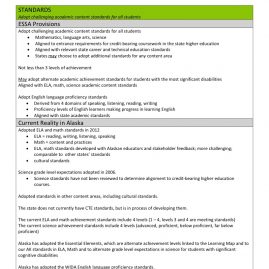
Current Reality in Alaska
Adopted ELA and math standards in 2012
ELA = reading, writing, listening, speaking
Math = content and practices
ELA, math standards developed with Alaskan educators and stakeholder feedback; more challenging; comparable to other states’ standards • cultural standards
Science grade level expectations adopted in 2006.
Science standards have not been reviewed to determine alignment to credit-bearing higher education courses.
Adopted standards in other content areas, including cultural standards.
The state does not currently have CTE standards, but is in process of developing them.
The current ELA and math achievement standards include 4 levels (1 – 4, levels 3 and 4 are meeting standards) The current science achievement standards include 4 levels (advanced, proficient, below proficient, far below proficient)
Alaska has adopted the Essential Elements, which are alternate achievement levels linked to the Learning Map and to our AK standards in ELA, Math and to alternate grade level expectations in science for students with significant cognitive disabilities
Alaska has adopted the WIDA English language proficiency standards.
ASSESSMENTS
Implement a set of high quality student academic assessments for all students, all public schools
ESSA Provisions
Implement a set of high quality student academic assessments for all students, all public schools
Mathematics, language arts, science
aligned with the challenging State academic standards,
measure student attainment of such standards in at least three achievement levels
whether the student is performing at the student’s grade level
be used for purposes for which such assessments are valid and reliable, consistent with relevant, nationally recognized professional and technical testing standards, objectively measure academic achievement, knowledge, and skills
do not evaluate or assess personal or family beliefs and attitudes, or publicly disclose personally identifiable information
be of adequate technical quality
May assess other subjects
Math, language arts
In each grade 3–8
once in grades 9 – 12
Science
once in grades 3-5
once in grades 6-9
once in grades 10-12
Current Reality in Alaska
Current assessment, Alaska Measures of Progress (AMP), is aligned to the ELA and Math standards.
Not yet peer reviewed for technical quality (technical report available this month and technical advisory committee (TAC) will be reviewing)
All items reviewed by EED, educators for bias and sensitivity
ELA and math assessment does not yet measure the full depth and breadth of the standards
Listening is field-tested this year
Performance tasks were planned for 2017 to assess writing and math problem solving/practices
AMP assessments is administered to grades 3-10.
The Alaska Science Assessment is aligned to the science GLEs.
Peer reviewed for technical quality.
All items reviewed by EED, educators for bias and sensitivity
Alaska science assessment is administered to grades 4, 8, 10
Involve multiple up-to-date measures of student academic achievement, including measures that assess higher-order thinking skills and understanding,
may be partially delivered in the form of portfolios, projects, or extended performance tasks
May include measures of student academic growth
At the state’s discretion administered through
a single summative assessment <br/ >OR
multiple statewide interim assessments during the course of the academic year that result in a single summative score that provides valid, reliable, and transparent information on student achievement or growth
May develop and administer computer adaptive assessments
Measure student’s academic proficiency on grade level standards
Growth toward standards
May use items above or below student’s grade level
Current Reality in Alaska
Measuring higher order thinking
AMP ELA and math assessment item specifications includes depth of knowledge (DOK) measures of 1-4
ELA and math assessment plan was to include performance tasks (field test planned for 2016 postponed).
Science assessment does not include high order thinking measures
Growth
Growth can be measured on AMP ELA and math assessments, but decisions not yet made on how to measure student growth
a value table was used on previous assessment (SBA)
growth was not measured on science assessment
Adaptivity
ELA/Math was planned to go adaptive in the spring 2017 administration.
Alaska currently administered a summative assessment in a stage format. Stages can be taken all at once or spaced out over any number of days.
AMP had a stage adaptive design (as opposed to an item adaptive design)
Adaptive assessments allow for greater score precision, especially for students who score at either end of the scale
Adaptive assessments require a more robust item bank
Items require a process to write, review, and field test
AMP was designed to adjust item difficulty, but not go below grade level (high achieving students would see some items from one grade level above)
AK Science test was not adaptive.
ASSESSMENTS
Nationally-recognized high school academic assessment option
ESSA Provisions
States may approve nationally recognized high school academic assessments for districts to choose to administer in lieu of the state high school assessment for math, language arts, and science.
Aligned to state standards
Equally or more rigorous
Provides data that differentiates between schools
Current Reality in Alaska
Alaska has given a college & career ready assessment (CCRA) for two years (2015, 2016), as required by statute. It required students to take the SAT, ACT, or WorkKeys assessment as a graduation requirement.
Previously AK required students to take WorkKeys in their grade 11 year.
This statute has been repealed.
Not all schools/communities in AK are able to administer the ACT or SAT test during the school day without a state contract due to the requirements of the vendor.
ASSESSMENTS
Participation; assessment time limits
ESSA Provisions
Allowed: state or local laws that allow parents to decide about their child’s participation in academic assessments.
States may set a target limit on the amount of time devoted to the administration of state required assessments for each grade (percentage of instructional hours)
Current Reality in Alaska
Alaska does not currently have state laws that address parents’ rights about having their child tested. Some districts have local procedures to document parent and student refusal.
2015 was the first year there was a significant issue in AK with participation. The issue was concentrated primarily in correspondence schools and few communities.
Alaska does not currently have a limit on state required testing.
ASSESSMENTS
Accommodations, reports, language assessments
ESSA Provisions
Accommodations required for
students with disabilities
English learners
Reports
Produce individual student reports of achievement on math, language arts, science assessments
interpretive, descriptive, and diagnostic
allow parents, teachers, principals, and other school leaders to understand and address the specific academic needs of students
in an understandable and uniform format
to the extent practicable, in a language that parents can understand
LANGUAGE ASSESSMENTS.— ‘‘(i) IN GENERAL.—Each State plan shall identify the languages other than English that are present to a significant extent in the participating student population of the State and indicate the languages for which annual student academic assessments are not available and are needed. ‘‘(ii) SECRETARIAL ASSISTANCE.—The State shall make every effort to develop such assessments and may request assistance from the Secretary if linguistically accessible academic assessment measures are needed. (English learners required to take the tests in English after 3 years in US schools, with the possible exception up to 5 years on a case-by-case basis. English learners entering school in Kindergarten would be required to test in English in grade 3.)
Current Reality in Alaska
Accommodations
Our current computer based ELA, math and science assessments offer both universal tools for all students as well as innovative accommodation tools for students with disabilities, ELs, etc.
Reports
ELA and Math reports for AMP 2015 were not well-received by educators or the public. Criticisms:
Too much text
Reading level too high
Confusing graphs (subscores)
Not enough detailed information
Not enough information to know what to do next for student
Student scores were based on 55 items. This makes reporting out on specific skills difficult to do reliably.
Reports were available only in English.
Language
Currently assessments are administered in English only.
Part of an ongoing series exploring how the U.S. can educate the nearly 5 million students who are learning English.
Brains, brains, brains. One thing we’ve learned at NPR Ed is that people are fascinated by brain research. And yet it can be hard to point to places where our education system is really making use of the latest neuroscience findings.
But there is one happy nexus where research is meeting practice: bilingual education. “In the last 20 years or so, there’s been a virtual explosion of research on bilingualism,” says Judith Kroll, a professor at the University of California, Riverside.
Again and again, researchers have found, “bilingualism is an experience that shapes our brain for a lifetime,” in the words of Gigi Luk, an associate professor at Harvard’s Graduate School of Education.
At the same time, one of the hottest trends in public schooling is what’s often called dual-language or two-way immersion programs.
Traditional programs for English-language learners, or ELLs, focus on assimilating students into English as quickly as possible. Dual-language classrooms, by contrast, provide instruction across subjects to both English natives and English learners, in both English and in a target language…
By Andrew Chiappazzi and Daveen Rae Kurutz, timesonline.com
On a Wednesday night in late May, Erie Superintendent Jay Badams stood in front of his school board and a packed auditorium of parents to make a startling proposal: Rather than make more cuts and eliminate sports, arts and music programs, the district should pass an unbalanced budget.
Badams said he’d rather shut down all four of the city’s high schools than continue with program cuts. Drastic matters call for drastic actions, he said. When Badams took the helm of the state’s 10th-largest district in 2010, he erased a $26-million shortfall by cutting 240 teaching positions.
Enough was enough.
“The only things left substantial that we have to cut are student programs,” Badams said. “And that’s something we’ve tried avoid like the plague for the past five years.”
The Washington Post — President-elect Donald Trump has said repeatedly that he doesn’t support a strong federal involvement in public education. It’s a district and state responsibility, he says, and that’s how it should be. But what will the upcoming Trump administration actually do to ensure that this vision is implemented?
In this post, Carol Burris, a former New York high school principal who is executive director of the nonprofit Network for Public Education, looks at the signs that Trump and his allies have been waving about his education reform priorities and paints a disturbing picture of where the education world may be headed.
Burris was named the 2010 Educator of the Year by the School Administrators Association of New York State, and the same organization named her the New York State High School Principal of the Year in 2013. She recently wrote a series on California charters, which you can find here, here and here.
By Carol Burris
Donald Trump had little to say about education during the campaign, but that does not mean that he and those who surround him do not have a plan. There are clear indications that President Obama’s Race to the Top will be replaced with something that could be called “Race to the Bank,” as the movement to privatize education seems certain to accelerate under an administration run by Trump and his vice president, Mike Pence.
Trump’s disdain for public schools is apparent. The Trump/Pence website uses the adjective “government” instead of “public” when referring to community schools. It claims that school choice is “the civil rights issue of our time.”
Donald Trump Jr. used the convention as an opportunity to denigrate public schools by comparing them to “Soviet-era department stores that are run for the benefit of the clerks and not the customers.” Trump Jr.’s rhetoric belongs to a long-standing, right-wing belief that public education is a socialist institution and that schools should be run by the private sector.
Let’s stop for a moment and think about the “government” that runs public schools. It is not, as the slogan implies, a Washington cabal. Except in those cases where mayors have grabbed control, public schools are governed by locally elected school boards. The origin of the school board dates to 1647, when the Massachusetts Bay Colony required every town to establish a public school. Committees of school governance sprang up, becoming autonomous, local governing boards as early as the 1820s.
Nearly all school board members serve without pay. Most are dedicated, locally elected community servants who must abide by strict laws regarding conflict of interest — laws from which many corporate charter boards are exempt. Yet school boards are viewed as an impediment by billionaires, like Reed Hastings of Netflix, who argued that school boards should be replaced with corporate boards through charter expansion…
The Wolf Administration … issued directives aimed at addressing the troubling incidents of racism and religious intolerance that have played out across Pennsylvania schools in the wake of the election.
The administration has directed schools to contact the Pennsylvania Department of Education Safe Schools office and the Pennsylvania Human Relations Commission whenever an incident of hate or intolerance takes place. State offices will dispatch counselors to the school and along with commission staff take appropriate measures to provide assistance. The Pennsylvania State Police will also play a role, monitoring threats and providing support to victims and other law enforcement agencies.
“We need to fight racism and bigotry when it arises and my administration will work actively with school districts and other public institutions to stand up to intolerance,” Gov. Tom Wolf said in a written statement. “Our schools must be safe and open spaces where all children can learn and grow free of concerns for their physical, mental, and emotional safety…”
Pennlive.com, By Ryan Riley — The increase in graduation rate calls for an increase in the standard of education for students.
With graduation a handful of months away, high school seniors are preparing themselves for their turn to walk in a cap and gown to receive their diploma.
What has been an issue for many high schoolers in the past can now be a light at the end of the tunnel to know that the nationwide high school graduate rate has hit a new record of 83.2 percent, which is four points greater than the 2010-2011 school year.
This is the highest the graduation rate has ever been in the country, and marks a huge achievement for educators, state facilitators and the students themselves.
Schools should take a great deal of pride in the fact that the graduation rates have increased, as this shows promise for continued improvement. However, our jobs are not done yet.
The national math and reading test scores for college entrance exams, such as the SAT and ACT, are currently in decline…
“It is my belief that schools can and must be a sanctuary of safety and possibility for all of the young people in their care.” So says Flint Community Schools superintendent Bilal Tawwab, of Flint, Michigan, in a commentary published by Huffington Post.
These are not idle words. Flint has experienced chronic economic decline, as well as a major water crisis that landed the city in the news for all the worst reasons. As Mr. Tawwab puts it, “These challenges our children face – and, in too many cases, the traumas they have experienced as a result – stack the odds against them before they even get to school.”
So it’s exciting to share some good news from this resilient community.
Despite the challenges, students in Flint achieved significant growth as measured by our very own MAP – in part thanks to what Mr. Tawwab calls a wise investment “in the people who can most impact a child’s learning: Teachers.”
Under Mr. Tawwab’s leadership, the district made a series of strategic investments. First, given the water crisis and on-going trauma that many children in the district have experienced, Flint invested in non-academic supports to make sure students have access to healthcare and tools to manage the stress. Then, to support student learning, as Mr. Tawwab says, the district “…invested resources in the people who can most impact a child’s learning: Teachers.”
Flint committed to a professional learning program that included things teachers said they needed. How could they use data from MAP to build individuated education programs (IEPs) for special education students? How could they better use the Learning Continuum to unpack what students were ready to learn next, and where they needed extra help? How could they set goals with students, and talk to them about growth?
Working with NWEA, the team developed a customized program that met the district’s needs and included data coaching, and smart use of NWEA’s different professional learning modules. Throughout, NWEA staff worked with the district closely to ensure that the plan continues to meet teacher needs.
The results speak for themselves. Join us in sending a big congratulations to @FlintSchools on this great news!
The stakes for K-12 policy in this year’s state-level elections couldn’t be clearer: Whoever voters pick in the legislative and gubernatorial races will have significant new leverage in shaping states’ education agendas in the years ahead.
The reason is the new federal EveryStudentSucceedsAct, which gives state governments sweeping authority to design, among other things, teacher evaluations and school accountability systems, topics that political observers expect to dominate policymakers’ 2017 legislative seasons.
Observers wouldn’t necessarily know that, however, by hanging out on the campaign trails this year.
Aside from school finance, teacher pay, and transgender students’ access to bathrooms, education policy has mostly stayed out of the fray of this year’s topsy-turvy election cycle…
Phi Delta Kappa International (PDK) released its 48th Annual poll results on the public’s views toward the nation’s public schools. And while the American public does not agree on a single purpose for public education according to Joshua P. Starr, the chief executive officer of PDK International, it is continuing its decades long trend and giving good marks to its local schools. Forty-eight percent of the public gave their own local schools a grade of “A” or “B.”
Where the public disagrees is in what they view as the main focus of public education. PDK found 45 percent of respondents believe the goal should be preparing students academically, and 51 percent said that the focus should be either on preparing students for work (25 percent) or preparing them to be good citizens (26 percent). Given a choice, 68 percent of poll respondents said having their local public schools focus more on career technical or skills-based classes is better than focusing on more honors or advanced classes.
“There’s a real question today about education’s return on investment.” Starr notes in the report. “While we know that a college degree is essential in today’s economy, parents and the public want to see a clearer connection between the public school system and the world of work. According to Starr, preparing students academically, for work, and for good citizenship don’t need to be mutually exclusive with the right curriculum and pedagogy.
Not a surprise, PDK found communication to be key for parents who give A’s and B’s to their local schools, reporting that their schools communicate more effectively with them, give them frequent opportunities to visit and offer input, and are interested in what they have to say.
When it comes to failing schools, the poll found the public prefers keeping them open and trying to improve them rather than simply closing them down, 84 percent vs. 14 percent respectively. On the question of whether schools should use more traditional teaching and less technology, respondents split evenly 43 percent to 43 percent.
For more findings and information on PDK’s methodology, visit www.pdkpoll.org
Between now and August 18, 2016, the U.S. Department of Education is collecting input on the educational and technical assistance needs of states and school districts. The input the Department receives is intended to inform priorities for the next grant cycle of Regional Educational Laboratories as part of the Comprehensive Centers program; the program that provides technical assistance to state education agencies.
Who is the Department looking to collect input from? Students, parents, teachers, principals and school administrators, superintendents, school board members, state and local education agency staff, and all others who are interested in affecting the future of public education and learning opportunities in their community, state, or region.
The short survey asks that you indicate your state; primary role (student, parent, teacher, etc.); highest priorities for education in your region (choice of items); top three educational needs in your region (fill-ins); and your recommendations for how the Comprehensive Assistance Centers can address the educational needs you indicated.
If your primary role category isn’t listed in Question #2, we recommend using the “Other” option to identify yourself. For example, to identify yourself as a local school board member in Question #2, use the “Other” option and write in school board member.
NSBA’s Legislative Priorities for the implementation of the new education law, the Every Student Succeeds Act, are available for reference as you complete your survey, in addition to a handout specifically for school board members.
More information about the Comprehensive Centers Program and the Centers’ current priorities, is available on the Department’s website.



 Part of an ongoing series exploring how the U.S. can educate the




 “It is my belief that schools can and must be a sanctuary of safety and possibility for all of the young people in their care.” So says Flint Community Schools superintendent Bilal Tawwab, of Flint, Michigan, in a

 -Joshua P. Starr, CEO of PDK