Susan TerLouw takes a proactive approach to fostering collaboration with her students’ parents.
“I have found texting to be an amazing way to get connected with parents,” says the high school special education teacher. “After not having calls returned, I tried texting and got immediate responses.”
Texting parents allows TerLouw to update them on their child’s progress before waiting for an issue to arise. It’s quick and easy, and TerLouw says the constant flow of contact with parents has done wonders for her own parent-teacher relationships.
“I have been able to move past it to actual conversations, face-to-face meetings, and a trusting relationship.”
It’s that communication and trust that are key to fostering student success, yet connecting with parents still remains a challenge for many educators. Fortunately, savvy teachers are always discovering ways of creating meaningful parent-teacher relationships, from opening a clear channel of communication with their household to drawing parents into the school community through events and programs. Here are some other ideas gathered from your colleagues about how they engage parents.
Focus on the Positive
Middle school teacher Maxine Taylor says that a great way to build a successful parent-teacher relationship is to contact parents before there’s a problem.
“I call or email parents whenever a student does a particularly nice job or has been exceptionally helpful in class,” she says.
Throughout the nation, NEA educators are working closely with parents to ensure their students succeed. For examples and resources for educators and parent, visit our Parent Partnership Resource center.
The extra effort only takes her a few minutes and does wonders for her relationship with parents. By focusing on their child’s successes, Taylor is able to equate parental interaction with positive news, ensuring that parents will be more willing to hear her out when there’s an issue.
“It helps the parents not cringe when we come into contact because they don’t just expect to hear bad things.”
Jenna Bower, a middle school teacher who’s in her first year teaching, also stresses the positives with the negatives when it comes to contacting parents.
“As a new teacher I’ve begun sending out ‘HI-LO’ notes on my students’ homework packets,” Bower says. “The weekly note begins with ‘Your Student’s Success,’ and I include two things in this section. The next section is ‘Still Working On,’ and one item goes here.”
By emphasizing successes, Bower is able to get students to willingly share their school experiences with their parents.
“The best part is I have the students read to their parents, so they get to share their successes with parents,” says Bower. “Many times the parents send it back with a thank you note attached. I send out 30 notes a week and it only adds 20 minutes to my Tuesday evenings.”
Share School Experiences
“How was school today?”
“Fine.”
Too often, this is the extent of the conversation students have with their parents about school, so parents love it when teachers go out of their way to fill in the missing experiences.
“In order to keep parents current on classroom milestones, activities and events, and to meet the technology goals of my students, I have my students create a classroom newspaper,” says high school special education teacher Heather Vanover says. “It consists of topics such as sports schedules, upcoming events like picture day and prom, school news, and classroom topics.”
And, because students write the columns and help produce the newspaper, Vanover doesn’t have to spend much time working on it outside the classroom. The end result is a successful product for parents that shows off their children’s skills while keeping them up-to-date on school happenings.
“Each edition has my contact information and a current report of any classroom issues or rewards,” Vanover says. “It’s a fun way to communicate with parents and publish students’ writing.”
Kindergarten teacher Martha Richardson uses disposable cameras (yes, they still exist!) to share experiences with parents.
“I have my kids bring in a disposable camera with their school supplies,” Richardson says. “I snap special moments that happen during the school year (things that parents miss). When it’s filled, I send it home. Parents can have it developed and send in another if they wish. It’s a great way to capture school experiences.”
Find Common Ground
If you show a willingness to learn more about your students from their parents, then they’ll be more willing to work with you throughout the school year. To accomplish this, you need to be ready to open up to parents and listen to what they have to say. Show an interest in them, and they’ll return the favor.
Mellanay Auman, a middle school language arts teacher, uses the beginning of the year as a time to get to know both parent and student better.
“The first week of school, I send home a fill-in-the-blank letter in English and Spanish for the parents to write to me about their son/daughter,” says Auman. “They get a chance to tell me about what they want their child to accomplish in my class, and about their child’s strengths, hobbies and interests.”
Since you’re asking the parents for input about their children—treating them as partners—they’ll be more willing to communicate with you throughout the year.
“The parents love bragging about their child, and this letter opens the lines of communication for the rest of the year.”
Many educators also find it helpful to include students in parent conferences.
L. Cavel Wilson, a middle school geography teacher, says that parents often bring their child with them to school conferences, so Wilson uses the opportunity to have the student discuss their class behavior and performance.
“During the conference, I ask the student direct questions, leading him to explain to his own parents what he is doing in the class,” Wilson says. “This takes the focus off teaching styles, content, or even communication issues and puts it squarely on the shoulders of the student, who has ultimate responsibility for his own success.”
And, more often than not, Wilson says the approach allows him to find some common ground with the parents.
“Unless there is a major behavioral problem or a moral issue at stake, you should be able to find common ground with parents — if nothing else, there is always your concern and caring for their child and your desire to help him succeed in your class and in life.”
Entice Parents into School
Retired teacher Karen Clark works as a Parent Educator in one of the Atlantic City School District’s 9 Parent Resource Centers, where she helps organize a number of district-wide programs designed to draw in and support the entire family unit.
“The goal is to try and provide a link between the school and home,” Clark says. “We really want to provide parents a place where they can feel comfortable going. We have workshops and classes for the parents, computers and fax machines they can use to apply to jobs or check their email, resources for families who have lost their homes or are in danger or losing them, and a whole bunch of other programs to support families.”
While the Parent Resource Centers are funded through Title-1 funding, there are many ways teachers can use the same basic principle in their own schools. Delynn McCash uses an informal after-school ESL course to bring students and parents into the classroom.
“Every Tuesday Night, I invite my students and their parents into my room,” McCash says. “To prepare, I borrow all the iPads I can. Students sit on one end of the room using iPads and parents are on the other side learning English on the Smartboard. They have increased PTO attendance and the students are participating in more school functions. I am out a few hours of personal time, but I gain an immensely rewarding true teaching experience and personal satisfaction.”
Visit Parents Directly
If all else fails, sometimes the best approach is to offer parents the option of meeting with you in their home. Not only will most parents appreciate the effort, but you might even learn a bit more about the lives of your students and their families.
“Home visits are the best thing I ever did,” says elementary school teacher Kathy Dowd. “I am humbled by how hard our families work, and how little they have to show for it. It makes me realize why involvement is so hard for so many of them.”
When it comes to interacting and working with parents, always consider how you would respond in their situation. Understanding is one of the keys to unlocking a successful relationship with your students’ parents.
“Think of every kid as if they were your own child,” teacher Tanya Wilson-Smith says. “What would you want for your child if he or she were facing a particular situation? Every parent loves their child, but not every parent knows how to be a parent. Be gentle, be caring, be honest, but do what you do best and educate the parent too.”
A Delaware business’ $100,000 donation will allow 200 science teachers from across the state to continue in a leadership and professional learning program.
LabWare’s donation will allow the NextGen Teacher Leader project to extend into a third year.
Governor Jack Markell thanked Vance Kershner, president and CEO of LabWare, a Delaware-based laboratory informatics company, for his company’s continued support.
Under the NextGen Teacher Leader program, educators from across the state have developed and field tested units aligned to the new standards, sharing their knowledge and experiences with their colleagues in their buildings and across the state.
“The NextGen Teacher Leader project is not only an important initiative for supporting quality science education but also an opportunity for science educators to take on leadership responsibilities, one that allows them to do this without leaving the classroom for an administrative position,” Markell said.
This is the second gift LabWare has made to the program. Two years ago, LabWare donated $60,000 to help the state launch the program.
“LabWare is honored to be able to continue to support this very special initiative that will allow Delaware educators to continue their development and will allow students to understand core scientific concepts, to understand the scientific process of developing and testing ideas, and to have a greater ability to evaluate scientific evidence,” Kershner said.
Delaware was among 26 states that participated in the development of the Next Generation Science Standards, which emphasize inquiry, engineering design and understanding the broad concepts common to all scientific disciplines. The State Board of Education unanimously adopted the standards in September 2013, and the state has spent the years since preparing for implementation.
“For more than 200 years, our state has had a tradition of innovation in the sciences and technology, and employers continue to seek employees skilled in science, technology, engineering and mathematics. If we are going to ensure that Delaware students can meet that need, Delaware schools need to effectively prepare them for STEM careers,” Markell said. “That is why this investment means so much.”
Michelle Kutch, Brandywine School District’s director of STEM, science and social studies and co-chair of the Delaware Science Coalition, said that with the adoption of new standards comes the need for new curricula materials and a great deal of professional development for teachers.
“This is no easy feat and typically brings a large price tag that not one local education agency can carry on its own. The Science Coalition relies on the collaborative philosophy of sharing resources among member districts and charters, however new initiatives require monies above and beyond our budget. We are very thankful for the generosity of LabWare’s donation to our teacher leader program. We will be able to continue building our capacity in teacher leadership by providing quality professional development to our staff in supporting science education throughout the state,” she said.
Shelley Rouser, director of K12 initiatives and educator engagement at the Delaware Department of Education, said investments such as this in our teachers are so valuable.
“When it comes to ensuring the best education for our students – the best science education – we know it’s more about investing in people and less about purchasing programs. That is what is so significant about LabWare’s support,” she said. “Their trust in and support of teacher training and leadership development supported the launch of this teacher leader program two years ago, and we are thankful that they are committed to support sustaining it.”
Delaware Foundation for Science and Mathematics Education (DFSME) Executive Director Randy Guschl, Governor Jack Markell and LabWare President and CEO Vance Kershner
The Every Student Succeeds Act (ESSA), the successor to No Child Left Behind (NCLB), must be fully implemented in school districts across the country in the 2017-18 school year. To assist states and districts in meeting that deadline, the U.S. Department of Education is engaged in developing regulations to clarify complex provisions of the law. States, in turn, are beginning to write their implementation plans and figure out the new state accountability requirements.
The Regulatory Process
The regulatory process began with several weeks of “negotiated rule making,” with a panel of stakeholders – administrators, teachers, parents, representatives of students with disabilities, and civil rights advocates, among others – debating the assessment provisions of the law. Unfortunately, all specialized instructional support personnel (SISP), including OT, were represented only by an alternate to the panel who was a speech-language pathologist. Considering SISP are included in ESSA in a more comprehensive way than under NCLB, AOTA felt SISP deserved a regular seat at the table and greater input overall into the discussions.
As a next step the Department of Education is now soliciting comments on the draft regulations on assessment, as well as on the new accountability provisions. AOTA will provide comments to the Department to ensure the OT perspective is considered. There is some urgency to get these regulations out for comment, since there are a number of steps after comments are submitted before the final regulations are issued. The presidential election increases that urgency, since a new administration can choose not to accept any pending regulations developed by its predecessor.
Earlier this year the Department of Education asked for input on what types of guidance they should provide to states on implementing ESSA. You can read AOTA’s letter suggestion that the the Department of Education address the critical roles of specialized instructional support personnel, including occupational therapy practitioners in ensuring student success. Furthermore we suggested the Dept. of Education highlight the role of OT in early learning, transitions, and multi-tier systems. That letter is attached below.
Title I State Plans
States are already in the process of developing their Title I state plan. Title I is the core of ESSA that includes instruction and assessment of and accountability for the four subgroups of students most affected by the law. Those subgroups – the same as under NCLB – are economically disadvantaged students, students from major racial and ethnic groups, children with disabilities, and English learners. State’s must develop a plan (in accordance with new ESSA requirements) to meet the needs of these subgroups.
So what can you do to affect this process? The law requires that SISP are one of the groups state departments of education must consult in developing their plans, as well as being part of the peer review process. This plan is critically important because it remains in effect for the duration of ESSA, unless the state needs to submit some amendments as situations may change.
AOTA members can find out immediately where their states are in this important process. More important, they should find out if OT is represented or if the state is still determining who will be consulted in the development and review of the plan. If they are not, you can work with AOTA and your state association to promote inclusion of occupational therapy practitioners in the plan development. The easiest way to get this information is to search the state department of education website for “ESSA implementation.” This is an opportunity to be at the table as the state decides how it will implement the law and what role various stakeholders will assume.
In future blog posts we will break down the different Titles and pieces of ESSA and how they relate to the role of occupational therapy in schools.
On December 10, 2015, the President signed into law the Every Student Succeeds Act of 2015 (ESSA), which reauthorizes the Elementary and Secondary Education Act (ESEA). Under the previous version of ESEA (the No Child Left Behind Act), the education of homeless children and youth was included in Title X, Part C. Under ESSA, homeless education is included in Title IX, Part A. The McKinney-Vento portion of ESSA takes effect on October 1, 2016.
The Every Student Succeeds Act (ESSA) offers a number of opportunities to support rural education by providing states and local districts more flexibility while preserving the critical role of the federal government. ESSA also includes an array of federal funding programs, research initiatives, and capacity-building efforts directed to support rural schools.
Alliance for Excellence in Education, Originally Published on Jun 9, 2016
ESSA includes several provisions that support state and district efforts to prevent students from dropping out of high school and reengage out-of-school youth.
NSBA honors the anniversary of the landmark 1954 U.S. Supreme Court Brown v. Board of Education decision which established the segregation of public school students based on race as unconstitutional.
Public education is America’s most vital institution and the foundation of our democracy. NSBA believes that public education is a civil right and that each and every child deserves equal access to a high quality public education that maximizes his or her individual potential.
The Court’s decision validated the struggle and remarkable actions of countless Americans who challenged the destructive effects of segregation in our society. The Court recognized we’re a multicultural society and that we’re stronger when we’re united. The decision had and continues to have a profound and significant impact on the lives of our children, our country’s educational system, and our nation as a whole.
NSBA recognizes the significance of the Court’s unanimous decision more than fifty years ago and what equal protection under the law continues to mean for Americans today. Every child in America deserves and has the right to attend a great public school where they live.
NSBA joined over 50 National Coalition for Public Education (NCPE) members in expressing their opposition to school vouchers and tuition tax credit programs in a recent letter to the U.S. House of Representatives.
Public funds should be spent on public schools, not private schools state the coalition of public policy, education, religious and civil rights organizations in the joint letter. Public schools have great value, but they are undermined by private school vouchers that divert resources away from the public school system, and do not provide greater opportunities for academic achievement for the few, voucher students who do participate. Read the coalition letter in its entirety below.
NSBA’s information and resources regarding vouchers available here.
The Every Student Succeeds Act—or ESSA—successor to No Child Left Behind (NCLB), provides numerous opportunities and challenges. Extensive autonomy is being conveyed to the states to design accountability, allocate funding, drive school improvement, and modernize educator and leadership development.
District administrators and educational leaders across the US are closely eyeing their Google alerts to keep informed on ESSA regulations impacting the provisions. They’re paying close attention to state leaders, watching enews for progress of various committees, and listening to their educational advisors. The next few years will see a flurry of activity as educational leaders track funding changes and plan to align with pending state directives for performance.
Freedom and flexibility
Although the law doesn’t go into full effect until the 2017-2018 school year, the coming school year will see more sustainable and simpler initiatives from states, and freedom for districts to create their own goals.
This new pressure on state education agencies comes against the backstory of overall recovery to K-12 aid nationally. According to the National Association of State Budget Officers, 41 states increased their K-12 funding in the 2016 fiscal year. ESSA advocates and policymakers say the law takes important steps to exposing funding inequalities and ensuring different populations of kids have access to a quality education, no matter where they live, how they learn, or their care-givers’ socioeconomic status.
The responsibilities of State Departments traditionally charged with administering standardized tests, establishing and certifying curriculum, and making sure federal funds are distributed appropriately will greatly expand under ESSA. And, the law includes a range of transparency requirements to give the feds, states, districts, educators and advocates a lens on how different populations of kids are doing and what kind of access they have to educational assets and funding.
Looking at the impact of ESSA on curricula, here are some potential opportunities under ESSA and possible actions for districts and schools to contemplate:
Extended Curriculum – In the startup years of NCLB, federal funds flowed into schools to promote reading and math improvement, yet important subjects may have been neglected by some schools. Action: Under ESSA, the focus can return to a holistic curriculum including not only traditional academic subjects, but also music and the arts. Now may be the time to explore a broader range of instructional materials. For instance, STEM funding gets a boost in the legislation under both Title II and Title IV funding. Instructional program options for social studies and STEM can accelerate learning and expand critical skillsets needed for college and career readiness. Ensure a well-rounded education by evaluating newer blended and digital programs like Music Studio interactive music curriculum, and Inspire Science for K-5 students.
Specialized Improvements – Districts gain an opening to excel by designing new systems that reach far more children, with localized intervention strategies that meet their needs and those of the schools. And, schools can leverage up to 7 percent of all their Title I funds for school improvement, up from 4 percent in the current law. Action: ESSA requires that state accountability systems incorporate a measure of student growth. It’s predicted that many schools will increase the focus on growing all students to proficiency—not only boosting the low-performing kiddos. Strong intervention and supplemental curriculum programs for reading and math can support the ESSA-mandated comprehensive improvement plan in schools where subgroups are chronically underperforming.Tiered interventions (RTI and MTSS) can help low-income students, dual language learners, special education, and other subgroups gain grade-level performance. Consider only research-proven curriculum programs that show solid evidence of improving student achievement with the underperforming subgroups. And, choose programs that contain inclusive and accessible assessments for students with disabilities. Direct Instruction (DI) is one methodology proven to lift achievement that can be part of an evidence-based plan to help particular groups of students who are falling behind or chronically underperforming. DI programs like Reading Mastery, Connecting Math Concepts, and alternative core basal programs like SRA Open Court Reading, are legacy-proven to assist with turnaround efforts.
Data-driven Assessments – ESSA encourages the use of computer adaptive testing, and stipulates that information and data is no longer just collected and reported, but applied to personalize learning, empower decision making and transform educational progress for higher student outcomes. Action: Summative assessments will continue to be required, and states will soon submit plans for interim testing to monitor students’ progress. Educational leaders need to ensure their data-driven programs can inform state and local decision making. Curriculum-aligned assessment programs should assist teachers with daily decisions to help each student master concepts and develop competencies. They should help principals evaluate the types of professional development needed for staff improvement. Choose digital programs with dashboards that capture information, redirect curriculum content to close the gap on achievement gaps, drive closed-loop performance reporting, and provide transparency for teachers, parents and other stakeholders. One option is the Acuity (3-8) college and career readiness adaptive assessment solution. Another is Engrade (K-12), an assessment solution providing configurable, district-wide benchmark assessments and comprehensive analytics.
Digital Learning – ESSA contains a momentous new statutory authority for states and districts to pursue innovative educational technology strategies. Title IV states that schools can use up to 15 percent of the funding they receive to improve the use of technology (ESSA’s authors included this cap to keep schools from spending all their Title IV dollars on hardware investments). Action: With a digital infrastructure increasingly in place, including through the FCC’s revamped E-Rate program, digital innovation and digital learning solutions are transforming the teaching and learning experience. The Student Support and Academic Enrichment Grants provide a giant $500 million block, and schools can use up to 60 percent of funds for “the effective use of technologies”.Grants such as the i3 (Investing in Innovation) Development Grant, solutions that have strong STEM, digital and research-based components fit the bill. Many grantees are assigning up to 20 percent of their awards to conducting evaluations of evidence-based claims. Plan to test digital strategies, hybrid and blended learning, interactive learning resources, and digital content in your classrooms. Some of the programs in this category include Thrive (Grades 3-8), ALEKS (K-12), Number Worlds (PreK-8), SRA FLEX Literacy (3-12), SRA Open Court Reading (PreK-3), StudySync (6-12), Inspire Science (K-5), Learnsmart (6-12), and Engrade (K-12).
Academic Standards – High academic performance standards like the Common Core are required, but the states govern the adoption and implementation of their own standards. Action: Districts should continue to choose high quality, proven standards-based materials such as textbooks, online resources and worksheets. Select curriculum programs which are flexible enough to be customized, to align specifically to individual state standards. High standard like Common Core are not going away; in fact, 36 states have increased the rigor of their standards since 2013, while only five made them less rigorous. Deploying challenging programs like Wonders (PreK-5) for core English Language Arts (ELA) instruction connects students to core standards, and builds strong literacy foundations. For math options, Everyday Mathematics (K-6) helps students achieve mastery of the CCSS by continually reinforcing math concepts through real-world applications and learning progressions; while McGraw-Hill My Math (PreK-5) provides the rigor, personalization, and engagement students need to be successful with your state standards.
Individualized Instruction – ESSA strongly encourages personalizing education. And, districts identified for improvement will likely have access to state funding including up to 3 percent of their Title I allocations for direct Students Services providing personalized learning activities. Action: ESSA supports competency-based, student-centered learning including mastery-based approaches. Blended, adaptive and personalized learning allow students to learn at their own pace. They provide more equitable access to technology and digital learning experiences, especially for struggling students. Incorporate proven personalization and individualized instruction solutions into your increasingly blended curriculum. For example, Number Worlds (PreK-8) helps struggling learners in Response to Intervention Tiers 2 and 3 achieve math success and quickly brings them up to grade level by intensively targeting the most important standards. Likewise, SRA FLEX Literacy (3-12) offers personalized learning for diverse readers at all skills levels using an ESSA-aligned Universal Design for Learning framework. Last, student-centered, interactive digital resources personalize learning for students using WonderWorks (K-6 intervention) and Building Blocks (PreK-8 supplemental)
Curriculum Resources – The law increases the diversity of approaches and materials used in classrooms. It expressly allows states and local education agencies to use funding under Title IV to develop or acquire open educational resources (OER), available in the public domain or released under an IP (intellectual property) license for reuse. Action: Districts are free to design programs that work best for them. Some OER resources are fantastic and convey the type of rigor found in more costly, proven courses. But, educators often find the materials and resources are poorly curated, patchy in quality, and lacking in publisher and professional development support. Student diagnostics and performance monitoring may be lacking as well. ESSA is asking schools to make a good-faith effort to use evidence-based programs—defined as an activity, strategy, or intervention that shows a statistically significant effort on improving students’ or other relevant outcomes. It makes sense to consider programs which are already research-proven and widely deployed in many school environments, to implement a more direct route to higher performance.
Literacy Boost – ESSA calls for significant changes to literacy funding and programs, which districts and states will need to address. What’s more, Title I funds can be used above the 40% low-income threshold, if the proposed use of funds will strongly impact student achievement. Action: ESSA authorizes Literacy Education for All, Results for the Nation (LEARN), calling for states to develop or enhance comprehensive, evidence-based instruction for PreK-12 in high-need areas. Districts will likely move to support equitable education by implementing personalized blended and digital literacy solutions that increase reading achievement among struggling learners. Take a look at core and supplemental programs and for allocating additional Title I funds—these could include programs like Wonders (PreK-5) core ELA and SRA FLEX Literacy (3-12) for supplemental reading instruction and support.
English Language – For the first time, states must include English-language proficiency as one of three required academic indicators in school accountability systems, and it must occur within 5 years for each student. What’s more, accountability for English Language (EL) instruction under ESSA is now moved to Title I, with funding streams coming from both Title I and Title III. Action: As states take over most of the responsibility for ensuring that EL populations gain increasing instructional support, the number of EL learners will continue to grow—yet the funding per pupil will only nominally increase. Educators will need to maximize their investment by choosing proven curricula programs that drive faster progress in achieving EL proficiency. EL programs provide English Language Learner Literacy, including comprehensive language and Spanish reading solutions for Grades PreK-6.
Early Learning – New funding streams for early childhood afford opportunity to boost young learners’ proficiency in reading and math before 1st grade, as programs are more tightly connected with K-12 schools. Action: Support broadening access to early childhood education by adopting PreK programs that provide a strong foundation for success. Engaging early numeracy and literacy programs give children the strongest possible start. Building Blocks and World of Wonders are both grounded in research, developed by nationally respected authorship teams, and built to ensure kindergarten readiness for every child.
Professional Learning – ESSA provides a definition of professional development embedded in research based on standards developed by teachers. It provides tremendous latitude in fostering professional development for educators, including calling for more edtech-related professional development (PD). Action: Strive for excellence in building educator capacity through professional development. ESSA directives call for incorporating professional development which is sustained over time, intensive, collaborative, job-embedded, data-driven, and classroom focused. Look for PD already built into core, specialized, and digital learning courses and platforms. Look to the professional expertise of your curriculum advisors to ensure that programs are implemented quickly and efficiently, and instruction is delivered with top rigor. And, strong PD in your digital edtech programs enables teachers to better support the implementation and academic success of digital technology projects, and lift student achievement. For instance, the Professional Learning Environment (PLE) for grades K-12 gives teachers instant access to a range of resources for mastering the programs they use every day. The comprehensive PLE empowers teachers to control their own professional learning, from implementation onward.
ESSA will help build on essential progress made in education over recent years. Just look at the record high graduation rate of 82 percent, major expansion of high-quality preschools, and recent positive action in the lowest-performing schools.
States are now responsible for making sure every student succeeds. This is a tall order which can only be fulfilled by employing strong curriculum and assessment supports to ensure that we prepare every child for college, a well-paying career, and responsible and prolific citizenship. See this ESSA FAQ to find out more about three of the top issues under ESSA: school interventions, English Learner education, and digital learning.
The Every Student Succeeds Act (ESSA), the new federal education law, requires education leaders to take research evidence into account when choosing interventions or approaches. ESSA defines three “tiers” of evidence—strong, moderate, and promising—based on the type and quality of study that was done and its findings.
Are the ESSA definitions the same as those of Institute of Education Sciences’ What Works Clearinghouse (WWC)? Not exactly. ESSA definitions and WWC standards are more like cousins than twins.
Like ESSA, the WWC has three ratings for individualstudies – meets standards without reservations, meets standards with reservations, and does not meet standards. The WWC uses a second set of terms to summarize the results of all studies conducted on a particular intervention. The distinction between one study and many studies is important, as I will explain below.
You may be wondering: now that ESSA is the law of the land, should the WWC revise its standards and ratings to reflect the tiers and terminology described in ESSA? Wouldn’t the benefit of making things nice and tidy between the two sets of definitions outweigh any drawbacks?
The short answer is no.
The most basic reason is that the WWC’s standards come from a decision-making process that is based in science and vetted through scholarly peer review, all protected by the independent, non-partisan status of the Institute of Education Sciences (IES). This fact is central to the credibility of the WWC’s work. We like to think of the WWC standards as an anchor representing the best knowledge in the field for determining whether a study has been designed and executed well, and how much confidence we should have in its findings.
WWC Standards Reflect the Most Current Scientific Knowledge – and are Always Evolving
WWC standards were developed by a national panel of research experts. After nearly two years of meetings, these experts came to a consensus about what a research study must demonstrate to give us confidence that an intervention caused the observed changes in student outcomes.
Since the first WWC standards were developed over a decade ago, there have been many methodological and conceptual advances in education research. The good news is that the WWC is designed to keep up with these changes in science. As science has evolved, the WWC standards have evolved, too.
One example is the WWC’s standards for reviewing regression discontinuity (RD) design studies. The first version of RD standards was developed by a panel of experts in 2012. Since then, the science about RD studies has made so much progress that the WWC recently convened another panel of experts to update the RD standards. The new RD standards are now on the WWC website to solicit scholarly comment.
When it Comes to Evidence, More is Better
The evidence tiers in ESSA set a minimum bar, based on one study, to encourage states, districts, and schools to incorporate evidence in their decision making. This is a very important step in the right direction. But a one-study minimum bar is not as comprehensive as the WWC’s approach.
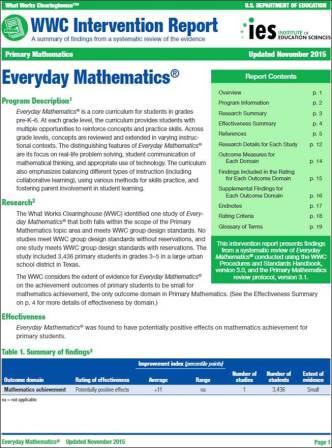
In science, the collective body of knowledge on a topic is always better than the result of a single study or observation. This is why the primary function of the WWC is to conduct systematic reviews of all of the studies on a program, policy, practice, or approach (the results of which are published in Intervention Reports like the one pictured here).
The results of individual studies are important clues toward learning what works. But multiple studies, in different contexts, with different groups of teachers and students, in different states, and with different real-world implementation challenges tell us much more about how well a program, policy, practice or approach works. And that, really, is what we’re trying to find out.
An Improved WWC Search Tool and Ongoing Support for States and Districts
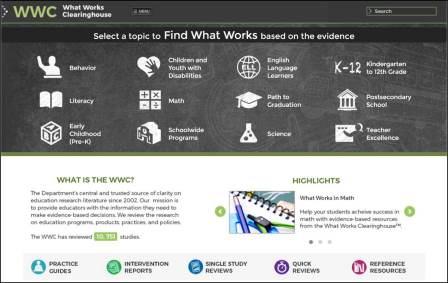
One area where WWC will make changes is in how users find studies that have certain characteristics described in ESSA’s evidence tiers. For the past 16 months, the WWC team has been hard at work behind the scenes to develop, code, and user-test a dramatically improved Find What Works tool. We expect to release this tool, along with other changes to the WWC website, in fall 2016. (More on that in another post, but the picture below offers a sneak preview!)
These changes should further increase the utility of the WWC website, which already gets more than 300,000 hits each month and offers products that are downloaded hundreds of thousands of times each year.
We know that providing information on a website about evidence from rigorous research is just a first step. States and districts may need additional, customized support to incorporate evidence into their decision-making processes in ways that are much deeper than a cursory check-box approach.
To meet that need, other IES programs are ready to help. For example, IES supports 10 Regional Educational Laboratories (RELs) that provide states and districts with technical support for using, interpreting, and applying research. At least two researchers at every REL are certified as WWC reviewers (meaning they have in-depth knowledge of the WWC standards and how the standards are applied), and every REL has existing relationships with states and districts across the nation and outlying regions. Because the RELs are charged with meeting the needs of their regions, every chief state school officer (or designee) sits on a REL Governing Board, which determines the annual priorities of the REL in that area.
As states prioritize their needs and identify ways to incorporate evidence in their decisions according to the new law, the WWC database of reviewed studies will provide the information they need, and the RELs will be ready to help them use that information in meaningful ways.


 Susan TerLouw takes a proactive approach to fostering collaboration with her students’ parents.
 A Delaware business’ $100,000 donation will allow 200 science teachers from across the state to continue in a leadership and professional learning program.





 NSBA honors the anniversary of the landmark 1954 U.S. Supreme Court Brown v. Board of Education decision which established the segregation of public school students based on race as unconstitutional.