The New School has launched the Digital Equity Laboratory, a project-based center that identifies and supports strategies to transform how technology is understood and used to drive racial, gender and economic equity and disrupt the use of technology to produce and reproduce inequity in our social, economic and civic life. It will focus on cross-sector strategies to expand broadband access to communities, particularly low-income communities of color, that have been systematically excluded, marginalized and targeted by many technology systems; ensure that smart-city innovations benefit those communities; and understand the equity implications of big data, algorithms and new edge technologies. The DEL will be housed at The New School’s Milano School.
“Technology is neutral, but people are not,” Maya Wiley, founder and co-director of the DEL, and Greta Byrum, co-director of the DEL, said in a statement. “With the fast pace of technological change to our job markets, how we communicate with one another and the data produced and collected about us, and how it is used, technology has great potential to drive social benefits democratically or deliver social, economic and civic devastation for some. We no longer have a digital divide. We have a technological chasm. The laboratory will provide a space for people of diverse disciplines to collaboratively develop approaches and strategies to protect democracy; increase the economic, social and civic health of our communities, particularly low-income communities of color; and support innovation that disrupts inequality, rather than reproducing it.”
Bruce Fuller, a sociologist at the University of California, Berkeley, works on how schools and civic activists push to advance pluralistic communities. He is a regular opinion contributor to edweek.org where he trades views with Lance Izumi, on the other side of the political aisle.
This blossoming spring of teacher uprisings—marching on state capitols, winning hefty pay raises—cheers any citizen who knows that robust societies depend on vibrant schools.
But arid summers may await the nation’s educators, as the Trump-tweaked U.S. Supreme Court seems ready to eviscerate these same teacher associations who battle each day for better schools.
While hearing oral arguments in the Janus v. American Federation of State, County, and Municipal Employees Council 31 case in February, justices voiced skepticism over compulsory union dues, the life blood of local associations that mobilize the nation’s 3.2 million teachers.
Still, it’s the wildcat strikes moving across the nation—ignited mostly by young and passionate teachers—that may reshape the future of labor unions…
Read the full article here: May require an Education Week subscription.
The secretary will speak to lawmakers on the House education committee about the “policies and priorities” of the U.S. Department of Education. Compared to her predecessors, DeVos hasn’t been on Capitol Hill a lot during her roughly 16 months as education secretary, at least in terms of public appearances: She’s testified before spending committies three times, and once to the Senate education committee for her rocky confirmation hearing in January 2017. Tuesday’s hearing would be the first time she’s testified before the House committee that deals with K-12 issues.
DeVos has met privately a few times recently with lawmakers on Capitol Hill. But education committee lawmakers haven’t had the chance to ask DeVos detailed questions in public about her track record. In fact, on Friday, House committee Democrats sent out a fact sheet pointing out that her predecessors spent significantly more time testifying to Congress over comparable periods of time. In former Secretary Arne Duncan’s first 15 months, for example, he testified to Congress nine times.
With a big House election in November coming up, Dems on Tuesday might be particularly eager to trip DeVos up during her testimony and spin what they see as embarassing sound bites into campaign ads.
So what might lawmakers ask DeVos? Democrats in particular will have pointed questions for her in the name of opposition party oversight; here are a few prominent items that might come up…
Read the full article here: May require an Education Week subscription.
Childhood and adolescence were anything but easy for Duncan Campbell.
He was neglected by his alcoholic parents from a young age, and his father spent years in and out of jail.
Knowing he couldn’t rely on them, Campbell worked several jobs to get through school. In his 20s, he worked in a juvenile court in Oregon as a child care worker, where he built strong bonds with the children in his unit.
After a stint as a successful businessman, Campbell sold his timber firm to focus on helping at-risk children break out of generational poverty. That’s when he started Friends of the Children, a nonprofit that soon grew nationally.
But the nonprofit’s recent presence in Los Angeles is particularly apt, said Thomas G. Lee, executive director of the organization’s local branch. And that’s because Los Angeles has the largest child welfare system in the country.
“[Friends of the Children L.A.] is about building strong networks with children,” Lee said. “Networks matter. As children form networks with families, it’s important if we’re going to break cycles of poverty and get them out of the welfare system. We have to connect children with families and individuals in a meaningful way and with depth.”
And that’s what the organization does: connect at-risk children with caring adult mentors.
The nonprofit identifies kindergarten children living in poverty and matches them with an adult mentor –– or friend –– until the child graduates from high school.
Mentors spend two hours a week in the children’s classroom and two hours one-on-one, totaling 16 hours a month together.
“Our focus is making sure the child is meeting educational outcomes, social and emotional outcomes, and to expose and get them connected to the array of sources [available to them] in L.A. County,” Lee said.
Thomas Lee
Although L.A. has countless resources for foster children, they are often underused because individuals don’t know about them, Lee said.
“Our mentors become a bridge to those resources,” getting families and children connected to a larger network of support.
But it’s not just foster youth that Friends L.A. advocates for. It’s also youth exiting the foster care system that are parenting.
Lee said the local organization wants to focus on enrolling the 128 children of foster youth into their program. By doing so, it hopes to serve “that population in a real and intentionally meaningful way.”
And their program seems to be working. The organization’s website reports that 83 percent of its children graduate from high school; 93 percent stay out of the the juvenile justice system; and 98 percent avoid parenting, even though 85 percent were born to a teenage parent.
While Friends L.A. is just planting its feet in the county –– particularly in East and South L.A. –– communities and organizations have warmly received it, Lee said, and already it is looking to extend a broader hand to more children in need.
“Foster youth have much skepticism about adults in their life, and for good reason,” Lee said. “But developing a deep level of trust between us and them was really important. … It requires a level of humility, thoughtfulness and care, especially for kids who have been failed by a lot of people.”
But Friends of the Children L.A. is changing that, one friend and one child at a time.
INFORMATION BOX
L.A. Executive Director: Thomas G. Lee
Years in operation: national: 25; L.A.: 7 months
Annual budget: $3 million
Number of employees: 7
Location: 672 S. Lafayette Park Place, Suite 33, L.A. 90057
“It was a great feeling watching the returns come in!” said Jonas Knotts, a high school teacher and president of the Webster County Education Association, an affiliate of the West Virginia Education Association (WVEA). “People and educators are really starting to see the power that they possess. We have a voting bloc that, if we turn out to the polls, can outvote anybody. Teachers are realizing this. It’s something that fills us with a very empowering feeling.”
Early this spring, WVEA members kicked off what NEA President Lily Eskelsen García has called an “education spring” with a statewide, nine-day strike that brought red-shirted educators from every one of the state’s 55 counties to the state Capitol.
Their massive show of solidarity, which ended with significant pay raises for all public workers, including teachers and education support professionals, and the establishment of a state task force to address public-worker health insurance, inspired educators across the nation and has been followed by statewide educator walkouts in Oklahoma, Arizona, and Kentucky, and huge Capitol demonstrations in Colorado and North Carolina.
Now, WVEA members are modeling what happens next: They’re taking their energy and passion for public education to the ballot box. In this May’s primary races, WVEA endorsed 115 pro-public school candidates for U.S. Senate, U.S. House, and the state’s House of Delegates and Senate. Of those, 99 candidates—or nearly 90 percent—won. One state lawmaker who had called union members “free riders” was shown the door.
This is exactly what public-school educators across the nation have promised to do in the mid-term elections this November. With this latest show of union strength, WVEA members have shown how it can be done—and how good it feels.
“This election was a huge vindication for the power of the movement because, of course, the opposition was saying ‘they’re going to forget, they’re going to stay home,’” said Knotts. “But we know it’s only one victory in a long war. We have to keep up those conversations, we have to keep people engaged, we have to show them how we’re working to improve everybody’s status—from teachers to support personnel to students to communities…”
Parents of public school students should consider pulling their children out of school until the nation passes new restrictions on gun laws, former U.S. Secretary of Education Arne Duncan tweeted Saturday.
Duncan, who has long argued that tighter gun restrictions would save children’s lives, was co-signing an idea, also floated on Twitter, from his one-time communications chief, Peter Cunningham. Cunningham now heads up Education Post, a K-12 advocacy and communications organization.
This is brilliant, and tragically necessary.
What if no children went to school until gun laws changed to keep them safe?
My family is all in if we can do this at scale.
Parents, will you please join us? https://t.co/Yo4wsFuJI5
“I’m open to other ideas, I’m open to different ideas, but I’m not open to doing nothing,” Duncan told the Post. “We will see whether this gains traction, or something does, but we have to think radically…”
Read the full article here: May require an Education Week subscription.
May 19, 2018 – Allison Kerley Townsend, a third-grade teacher at Barnwell Elementary School in Fulton County, is the 2019 Georgia Teacher of the Year, State School Superintendent Richard Woods announced tonight. As Georgia Teacher of the Year, Townsend will serve as an advocate for public education in Georgia.
“It is very clear to me that Allison Kerley Townsend is a teacher who walks into her classroom every day with her focus in exactly the right place: what do these students in front of me need to learn, and how can I help them learn it?” State School Superintendent Richard Woods said. “Then she brings all of her creativity, ingenuity and skill to the fore to accomplish that goal. I am honored to recognize her as the 2019 Georgia Teacher of the Year and look forward to working with her to tell the best story I know – the story of Georgia’s public schools, and the lives changing within them every single day.”
Townsend graduated from Clemson University in 2012 with a bachelor’s degree in elementary education. Since then, she has taught Pre-K, third-, fourth-, and fifth-grade students.
As a teacher, Townsend strives to give each child a voice in their learning, and inspires them to grow beyond “engagement” to “ownership.” She came away from her time as a Pre-K teacher with the conviction that all children start out as curious and excited learners, and that her goal as an educator should be to nurture their passion for learning.
“Some people believe that children are the ‘leaders of tomorrow,’” Townsend said. “I like to challenge this idea. We cannot ignore the incredible impact children can have on the world today, if we let them. My mission is to help students take ownership of their learning and have an impact beyond the classroom…whether they are Skyping a scientist across the country, blogging about how they believe we should combat pollution, or sharing the inspiring music videos we create as a class.”
Townsend is also dedicated to having an impact on students and teachers beyond her own classroom and making her mark on education at the global level. From presenting at conferences to using Twitter as a window into her classroom, she has made connections with educators all over the world.
“I have helped a teacher in North Carolina design an authentic project-based learning unit for her students based on nutrition and fractions,” Townsend said. “I have Skyped with a teacher in Virginia to teach him how to implement student-led conferences. I have even had a teacher across the world in Vietnam reach out to me to let me know that she shared my students’ personal mission statements with her class, and that inspired them to write their own, too. I am passionate about inspiring students and teachers around the world and believe that our impact does not have to wait for ‘tomorrow.’ Every single one of us can help change the world today.”
As Georgia Teacher of the Year, Townsend will represent Georgia teachers by speaking to the public about the teaching profession and potentially conducting workshops and programs for educators. She will also participate in the competitive selection process for the 2019 National Teacher of the Year.
Being a part of a national network designed to assist schools in building stronger pathways to college and career is advantageous for all students. Burke High School (BHS) became part of the New Tech Network (NTN) program in the 2017-18 school year. School administrators and staff were ready for the challenge of raising the level of project-based instruction across course content. This project opened many doors and after only one year of operation, the students and teachers at Burke earned NTN’s 2018 Best in Network award.
This honor is given to a project that exemplifies the goal of successfully combining active exploration, application, authenticity, and academic rigor. BHS teachers Amelia Navarrete and Edgar Johnson, along with their students, earned the award for their project: Finding a Voice.
“The recognition from NTN demonstrates the dedication and passion of our teachers in promoting academic success for our students,” said Burke’s Executive Principal Cheryl Swinton. “Likewise, this recognition applies to our students who showed perseverance and motivation in taking ownership of their own learning. Ultimately, the project furthers not only their success, but the success of the community.”
Finding a Voice combined World Literature and Government classes, and asked students to design graphic novels about disenfranchised and marginalized groups around the world. To assist with the graphic novels, Ms. Navarrete and Mr. Johnson reached out to the Charleston County Public Library system, which enthusiastically joined the project. The students reached the final stage of their project by doing independent research and interviewing a student their age who is from the Democratic Republic of Congo. Then the students wrote first-person narratives about someone in their region and storyboarded all the panels of their graphic novel.
“These questions of international policy and humanitarian concerns have engaged political leaders around the world,” stated Ms. Navarrete. “Our students used these platforms to spread awareness of these issues from being a refugee, to child soldiers, to understanding that women in other countries are still fighting for rights that they might take for granted. Our students surprised even us with the level of empathy and understanding they showed for the people of their regions, as they progressed through the project.
“This banner has been commissioned to hang on the Fishburne Street side of the building to congratulate and honor the students, faculty, and administration for excellence in education.
The BHS Parent Engagement Collaboration, composed of representatives from the D20 Board,the BH School Improvement Council (SIC), the BHS Foundation, and the BHS PTSA, is sponsoring the banner.“Great job scholars”, says Tony Lewis.“We know that you have greatness in you and we stand behind you as you continue to grow the legacy of academic achievement for Burkeites,” says Dr. Barbara Dilligard. BHSIC Chair, Eric Jackson said: “We are so proud of our students and we will continue to work for them to have everything they need to be successful.
The Arizona State University and Phoenix Seminary graduate has been on that mission since she gave birth to a son, years ago.
Her prayer, she said, is that she’ll be a “radiant light in dark spaces” who leaves a legacy of hope, peace and love.
Wood and other parents in the Phoenix area’s Black Mothers Forum are seen as game-changers in the fight for education equality for Black children.
Led by Wood, who has served as a pastor in a women’s prison and as Chief of Staff for the Phoenix City Council, the group has taken the Every Student Succeeds Act (ESSA), the education law passed during the Obama Administration, very seriously. The Black parents’ group is using ESSA to leverage their awareness and involvement in their children’s education and to ensure that African American students excel in the public school system.
“We, as Black mothers, have come together to collectively address the concerns that we have with our Black sons and daughters being pushed out of their schools at an alarmingly higher rate than their White peers all over the nation,” Wood said.
The mission of the Black Mothers Forum, Wood explained, is to educate parents on their rights with respect to student discipline and a culturally-inclusive curriculum, while also getting organized through focus groups that allow members of the forum to execute a course of action to effectively make structural changes.
“We do this by meeting multiple times a month and having various experts come in from various organizations to educate and train our mothers on knowing their rights, sharing a culturally-integrated curriculum and learning [the signs and symptoms] of any mental health challenges our children may be experiencing,” Wood said.
For instance, the group has entered partnerships with the ACLU’s Demand 2 Learn program, Arizona State University’s Center for the Study of Race and Democracy, and other initiatives.
Members of the Black Mothers Forum, also completed a 13-week course on Black history to help develop a deeper understanding of their ancestors so that they could properly inform their children.
“We attend high school and grade school district board meetings regularly and address the disproportionate suspensions and dismissals of our students of color for minor infractions,” said Gwendolyn Payton, a Black Mothers Forum member, who also serves in the Equality division of the organization. “As a result of speaking out, schools are contacting us to come on campus and be visible and interact with our students of color. We challenge the schools to include more culturally diverse curriculum and activities and to hire more teachers and principals of color.”
In February, when a Black Phoenix charter school student was pulled out of school after officials claimed the boy’s hair braids violated school policy, the Black Mothers Forum sprang into action to defend the youth causing the district to issue a mea culpa and welcome the child back to school.
“The dress code at the school was specifically created as another means of targeting and harassing our Black children,” Wood said.
But, it’s just one reason why the group must encourage Black mothers to attend school board meetings and request study sessions be conducted publicly to address the disproportionate disciplinary practices with respect to Black children, Wood said.
“When we show up in large numbers to address an issue we have seen positive results,” Wood said. “We have found that in order to dismantle the school to prison pipeline it starts with us focusing in on ensuring our children are in safe and supportive learning environments and that means we need to address the punitive disciplinary actions administered by implicitly biased school administers and teachers.”
Wood continued: “We strongly believe that, as parents, we have the power to change the current school system when we collectively communicate the same message.”
According to Wood, that message is simple:
“We, as Black mothers, will no longer remain silent while our children are blatantly disrespected, threatened, harassed, intimidated, provoked, neglected and set up to fail through policies, disciplinary practices, curriculum, regulations and/or laws deeply rooted in racial stereotypes.”
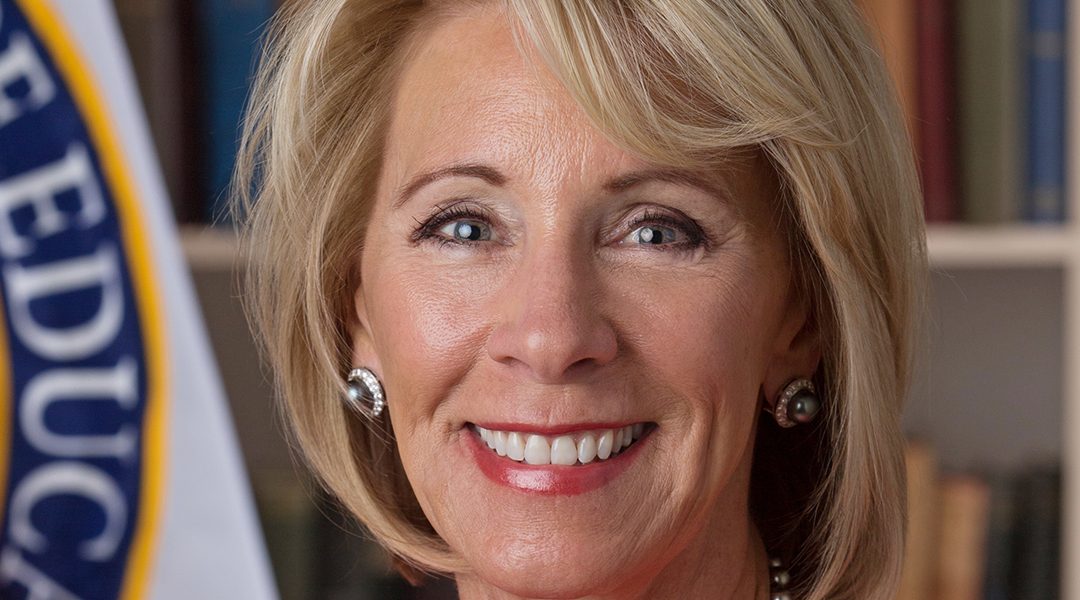
U.S. Secretary of Education Betsy DeVos has given the thumbs up to two more state Every Student Succeeds Act plans: Alaska and Iowa.
That brings the total number of states with approved plans to 44, plus the District of Columbia and Puerto Rico. Still waiting for the OK: California, Florida, Nebraska, North Carolina, Oklahoma, and Utah.
Alaska is working local interim tests into its accountability system, as a measure of school quality or student success for elementary schools. The state will also consider chronic absenteeism and literacy by 3rd grade. High schools will be measured on chronic absenteeism, “on track” freshmen, and how many students are eligible for “Alaska Performance Scholarships,” which are based on GPA, completion of a certain curriculum, and achieving a certain score on tests such as the ACT. The state also makes it clear it can’t ‘”coerce” a parent to make a child take standardized tests…
Read the full article here: May require an Education Week subscription.




 By Bruce Fuller, Opinion Contributor