The day Ayden came home from school with bruises, his mother started looking for a new school.
Ayden’s a bright 9-year-old with a blond crew cut, glasses and an eager smile showing new teeth coming in. He also has autism, ADHD and a seizure disorder. (We’re not using his last name to protect his privacy.) He loves karate, chapter books and very soft blankets: “I love the fuzziness, I just cocoon myself into my own burrito.”
“He’s so smart but lacks so much socially,” says his mother, Lynn.
She says Ayden was suspended repeatedly from his school in St. Lucie County, Fla., starting in first grade, for outbursts like throwing a chair. And during “meltdowns,” he was physically restrained by being held in a bear hug from behind or penned in with gym-style mats for up to 45 minutes.
“Not just sometimes, it was every single day!” Ayden says. “That kind of stress gets me all worked up and it makes my tics go crazy!”
One day, Lynn says, Ayden came home with marks all over his body from being restrained. “That was my final straw.” She started looking for another school.
Despite a decision by Congress this spring to repeal key provisions connected to the Every Student Succeeds Act, the Florida Department of Education has no intention of scrapping its efforts to date in creating an ESSA state implementation plan.
Education commissioner Pam Stewart recently informed superintendents that the state would continue its work toward the Sept. 18 due date, and have its proposed plan online for public comment over the summer. Toward that end, she has asked a group of district leaders including Mike Grego of Pinellas County to help hash out details of several key issues that needed more attention.
Those included requirements on percentage of students tested, assessment exemptions for English language learners and the use of subgroups to differentiate accountability. Florida takes approaches that do not necessarily correlate with the federal guidelines.
“Florida is ahead of most of the nation in our policies that feed into the ESSA State Plan,” Stewart said in a memo to superintendents. “We will seek the opportunity where necessary to request waivers and continue current practice where we believe as a group it is best for Florida.”
Stewart has remained steadfast in asserting Florida’s need to do what’s best for itself, and noting that the federal government cannot force states to take action beyond the scope of law, since 2016.
Visit the Department of Education’s ESSA website for more information about its progress and plans.
U.S. Secretary of Education Betsy DeVos who recently traveled to Florida to highlight dual-enrollment and career-readiness programs is hitting the road again Monday, this time to Kimberly Hampton Elementary School in Fort Bragg, N.C.
DeVos plans to visit classrooms, read to students, meet with school officials, and chat with parents.
The visit will be DeVos’ first to a school run by the Department of Defense. And her timing isn’t a coincidence: April, which starts Saturday, is the Month of the Military Child…
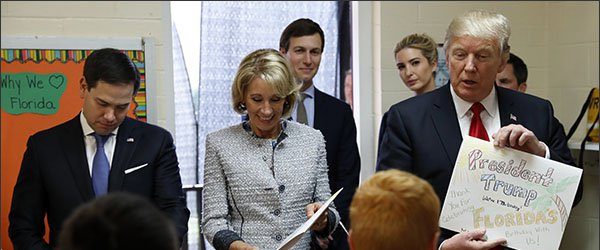
President Donald Trump made his first school visit as president Friday afternoon—and it should be no surprise, given the administration’s emphasis on expanding school choice, that he picked a private, Catholic school in Florida near Orlando.
It’s clear that school choice is the Trump administration’s favorite education policy. What’s less clear is exactly how he plans to push it from the federal level. One possibility: a tax-credit scholarship program, like the one in place in Florida and in more than a dozen other states. Many of the students at the school Trump picked—St. Andrew Catholic School, in Pine Hills—take advantage of the Sunshine State’s version of the program…
Michigan hasn’t been able to offer the same kind of voucher program as Floridabecause its state constitution prohibits public funds from being used for religious purposes. By contrast, Florida’s vouchers for special needs students can be used at schools affiliated with religious institutions. Michigan, which also has charters, recently started experimenting with Education Savings Accounts, which allow parents and students to “put [their] own customized plan together” for education, DeVos said…
Washington — President Donald Trump used his first speech to a joint session of Congress… to frame education as “the civil rights issue of our time”—a line used by other leaders in both parties, including former Presidents Barack Obama and George W. Bush.
And he called on Congress to go big on his favorite K-12 policy, school choice, without laying out specifics. He asked lawmakers to “pass an education bill that funds school choice for disadvantaged youth, including millions of African-American and Latino children. These families should be free to choose the public, private, charter, magnet, religious, or home school that is right for them.”
The push for school choice is no surprise—it’s the education issue Trump talked about most often on the campaign trail. And Trump picked an education secretary, Betsy DeVos, who spent decades advocating for expanding vouchers and charter schools.
To underscore the power of choice, Trump pointed to Denisha Merriweather, one of a handful of honored guests, sitting with Melania Trump, the first lady…
Read the full article here: May require an Education Week subscription.
In the newest expression of his commitment to expanding school “choice,” President Trump is making his first official visit to a school Friday (March 3) — to a Catholic school in Florida.
Trump will stop at St. Andrew Catholic School in Orlando, where several hundred students attend with help from a tax credit scholarship program that Education Secretary Betsy DeVos has praised in her declarations about the value of school choice.
Trump himself referred to the program in his address Tuesday night to Congress when he spoke glowingly about one of his guests, Denisha Merriweather, who attended a private school with help from the Florida Tax Credit Scholarships program for students from low-income families.
Trump has repeatedly expressed his interest in expanding school choice, which includes voucher and tax credit programs that use public dollars to fund tuition and other educational expenses at private and religious schools. Opponents say these programs violate the constitutional separation between church and state and harm traditional public education systems where the vast majority of America’s schoolchildren are enrolled. But they have grown substantially in the past decade, and DeVos has been a leader in the choice movement for decades.
The Senate education committee is meeting Tuesday to vote on President Donald Trump’s nominee for education secretary, Betsy DeVos, a billionaire school choice advocate, best known for her work chairing the American Federation for Children.
A broad contingent of civil rights organizations, educators, and advocates have come out against DeVos’ nomination.There’s a huge social media campaign to defeat her, and in-person protests across the country. At the same time, she has the support of Republican policymakers, like former GOP presidential nominee Mitt Romney, and even some Democrats and former Democratic Vice Presidential candidate Sen. Joseph Lieberman of Connecticut.
After a bumpy confirmation hearing, committee Democrats asked DeVos about 800 questions to flesh out her views on key K-12 issues. The top Democrat on the committee, Sen. Patty Murray, of Washington, asked DeVos some 140 questions, and made the answers public. (You can read them here.)…
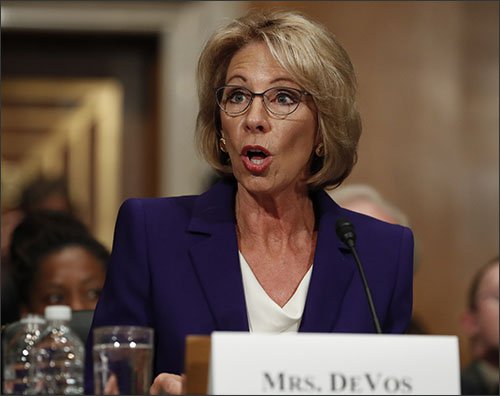
WASHINGTON — Betsy DeVos, Donald Trump’s pick to lead the U.S. Department of Education, sought to use her confirmation hearing to beat back the notion that she would undermine public education as head of the department, as Democrats pressed her on everything from her views on the civil rights of gay and lesbian students, to states’ responsibilities for students in special education, and guns in schools.
“If confirmed, I will be a strong advocate for great public schools,” DeVos said. “But, if a school is troubled, or unsafe, or not a good fit for a child—perhaps they have a special need that is going unmet—we should support a parent’s right to enroll their child in a high-quality alternative.” She also noted that her mother, Elsa Prince, was a public school teacher.
But those assurances didn’t seem to quell the anxieties of Democrats on the committee, including Sen. Patty Murray of Washington, the ranking member. “I have major concerns with how you have spent your career and fortune fighting to privatize public education and gut investments in public schools,” she said.
In the early stages of a tense hearing that lasted three and a half hours, Murray asked DeVos if she would be willing to commit not to “cut a penny from public education” or use her perch at the department to privatize public schools. DeVos said she would seek to give parents and children the best educational options possible, which Murray essentially took as a no.
DeVos didn’t delve into the specifics on many of the big questions on the table, like whether she would rein in the department’s office of civil rights, or how she would handle key details of the federal student lending program. And at times she seemed unclear on key policy details, including during a pair of exchanges with Democratic senators on whether federal special education laws should apply to all schools. (More here.)…
Read the full story here. May require an Education Week subscription.
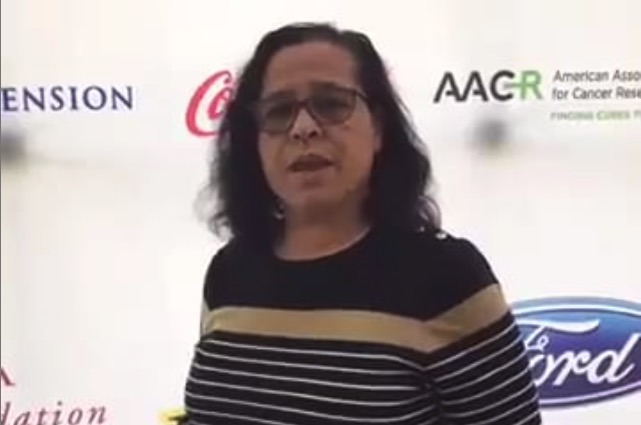
Dr. Elizabeth Primas, Program Manager for the National Newspaper Publishers Association’s “Every Student Succeeds Act (ESSA) initiative talks about the the and its impact on minority and students of color during the NNPA’s Mid-Winter Conference in Ft. Lauderdale, FL. #nnpamidwinter #nnpa_ESSA



 Washington — President Donald Trump used his first speech to a joint session of Congress… to frame education as “the civil rights issue of our time”—a line used by other leaders in both parties, including