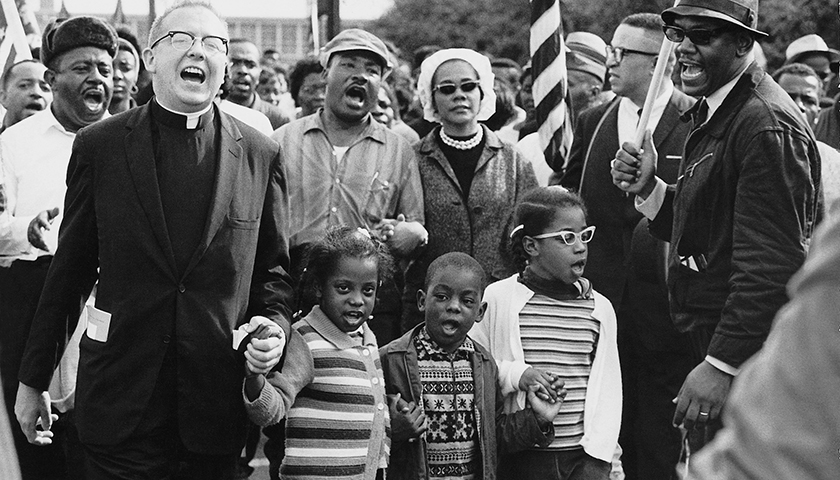
Dr. Martin Luther King, Jr.’s influence on the Civil Rights Movement is indisputable, but his fight for equity in education remains a mystery to some.
That fight began with his own education.
“He clearly had an advanced, refined educational foundation from Booker T. Washington High School, Morehouse College, Crozer Theological Seminary, and Boston University,” said Reverend Jesse Jackson, Sr., the founder of the Rainbow PUSH Coalition. “His education in his speeches and sermons and writings were apparent and he wanted us all to have that type of education.”
King completed high school at 15, college at 19, seminary school at 22 and earned a doctorate at 26.
“Dr. King laid down the case for affordable education for all Americans, including Polish children—from the ghetto and the barrios, to the Appalachian mountains and the reservations—he was a proponent for education for all and he believed that strong minds break strong chains and once you learn your lesson well, the oppressor could not unlearn you.”
Rev. Al Sharpton, the founder and president of the National Action Network (NAN), said that NAN works with Education for a Better America to partner with school districts, universities, community colleges, churches, and community organizations around the country to conduct educational programming for students and parents.
“The mission of the organization has been to build bridges between policymakers and the classrooms by supporting innovations in education and creating a dialogue between policymakers, community leaders, educators, parents, and students,” Sharpton said. “We’re promoting student health, financial literacy, and college readiness in our communities, just like Dr. King did.”
King was a figure to look up to in both civil rights and academia, Sharpton told the NNPA Newswire.
“Then, when you look at his values, he always saw education, especially in the Black community, as a tool to uplift and inspire to action,” Sharpton said. “It’s definitely no coincidence that a number of prominent civil rights groups that emerged during Dr. King’s time, were based on college campuses.”
Sharpton added that King routinely pushed for equality to access to education.
“Just as importantly, he always made a point to refer education back to character—that we shouldn’t sacrifice efficiency and speed for morals,” Sharpton said. “A great student not only has the reason and education, but a moral compass to do what’s right with his or her gifts. It’s not just important to be smart, you have to know what’s right and what’s wrong.”
Dr. Wornie Reed, the director of Race and Social Policy Research Center at Virginia Tech who marched with King, said when he thinks of King and education, he immediately considers the late civil rights leader’s advocating that “we should be the best that we could be.”
“King certainly prepared himself educationally…early on he saw that education played a crucial role in society, but perceived it as often being misused,” Reed said. “In a famous essay that he wrote for the student newspaper at Morehouse in 1947, he argued against a strictly utilitarian approach to education, one that advanced the individual and not society.”
Maryland Democratic Congressman Elijah Cummings, who remembers running home from church on Sundays to listen to King’s speeches on radio, said King had a tremendous impact on education in the Black community.
“Dr. King worked tirelessly to ensure that African Americans would gain the rights they had long been denied, including the right to a quality education,” said Cummings. “His fight for equality in educational opportunities helped to tear down walls of segregation in our nation’s schools.”
Cummings continued: “He instilled hope in us that we can achieve our dreams no matter the color of our skin. He instilled in us the notion that everyone can be great, because everyone can serve and there are so many great advocates, who embody this lesson.”
In support of education equality, civil rights leaders across the country are still working to ensure all students, regardless of color, receive access to experienced teachers, equitable classroom resources and quality education, Cummings noted further.
For example, the NAACP has done a tremendous amount, across the country, to increase retention rates, ensure students have the resources they need, and prepare students for success after graduation—whether it be for college or a specific career path, Cummings said.
During his Nobel Peace Prize acceptance speech in Oslo, Norway, King said: “I have the audacity to believe that peoples everywhere can have three meals a day for their bodies, education and culture for their minds, and dignity, equality, and freedom for their spirits.”
The need for high quality education in the Black community is universal and the route to get there may be different, but education does matter, Jackson said.
“Dr. King told me he read a fiction and a non-fiction book once a week. He was an avid reader and, in the spirit of Dr. King, today we fight for equal, high-quality education,” said Jackson. “We fight for skilled trade training, affordable college education and beyond.”
WASHINGTON – U.S. Secretary of Education Betsy DeVos today announced the approval of Minnesota and West Virginia’s consolidated state plans under the Every Student Succeeds Act (ESSA).
“States continue to embrace the flexibility and power given to them under ESSA,” said Secretary DeVos. “I am pleased to approve these plans, which comply with the requirements of the law. I look forward to seeing how the states turn ideas into action to improve outcomes for all students.”
Allowing states more flexibility in how they deliver education to students is at the core of ESSA. Each state crafted a plan that it feels will best offer educational opportunities to meet the needs of the state and its students. The following are some of the unique elements from each state’s approved plan as highlighted by each state:
Minnesota
Plans to ensure that by 2020, 90 percent of all students will graduate from high school in four years and that the state aligns its efforts with its workforce development goals.
Identifies 25 percent of the lowest-performing schools across three domains—math, reading and English learner proficiency—to ensure all schools in need of support are identified and assisted, with the greatest support directed to the most acutely low-performing schools.
“Nothing is more important to Minnesotans than making sure every child has access to a great education,” said Minnesota Commissioner of Education Brenda Cassellius. “That consensus was shared by a broad majority of parents, community members and stakeholders across our state who made equity and ambitious goals the central tenants of our ESSA plan. Together, we created a shared definition of equity that serves as the foundation for a plan that is actionable, research-based and rooted in the best practices for supporting schools. Combined with rigorous accountability expectations, strategic support for schools that need it most, and the promise of easy-to-understand and transparent reporting for teachers, parents, and the public, this plan is a significant step forward in our shared vision for all kids. I look forward to implementing our new plan, and supporting every Minnesota educator as they work even harder to ensure every child has the same opportunity to learn, succeed and thrive.”
West Virginia
Plans to reduce the number of non-proficient students, overall and for each subgroup, in half by 2030.
Provides LEAs access to evidence-based interventions and professional development based on performance on individual indicators within the Statewide Accountability System, so that any school struggling with a single indicator receives support.
“The intent of our ESSA plan is to be a catalyst for economic growth and development in West Virginia. Our goal is to ensure that every student is provided the opportunity to be successful after graduating high school in their chosen career and/or post-secondary endeavors. Our comprehensive system will individualize support and capitalize on a network of education partnerships, while supporting Gov. Jim Justice’s focus on education and economic development,” said Steven Paine, West Virginia’s state superintendent of schools.
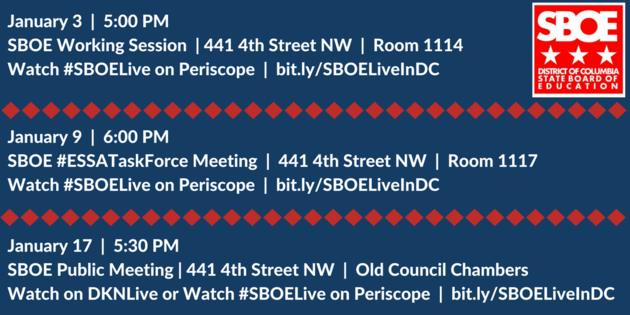
Washington, DC- The DC State Board of Education (SBOE) will hold its monthly public meeting on Wednesday, January 17, 2018, at 5:30 p.m. in the Old Council Chambers at 441 4th Street NW. The SBOE wants to hear the community’s thoughts on the proposed content of a new school report card that will provide the same information about every public and public charter school in the District. The school report card will contain two kinds of data: information that is required by the federal Every Student Succeeds Act (ESSA) and information that is important to the residents of the District. The public may sign up online to testify at this month’s SBOE Public meeting about the school report card. The deadline to sign up is 5:00 p.m. on Tuesday, January 16, 2017. Residents who testify will have three minutes to provide their input and recommendations to the SBOE.
At Tuesday night’s SBOE ESSA Task Force meeting, representatives from the Office of the State Superintendent of Education (OSSE) outlined updates to their content and format proposal for the new report card. Task force members reviewed the proposal and provided comments and recommendations. This proposal was based on feedback from State Board members, community members, and the members of the ESSA Task Force. Over the next few weeks, OSSE will work with the SBOE to finalize the content proposal with the intention that the State Board will vote on the proposal at its February public meeting.
At this month’s public meeting, the State Board will also honor the recently named District Tier 1 public charter schools and organizers of National School Choice Week with ceremonial resolutions.
Individuals and representatives of organizations who wish to comment at a public meeting may also submit testimony via email at sboe@dc.gov. Individuals should furnish their names, addresses, telephone numbers, and organizational affiliation.
The draft agenda of the meeting is below. Please note that the agenda may be altered, modified or updated without notice.
Call to Order
Announcement of a Quorum
Leadership Election
Approval of the Agenda
Approval of Minutes
Comments from the President of the DC State Board of Education
Comments from the State Superintendent of Education
Public Comment
2017 Tier 1 Public Charter School Ceremonial Resolution (VOTE)
National School Choice Week Recognition Ceremonial Resolution (VOTE)
2018 Committees Resolution (VOTE)
ESSA Report Card Recommendations
Adjournment
The DC State Board of Education is an independent agency within the executive branch of the Government of the District of Columbia that works to advise the Office of the State Superintendent of Education (OSSE), which is the District’s state education agency. The Board is comprised of nine elected representatives, each representing their respective wards, with one member representing DC at large, in addition to two student representatives. While OSSE oversees education within the District and manages federal education funding, the Board approves education policies, sets academic standards, and determines teacher qualifications. The State Board views its role in the achievement of this mission as one of shared responsibility, whereby it engages families, students, educators, community members, elected officials and business leaders to play a vital role in preparing every child for college and/or career success. More information about the SBOE can be found at sboe.dc.gov.
The U.S. Department of Education is almost done critiquing states’ Every Student Succeeds Act plans. In fact, Idaho, which received a letter from the department on Dec. 27, is the second to last state to get a response. (The lone state still waiting: South Carolina, which turned in its plan late for weather related reasons).
Like the other thirty-two states that have gotten feedback so far this winter, Idaho has a long list of things to work on. For instance:
Idaho is planning to create a “minority children” subgroup that combines six different groups of students. Civil rights groups say that combining subgroups that way masks achievement gaps. And the department says they are an ESSA no-no if states try to use those “super subgroups” on their own for accountability.
Idaho doesn’t have a clear method of measuring English proficiency and incorporating it into its accountability system. That’s not Kosher under ESSA, the department says. (Florida has a similar issue.)
Idaho needs to be more specific about how it will identify schools where subgroups of students are consistently low-performing.
Quick refresher: Sixteen states and the District of Columbia turned in ESSA plans in the spring. So far, all of them have been approved, except Colorado. The other 34 states submitted plans this fall. And all of them have gotten feedback, except of course, the Palmetto State. You can read all of the feedback letters here. Nearly every state had a lot to improve.
CHARLES CITY – Though the vast majority of students who are deaf or hard of hearing have no additional disabilities, an astounding percentage of them are falling behind their peers in the areas of language and literacy skills. The problem? Lack of access to interpreters and limited access to daily instruction from staff who are specially trained to teach the students.
While larger districts with deeper pockets can provide full-time access to interpreters, smaller districts are often left blowing in the wind, relying on services by itinerant teachers provided by their Area Education Agencies. While that’s sufficient for some students who are deaf or hard of hearing, it creates an educational barrier for others.
“We are talking about access to education,” said Jay Colsch, regional director for the Iowa Educational Services for the Blind and Visually Impaired and Iowa School for the Deaf. “If the student cannot communicate with teachers and their peers, how are they going to learn?”
It is estimated that the number of deaf and hard of hearing students in the state is nearly 1,600. While the state offers full-time class instruction at its School for the Deaf in Council Bluffs, for many parents the notion of sending their child far away isn’t an option.
And to that end, a state leadership team consisting of administrators from the Iowa Department of Education, Area Education Agencies, Iowa Vocational Rehabilitation Services, Iowa Educational Services for the Blind/Visually Impaired, Iowa School for the Deaf and the Des Moines Public Schools has developed a plan to create what’s known as regional academies. Regional academies are designed to be dotted across the state for the purpose of providing interpreters and full-time teachers of the deaf to students with hearing impairments. In addition, plans are under way to provide full-time teachers of the visually impaired and vision assistants (paraprofessionals) to students who are blind/visually impaired at various locations throughout the state.
The purpose of regional academies is to expand the continuum of services to students with sensory impairments by providing instructional services that supplement itinerant services currently provided by Area Education Agencies and Iowa Educational Services for the Blind/Visually Impaired.
At present, there’s only one regional academy – North East Iowa Regional Academy – located in Charles City, and it currently only serves students with hearing impairments. But the academy, known by its acronym NERA, is the pilot.
“The AEAs provide support through itinerant teachers,” Colsch said. “But they are limited with the time they can spend with each student and cannot provide full-time itinerant teachers. All too often I have been at IEP (Individualized Education Programs) meetings where the amount of service received is based on the availability of itinerant teachers, not based on what the student needs.”
If the itinerant teacher cannot provide sufficient support – typically, itinerant teachers can spend no more than one hour a day, twice per week, with individual students – those who are deaf or hard of hearing are often staffed into multi-disability special education programs.
“There is a seismic gap in the continuum of services” Colsch said. “If the amount of support from an itinerant teacher of the deaf/hard of hearing isn’t sufficient, the student often is placed in multi-disability special education programs taught by special education teachers who have little or no educational background or experience teaching students with sensory impairments. Special education teachers are inclined to rely on instructional strategies that are effective with students with learning disabilities or cognitive impairments rather than evidence-based strategies that are specially designed for students who have sensory impairments.”
Academic achievement data being collected by local school districts would suggest that the overall rate of progress among students with sensory disabilities is not sufficient to keep pace with their non-disabled peers.
“Deafness does not preclude children from learning at a rate commensurate with their peers,” Colsch said. “But it does require that they are taught in a different manner.”
In 2013, only 39 percent of Iowa students who were deaf/hard of hearing achieved proficiency in reading as measured by the Iowa Assessments. Another study was conducted last year of reading proficiency among Iowa’s children in grades K-3 who are deaf/hard of hearing using FAST Assessment results and other measures of early literacy skill development. Preliminary results indicate that less than 30 percent of Iowa’s children with significant hearing loss achieved proficiency.
“Our state leadership team recognizes that we can’t embrace the status quo,” Colsch said. “There is too much at stake here. Regional academies represent a systems change that is much needed.”
Susan Rolinger, director of extended learning for the School for the Deaf and Iowa Educational Services for the Blind and Visually Impaired, said it comes down to the matter of the law for providing all students free and appropriate public educations, known as FAPE.
“What is appropriate for a child who is deaf?” she said. “How you know something is appropriate is access – communication access. We have a communication plan for our IEPs. There is a reason for that. Now, if you have a student who is hard of hearing and they are falling farther behind, putting them into a special education room gets them in with a teacher with more hours dedicated, but it isn’t necessarily appropriate. The child needs education access, but the teacher doesn’t have the ability.”
In no way is the regional academy concept meant to impinge upon the work going on at the AEAs. Rolinger, whose daughter Madeline is deaf, thrived under the itinerant teacher model.
“But many kids who are deaf and hard of hearing are at significantly higher risk of having behavior problems,” she said. “The regional academy offers a critical mass where students who are deaf and hard of hearing have access to education, access to communication. We’re not saying that every deaf or hard of hearing child should be educated at a regional academy. But there is a significant chunk of students who need more.”
“During IEP meetings, the concept of an appropriate public education in the least restrictive environment must be considered,” he said. “Least restrictive environment isn’t a specific place; it is a learning environment where the child can receive an appropriate education with their non-disabled peers to the maximum extent appropriate. If a child is the only one who is deaf or hard of hearing, their communication needs must be addressed in an environment where learning is not restricted by lack of communication access. Placement in a regional academy is less restrictive than placement in a child’s home district, general education classes and multi-disability special education programs where they don’t have access to effective communication with their peers.”
As for Rolinger’s daughter, Madeline is attending the Rochester Institute of Technology in Rochester, N.Y., where she is studying public policy with the goal of becoming a disability rights attorney.
“She has critical mass for the first time in her educational career,” she said. “There are 1,200 deaf and hard of hearing students there. You can imagine she loves it.”
Rolinger considers her daughter lucky to have thrived in the mainstream. But she worries about those who don’t.
“Let’s not wait for them to fail before we send them to the regional academy,” she said.
This year featured a new president, a new education secretary, and the first year schools began shifting to the Every Student Succeeds Act. It’s been a busy year for us, and to cap it off, we’re highlighting the 10 blog posts we wrote that got the most readership in 2017. Here we go, from the post with the 10th-most views to the post with the most views:
President Donald Trump repeatedly said on the campaign trail in 2016 that he wanted to end the Common Core State Standards. So when U.S. Secretary of Education Betsy DeVos said this to a TV news anchor in April, she was channeling Trump’s stated desire. But DeVos’ statement wasn’t accurate, since more than three dozen states still use the content standards. The Every Student Succeeds Act also prohibits DeVos from getting involved in states’ decisions about standards.
Along with promoting school choice, one of DeVos’ big goals this year has been to restrain the federal government’s role in education when it comes to regulations, as well as the size and scope of the U.S. Department of Education. It doesn’t look like her push to significantly slash the department’s budget has the support of Congress, but DeVos has been trying to trim the department’s staffing levels recently.
Washington, DC – The DC State Board of Education (SBOE) announces that its High School Graduation Requirements Task Force will be taking a strategic pause during the month of January 2018 to take advantage of upcoming information that will influence the task force’s work. Stepping back for a month will allow staff and task force members to reflect on constituent feedback received thus far, as well as consider information from the ongoing investigation of the implementation of high school graduation requirements at Ballou High School and other schools across the city. The results of the citywide investigation being led by the Office of the State Superintendent of Education are expected at the end of January. Members will reconvene in February to continue their work.
“Too often, policymakers race forward with changes without pausing to consider how changing contexts may influence the direction of their work. We are taking the month of January to reflect on the work done so far by the task force, the input we have received to-date and to ensure we consider the outcomes of the ongoing investigation before moving forward,” said Laura Wilson Phelan, Ward 1 representative and task force co-chair.
“Recent developments make the work and forthcoming recommendations of this task force even more critical for our students and families”, said Markus Batchelor, Ward 8 representative and task force co-chair. “The promise of our work together with the broad representation that exists from across the city will be essential in the creation of groundbreaking new opportunities for our students. We want to seize this moment by ensuring our work incorporates new information as it becomes available.”
This task force marks an historic citywide effort to review, analyze and, as necessary, make thoughtful, implementable recommendations to adjust DC’s high school graduation requirements for all DCPS and public charter school students. Under the leadership of Ward 1 representative Laura Wilson Phelan and Ward 8 representative Markus Batchelor, the 26 members of the task force mirror our school-aged population, with half of the task force members living or working East of the Anacostia River. After the pause, the task force will resume its regular meetings with the goal of presenting recommendations to the State Board in the spring.
All task force meetings are open to the public. However, individuals and representatives of organizations are not permitted to speak or participate during task force sessions. District residents may stay involved and provide input throughout this process in a variety of ways. Individuals and representatives of organizations may submit written testimony or information for consideration by the task force by emailing sboe@dc.gov or by filling out this online form. Members of the public can also request to join our discussion group here to share input regarding the work of the task force.
The DC State Board of Education is an independent agency within the executive branch of the Government of the District of Columbia which works to advise the Office of the State Superintendent of Education (OSSE), which is the District’s state education agency. The Board is comprised of nine elected representatives, each representing their respective wards, with one member representing DC at large, in addition to two student representatives. While OSSE oversees education within the District and manages federal education funding, the Board approves education policies, sets academic standards, and determines teacher qualifications. The State Board views its role in the achievement of this mission as one of shared responsibility, whereby it engages families, students, educators, community members, elected officials and business leaders to play a vital role in preparing every child for college and/or career success.
For the latest updates on the work of the task force, please visit sboe.dc.gov/gradreqs.
The public reporting requirements of the Every Student Succeeds Act (ESSA) offer greater transparency about school quality, according to experts and education advocates who also predict that the new law will empower parents and make them more informed partners in the education process of their children.
President Barack Obama signed ESSA into law on December 10, 2015.
“Public reporting is going to be very important, because state systems, like what goes into [calculating] letter grades for schools, are incredibly complex,” said Phillip Lovell, the vice president of policy development and government relations for the Alliance for Excellent Education, a Washington, D.C.-based national advocacy organization that’s dedicated to ensuring all students graduate from high school, ready for success in college and in the workplace. “States are aware of and working on how to communicate information on school performance clearly.”
Brenna McMahon Parton, the director of policy and advocacy for Data Quality Campaign, one of the nation’s leading voices on education data policy and use, said that everyone deserves information, which is why ESSA requires that report cards are easy to understand.
“To date, states haven’t focused on parent needs and, as a result, report cards are difficult to find and use,” said Parton. “As states develop new report cards, they should be sure that parents will have a one-stop-shop that provides information they need about how students and schools in their community are performing.”
ESSA reauthorized the Elementary and Secondary Education Act (ESEA), the historic civil rights law passed in 1965 and effectively replaced the Bush-era No Child Left Behind Act.
Transparency and parental engagement are integral parts of the new law.
Under ESSA, all schools receiving Title I funds must inform parents of their right to request information about the professional qualifications of their children’s teachers; parents are also encouraged to support their children’s educational experiences by communicating regularly with teachers.
In a post on “The 74,” a nonprofit news site dedicated to education, Rashidah Morgan of the Sweden-based Education First, said that, “Greater transparency about school quality, will ultimately empower parents to make more knowledgeable choices about schools.”
Also, transparency on spending and academic results help the public understand how schools are performing in their communities, said Chad Aldeman, a principal at Bellwether Education Partners, a Washington, D.C.-based nonprofit focused on changing the outcomes and education life for the underserved.
“Accountability systems only work, if people understand what they’re being held accountable for and have enough information to know how to respond,” Aldeman said, adding that parents need good information to make informed choices about where to send their children. “To make that a reality, parents need information about both their own child’s performance, as well as how similar students are performing in other schools.”
Finally, clear, transparent school and district report cards help families make critical decisions and equip community members and the public to push for needed improvement in schools, said Dr. Lillian Lowery, the vice president of PreK-12 Policy, Research and Practice at The Education Trust, a nonprofit based in Washington, D.C. that promotes high academic achievement for students at all levels, particularly students of color and those of low-income.
“ESSA requires states to report a lot of important information on how schools are doing at preparing all groups of students, including students from low-income families, students of color, English learners and students with disabilities, for post-high school success,” said Lowery. “To maximize the usefulness of this information, state leaders should work with families and education advocates to ensure that report cards are easy to access and understand.”
Arkansas, California, Oklahoma, Pennsylvania, and Texas need to make some big improvements to their plans to implement the Every Student Succeeds Act, according to letters released publicly Friday by the U.S. Department of Education.
The most important letter is probably California’s. It’s a huge population center, and its plan, which relies on a dashboard to track school accountability, is either one of the most innovative and holistic in the country or one of squishiest and most confusing, depending on who you talk to.
The feds gave the Golden State a long, long list of things to fix. For one thing, the department says, it’s not at all clear from California’s plan that academic factors (like test scores) will count for more than school quality factors (like discipline data), an ESSA requirement. California wants to handle schools with low test participation by simply noting the problem on the state’s dashboard. The feds aren’t sure that meets the law’s requirements. And California told the department that it plans to finalize its method for identifying the lowest-performing schools in the state in January of 2018. The feds say they need it explained before they can greenlight California’s plan.
California also doesn’t have clear “interim” or short-term goals for English-language proficiency. It’s also unclear how the state will calculate suspension rates, which California wants to use to gauge school quality and student success. The state also needs to better spell out how it will make sure disadvantaged children get access to their fair share of effective teachers.
California has a long history of bucking the department. The state faced off with the Obama administration on student data systems, teacher evaluation, and more. So it will be interesting to see how many of these changes California makes, and whether the state will be approved even it doesn’t significantly revise its plan. A number of states that turned in their plans this spring didn’t make changes the department asked for, and got the stamp of approval anyway…
Read the full article here: May require an Education Week subscription.
SBOE Approves Resolution for Most Vulnerable Students
At December’s public meeting, the State Board unanimously approved a resolution that would change the way we report and monitor the progress of some of our most vulnerable students. Across the country, most jurisdictions use a definition of economically disadvantaged that is based on participation in the free and reduced-price meal program, commonly called FARM. SBOE President and Ward 7 Representative Karen Williams explained, “The problem is that many schools receive what is called community eligibility for FARM, where if a certain percentage of students at a school qualify for FARM, all of its students are labeled as economically disadvantaged. This leads to less precise reporting, since not all students at a community eligible school are actually living in poverty.”
The resolution approved by the State Board would instead link the definition of “economically disadvantaged” to other federal programs, including Temporary Aid to Needy Families (TANF), the Supplemental Nutrition Assistance Program (SNAP), and an individual student’s homeless or foster care status. The SBOE noted that this information is already being collected by the District for reporting the number of students labeled as at-risk, so the burden on schools is minimal.
State Superintendent Hanseul Kang spoke of ensuring the SBOE is informed of the work her agency is doing on a new definition for “economically disadvantaged” students to ensure that the District’s reporting requirements not only provide detailed information about these vulnerable students, but also that the rules do not have unintended consequences reporting & transparency.
Celebrating Ballou Senior High School’s Football Team, DC’s 2017 State Champions
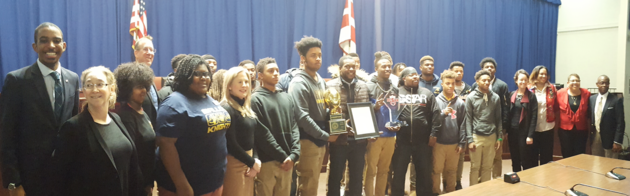
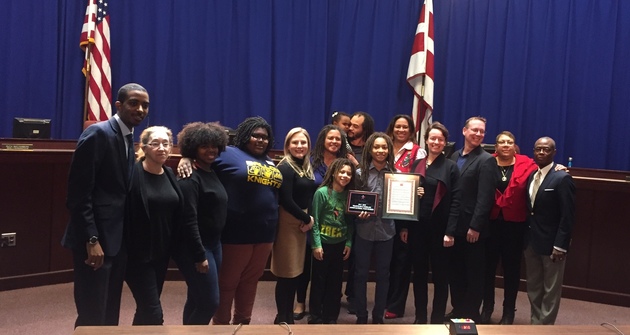
At this month’s public meeting, the State Board honored the achievements of the Martin Luther King Parade Committee, Changamire (“Changa”) Anderson II, and the Ballou Senior High School DC Football Champions. Ward 8 representative Markus Batchelor moved resolutions to honor the Ballou Senior High School Football Team, DC’s 2017 State Champions and the 12th Annual Martin Luther King Peace Walk & Parade Committee for their dedication to the enrichment of our students. Ward 4 representative Lannette Woodruff introduced a resolution honoring the hard work of student athlete Changa Anderson, grandson of former Ward 4 SBOE representative D. Kamili Anderson. Last month, Mr. Anderson represented the United States as a member of the U.S. National Gymnastics Team, competing at the World Trampoline Championships in Bulgaria.
Celebrating student athlete Changa Anderson, grandson of former Ward 4 SBOE representative D. Kamili Anderson
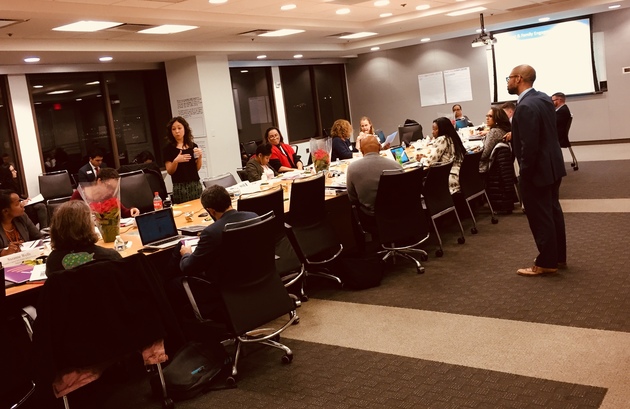
Maya Martin, PAVE Executive Director and Josh Boots, EmpowerK12 Executive Director present to the ESSA Task Force
The SBOE Every Student Succeeds Act (ESSA) Task Force met on Tuesday, December 5, 2017 to discuss the new version of DC’s school report card. Maya Martin, Executive Director of Parents Amplifying Voices in Education (PAVE), Josh Boots, Executive Director of EmpowerK12, and representatives from the Office of the State Superintendent of Education (OSSE) provided task force members with an overview of recently held parent feedback sessions on the DC school report card. View the presentation materials here and watch the replay here.
PAVE held meetings with each of its Parent Leaders in Education (PLE) Boards in Wards 1, 4, 5, 6, 7, and 8. At each meeting, parents were asked to rank the top five things they looked for when they chose a school for their student. Parents then examined PCSB’s Performance Management Framework Reports, DC Public School’s Scorecards, and the LEARN DC profiles, and discussed the pros and cons of each. In addition, PAVE canvassed and collected surveys from 51 total parents. 85% of parents who attended sessions said “Student Performance by Subgroup” and “Teacher Quality” were the most important factors needed on a school report card. Re-enrollment, School Funding, and Attendance were also rated highly. Parents want one source where they can get data, and one that helps them interpret quality more easily.
OSSE’s Deputy Chief of Staff Naomi Watson & Special Assistant Justin Tooley presented information from recently held school report card parent sessions. OSSE reported hearing from 430 parents, families, and community members at in-person sessions and from an online survey. The team expects to hear up to 1500 pieces of feedback. The top themes that parents are looking for include teacher data, parent and family engagement, graduation and college-preparedness, diversity, grades and test scores, and discipline and safety.
The OSSE Parent and Community Engagement Toolkit is now available here to learn how to facilitate your own feedback session. Community members can also take an online survey to provide feedback. OSSE will log and analyze all of the public feedback, and then update the report card content based on the analysis collected. OSSE will present a final proposed list to the State Board of Education in January 2018.
The next ESSA Task Force meeting will be held on January 9th.
OSSE Deputy Chief of Staff Naomi Watson and Special Assistant Justin Tooley present feedback from parent sessions on the school report card.
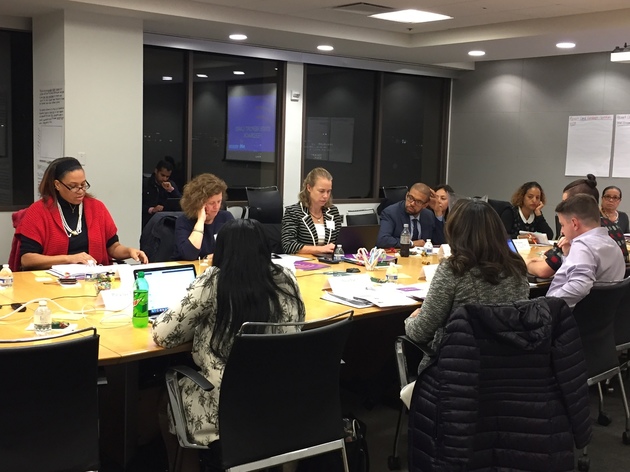
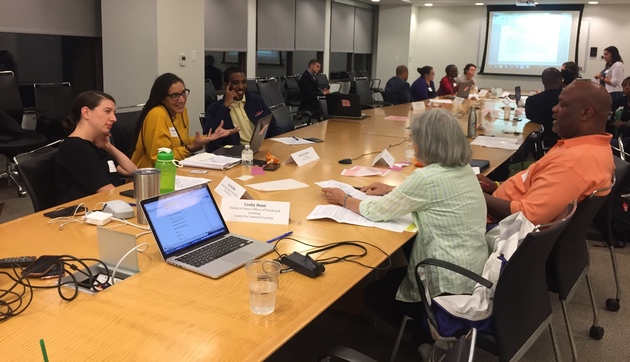
SBOE #DCGradReqs members participate in group work
The #DCGradReqs Task Force will be taking a strategic pause during the month of January 2018 to take advantage of upcoming information that will influence the task force’s work. Stepping back for a month will allow staff and task force members to reflect on constituent feedback received thus far, as well as consider information from the ongoing investigation of the implementation of high school graduation requirements at Ballou High School and other schools across the city. The results of the citywide investigation being led by the Office of the State Superintendent of Education are expected at the end of January. Members will reconvene in February to continue their work.
We encourage community members to engage in the discussions related to graduation requirements through our other forums. Your input is vital to our work as we move forward.
Joyanna Smith, Ombudsman for Public Education, and Faith Gibson Hubbard, Chief Student Advocate, provided an update to the Board on student discipline measures in the District at the December State Board Working Session. Ms. Smith provide statistics that showed that 33% of the cases her office receives that involve students who have been suspended also involve students who have IEP services, are undergoing evaluation, or are waiting to be evaluated. 36% of schools in the District of Columbia have a suspension rate above the District-wide average and 87% of schools with a suspension rate of 20% or higher are in Wards 5, 6, 7, and 8. Additionally, these schools also tend to be at least 95% African American and have an at-risk student population of more than 60%.
Ms. Smith stated that local analysis of the District’s discipline data demonstrates that despite efforts to overcome disparate discipline procedures by developing discipline LEA guidance, enacting the Pre-K Student Discipline Amendment Act of 2015 and piloting restorative justice practices – the District continues to suspend or expel low-income and students of color at disproportionate rates. In D.C., African American students are 6.8 times more likely to be suspended than their white peers, while Latino students are 2.4 times more likely to have received at least one out-of-school suspension than their white peers. For African American students attending D.C. public schools, the level of disproportionality is well above the national average.
Ms. Gibson Hubbard provided some context to the issue of student discipline in the District. Confusion exists in part due the essentially 60 plus schools districts that exist in the District of Columbia. Each of the school districts, or Local Education Agencies (LEA’s) has its own student discipline policy. DCPS has discipline and behavior policies which are subject to the city regulations, code, and government oversight. Public Charter Schools have the autonomy to create their own discipline and behavior policies, with considerations from OSSE’s non-regulatory discipline guidance and the Public Charter School Board disciplinary guidance.
For the past two schools years, the Office of the Student Advocate has conducted, in partnership with the Council for Court Excellence and Howard University School of Law, an analysis of LEA student discipline policies in the District. View the Ombudsman presentation here and view the Student Advocate presentation here.
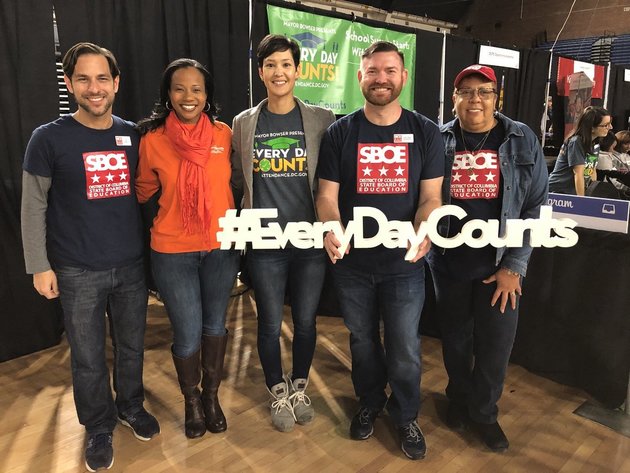
SBOE Public Affairs Specialist Paul Negron, Ombudsman for Public Education Joyanna Smith, Deputy Mayor for Education Chief of Staff Ahnna Smith, SBOE Executive Director John-Paul Hayworth and SBOE President and Ward 7 Representative Karen Williams at EdFEST17
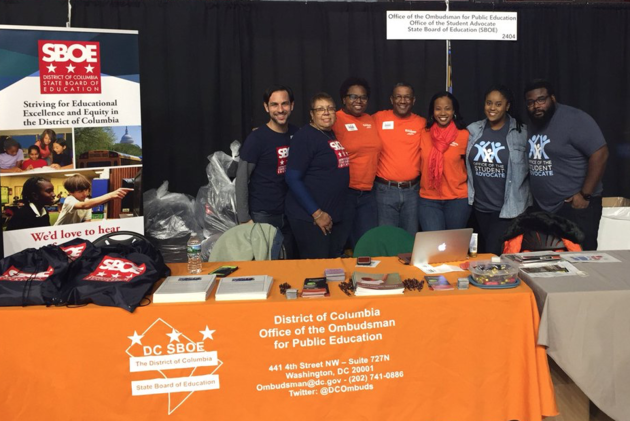
Rain, sleet and snow did not stop the SBOE from heading to EdFEST17 on Saturday, December 9th! Members from the State Board and the Office of the Ombudsman and Student Advocate joined a number of DC public schools and public charter schools to showcase the city’s public school options (PK3-12) for the upcoming school year at DC Armory.
The common lottery application is now officially open! Parents may start filling out applications here ahead of the February 1st high school and March 1st PK3-8 application deadlines.
EdFEST featured many free services and fun activities for the whole family:
Lottery application information and guidance from the My School DC team. Immunizations for youth and adults, health screenings for kids and teens, and lots more family fun, games and entertainment brought to you by the DC Department of Health and MedStar Georgetown University Hospital
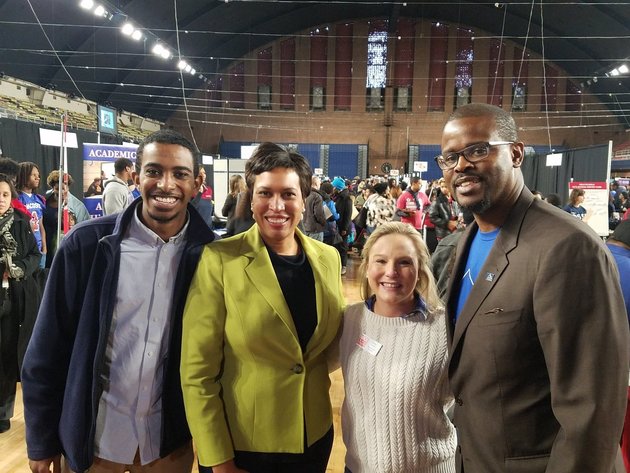
SBOE Ward 8 Representative Markus Batchelor, Mayor Muriel Bowser, SBOE At-Large Representative Ashley Carter and DCPS Chancellor Antwan Wilson at EdFEST17
SBOE Public Affairs Specialist Paul Negron, SBOE President and Ward 7 Representative Karen Williams, Ombudsman Program Associate Khadijah Williams, Assistant Ombudsman Clarence Parks, Ombudsman for Public Education Joyanna Smith, Student Advocate Program Associate Tiffany Wilson, and Student Advocate Dan Davis at EdFEST17
The Office of the Ombudsman for Public Education provides conflict resolution services for parents and students across the city. Serving approximately 500 families per year, the dedicated staff of the office, under the leadership of Ombudsman Joyanna Smith, works on issues including: student discipline, special education, truancy, student enrollment, transportation, academic progress and bullying. The 2017 Ombudsman’s report builds upon the equity analysis provided in last year’s report by introducing a proposed equity framework for the city. This framework builds upon more than three years of collaboration with school-based, local, and national education leaders, and intervention with over 1,500 families in all eight wards.
Office of the Student Advocate’s Annual Report and Workshop Series
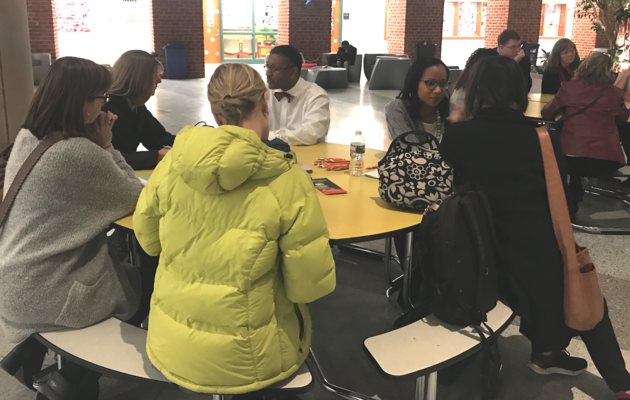
Parents speaking with the Ombudsman for Public Education Joyanna Smith during one of three rounds of individualized mini-sessions at the Office of the Student Advocate’s Know Your Rights Special Education Workshop on December 11th
The Office of the Student Advocate recently released its School Year 2016-2017 Annual Report. The report outlines the office’s work, with a focus on family engagement and student discipline, and provides recommendations that address the city’s top public education concerns. You can read the report here.
Most recently, the office relaunched its Special Education “Know Your Rights” Workshop Series in Ward 3 and its Parent Leadership Series in Wards 7 and 8. With the partnership of State Board members, Ruth Wattenberg (Ward 3), Karen Williams (President, Ward 7), and Markus Batchelor (Ward 8), the three kickoff events engaged more than 100 parents, families, community members, and representatives from partner organizations.
Be on the lookout for the second session of their Ward 7 Parent Leadership Series on February 10, 2018! To learn more about upcoming events and training, visit the Student Advocate training events page. If you have questions or concerns about public education in DC, give the office a call at 202-741-4692 or email student.advocate@dc.gov.




 The U.S. Department of Education is almost done critiquing states’ Every Student Succeeds Act plans. In fact, Idaho, which