DALLAS POST TRIBUNE — AUSTIN, Texas — Texas Appleseed, a public interest justice center, is accepting scholarship applications as part of its Diversity Legal Scholars program, aimed at diversifying the legal profession. The program helps low-income students of color expand their law school options through a scholarship that covers the full cost of a Kaplan (LSAT) preparation course, valued at about $1,299 per scholar.
The scholarship is offered three times a year, corresponding with LSAT test dates. Key dates are below:
Round 1: Accepting applications now. The application deadline is February 12, 2018. Scholarship recipients would take the LSAT on June 11, 2018.
Round 2: Accepting applications starting May 14, 2018. The application deadline is June 4, 2018. Scholarship recipients would take the LSAT September 8, 2018 or November 17, 2018.
Round 3: Accepting applications starting August 1, 2018. The application deadline is September 5, 2018. Scholarship recipients would take the LSAT January 26, 2019.
Scholarship recipients must be Texas residents and apply to take the LSAT on the designated date that corresponds to their application round. Additional requirements and details can be found at www.texasappleseed.org/diversity-legal-scholars.
According to the latest figures from the Bureau of Labor Statistics, only 4.4 percent of all lawyers in 2016 were Black, 4.7 percent were Asian, and Latinos comprised 5.6 percent of all attorneys. Texas Appleseed has awarded hundreds of Diversity Legal Scholars scholarships since its inception to give applicants a better shot at fulfilling their dreams of law school and entering the legal profession.
VOICE & VIEWPOINT — In describing his runaway hit “Hamilton,” actor and playwright Lin-Manuel Miranda said, “It’s this incredible way to explore how history isn’t told.” For students in San Diego City Schools and surrounding areas, this thought-provoking notion took center stage with their participation in eduHam, an innovative educational program coordinated with the Tony-winning play’s run at the San Diego Civic Theatre, which provided nearly 3,000 students entrée to a special matinee performance on January 11, including a lively Q & A session with some of the cast members, and, for some, the opportunity to perform their own original creative pieces—songs, rap, poetry, scenes, monologues—before an audience of their peers.
The Hamilton Education Program, or eduHam, is a multi-week program for high school students studying American history in Title 1 schools, culminating in an all-day field trip to the theatre. Hoover High School was one of 46 schools taking part in the special event. Students earned their spot at the coveted affair by participating in class activities and/or after school and Saturday sessions during which they researched extensively, studied primary sources provided by the philanthropic Gilder Lehrman Institute of American History in conjunction with the producers of “Hamilton,” and let their imaginations go full throttle to create individual projects that were informative and entertaining. Connections to current events are not lost on these thoughtful and curious students, adding dimension to their learning experience.
On a recent afternoon, three of the participating students from Hoover, Alexis Harnage, Edy Canaca, and Lilia Ruvalcaba, gathered in the classroom of ELA teacher Kristiana Riego de Dios in anticipation of the big day and shared thoughts on how the project had stimulated new learning experiences that helped them look at history in new and different ways.
“I thought it was cool that people were combining history and the arts because usually you see history as more academic, and dance and art as different,” said 11th grader Harnage. The use of contemporary music—hip hop and rap—along with the more traditional genres of R & B and jazz was a hook for the high school junior, who plays an instrument herself, part of a rigorous curriculum that includes AP US History. Harnage, at 17, is articulate and focused, a self-described overachiever who said she drew on prior knowledge of George Washington, supplemented with extensive research to create a rap about our founding father and his role as a revolutionary leader in America’s road to independence. Her hard work paid off, as her project, which she wrote and performed with fellow Hoover 11th grader Bernard Drake, was one of only 15 selected for presentation at the Thursday event. “What I learned is that every leader, every president sets a tone for how they will lead the country. George Washington was widely respected as the first president of the United States and as a leader. I constantly make the connection with our first president of the United States vs. our current president Donald Trump, because I know there is controversy as to whether he is a good president or not. What you put out and what you do for the people of the country will stick around for a really long time.”
Edy Canaca, whose AP US History teacher Ellen Towers describes as “a consummate learner, was drawn to the duel between Aaron Burr and Alexander Hamilton. The 11th grader created a poem, which he and two of his classmates acted out. Prior to his research, Canaca was not aware of the outcome of the duel, which Burr won when Hamilton chose to shoot his gun in the air. “But it still ended badly for Burr,” Canaca concluded, “and I’m pretty sure he regretted it. Destroying his enemy actually made it worse for him and he could not advance politically.” In his research, Canaca made an important discovery as to discrepancies in how history is told. “Every source says something different. It’s not always accurate and there are people who change it up. They always tweak it, depending on their perspective.”
Lilia Ruvalcaba, who loves writing poetry, found a fascinating subject in Abigail Adams. “When we look at history, we see a lot of men, and in our history class, we learned about the politics, but we didn’t really learn her side.” Ruvalcaba’s poem, written from the perspective of Adams, who was both wife of President John Adams and later the mother of 6th president John Quincy Adams, explores the woman’s role as intellectual confidante, but one who, as a product of the times, remained largely behind the scenes. Lilia is soft-spoken but delivers a powerful message in her observations about women’s roles that is especially timely. “One of the things she said that stands out to me,” said the 16-year-old, “was ‘Remember us ladies.’ That’s a significant line and important even today.”
“This is a story about America then, told by America now,” writer/producer Miranda has said. AP History teacher Towers, who worked with de Dios as eduHAM coordinator on the Hoover campus, encouraged inquiry in her students as they drew facts from their primary sources and at the same time humanized the historical figures they read about. “My focus since I’ve gotten into history is telling the untold story or telling the story from a different perspective,” she says. “It’s nice to see people thinking about history as a multi-dimensional and multi-perspective idea. I think in the back of every history teacher’s mind is ‘who have we missed and how can we bring them forward without being dishonest.’”
This point is not lost on Harnage, who adds, “Being African American, I sit in a lot of history classes and know that it is Eurocentric. When it comes to African Americans and the struggle of our people and what we have to overcome, I don’t hear about that in school that often, and I don’t necessarily think that it’s the teacher’s fault because I think that they are just teaching the curriculum. But,” she adds, “when I think about how history is told, I think that certain types of history are overtold and other types of history or other perspectives of history or types of people are undertold or not told at all.”
Projects like eduHAM can narrow this learning gap. And by casting African Americans and Hispanics in the “Hamilton” production, Miranda highlights the diversity of people who were there and not in the shadows, Towers says, “And,” adds De Rios, “why can’t a person of color play Hamilton or Aaron Burr? Who is to say that color has to define your role?”
Who indeed?
On the big day, when 2,833 high school students—the largest eduHAM ever—filled the seats of the San Diego Civic Theatre, love, laughter, and gratitude was palpable. “This is an honor,” said Hoover 11th grader Bernard Drake after his performance with student Harnage. “It’s amazing to me how an assignment for a class can lead to you seeing a performance of ‘Hamilton.’ Working towards a goal this way is very rewarding. It pushed me to do my best and I know will lead to even greater things.”
And, as Karli Dinardo, “Hamilton” cast member advised, “No dream is too big. Learning is endless. No matter how hard, throw yourself into the deep end and surround yourself with people who are positive, who encourage and nurture your dreams.”
Where you send your child toschool is one of the most important decisions you can make.
The new school quality data released by the state shows several public schools making great progress with Oakland children.
But before I get to the schools showing the most progress, let me offer a disclaimer.
No number can fully capture a school’s story of success. So take these insights as starting points and do your homework.
Now is the time to research and apply to schools in open enrollment.
All of the information below can be found on the Oakland Unified School District’s website.
We have never had more options, easier ways to enroll, or more information about schools, so we need make the best choices we can.
Check out this list of schools making significant gains in English language arts, math and graduation rates, as well as those that stand out for serving Black and Latino* students exceptionally well:
Elementary schools gaining in math and English
Aspire Monarch*
Francophone Charter school
Madison Park*
Manzanita SEED
Glenview
Middle Schools gaining in math and English
West Oakland Middle School+
American Indian Public Charter+
Claremont*
Epic Charter*
Oakland Charter *
K-8 Schools gaining in math and English
Greenleaf*
Ascend*
Melrose
American Indian Model School+
Hillcrest+
6-12 Schools gaining in math and English
Coliseum College Prep*
Aspire Golden State*
Aspire Lionel Wilson*
Madison Park*
Bay Area Technology Prep+
High Schools with academic gains and increasing graduation rates
MetWest*+
Leadership Public Schools R and D
ARISE*
Oakland Charter High*
Envision*+
Knowledge is power. So take advantage of your options and the information available. There are still enrollment fairs coming up from OUSD and Enroll Oakland before the enrollment deadlines. Your children are counting on you to do the best by them, and that starts with making informed choices.
On Monday, January 15, 2018, the holiday marking the birthday of Dr. Martin Luther King, Jr., the NAACP and the Africa-America Institute announced a groundbreaking partnership during the 49th NAACP Image Awards.
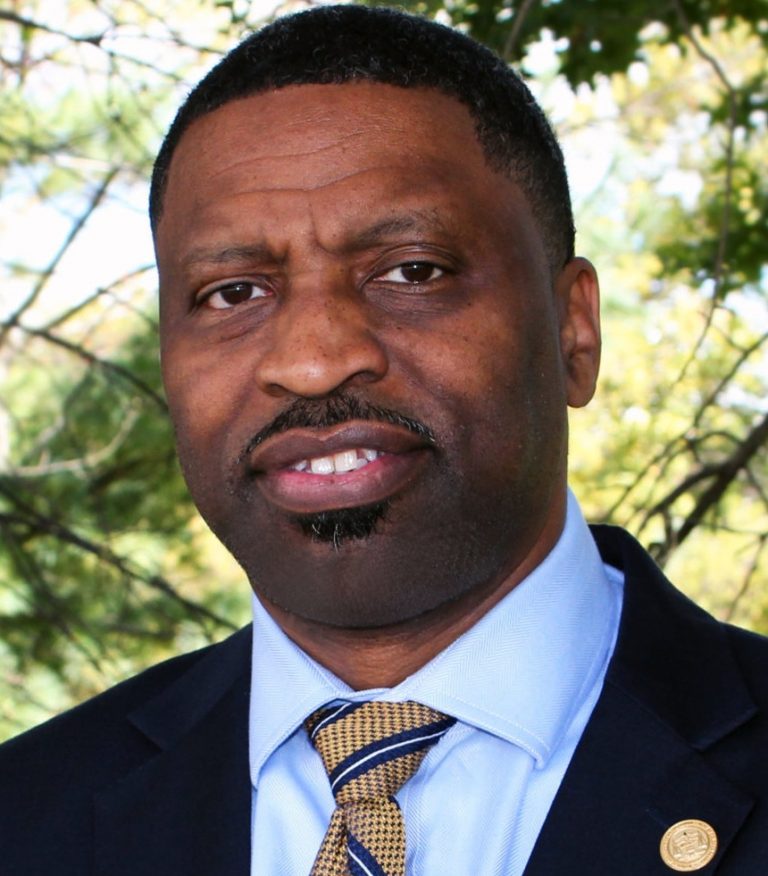
[/media-credit] NAACP President Derrick Johnson. The NAACP and the Africa-America Institute announced a partnership to develop and distribute a curriculum designed to highlight the accomplishments, achievements and history of Africa and its Diaspora. (NAACP)
The NAACP will work with the AAI on the development and distribution of a curriculum designed to highlight the accomplishments, achievements and history of Africa and its Diaspora.
“It’s appropriate that on a day that we honor Dr. King as well as promote positive images of people of color, we announce to the world a partnership that includes a curriculum, learning exchange and a network for advocacy and activism on behalf of those of African descent in the United States and abroad, “said Derrick Johnson, President and CEO of the NAACP.
“AAI has a long history of academic exchange and educational meetings between Africa and America. Now is an extraordinary time and opportunity to partner with the NAACP and together connect the more than 42 million Afro-descendants with the brilliance of the African history and its contribution to modern civilization,” added Kofi Appenteng, President of the Africa-America Institute.
The curriculum from the NAACP/AAI Alliance will include content such as Africa’s Great Civilizations, the critically acclaimed series by Professor Henry Louis Gates, Jr. Partners and NAACP chapters will benefit from organized screenings and lessons with an early education focus on positive identity formation and a more advanced curriculum that includes studies in social sciences.
A campaign kick-off will take place in February of 2018 as a part of Black History Month.
THE LEGACY NEWS – A Prince William County legislator is promoting a bill to add more mental health counselors in public high schools.
The bill, HB 252, proposed by Del. Elizabeth Guzman, D-Prince William, would that each student board employ one mental health counselor for every 250 high school students in the local school division.
Del. Elizabeth Guzman
In her district of Prince William County, Guzman said the average case load for a school counselor is between 450 and 500 students, but the counseling process involves more than just those students.
“When counselors help children, it’s not like they are serving one person,” Guzman said. “Many times we need to involve family members and friends as part of helping a person to become successful in life.”
Guzman said that if counselors have a smaller caseload, “they could help the parents to become a support system for the children.”
Guzman said being a mother of four children in the public school system gives her an inside perspective to the challenges public schools have faced throughout the years.
“Any time there was a school budget cut, the fields that were affected in the public education system were special education, school counselors, psychologists, [and] social workers,” Guzman said.
Guzman hopes to pass this bill with the help of her professional knowledge as a social worker. According to her campaign website, Guzman worked in the public sector for 10 years, most recently as the division chief for administrative services for the Center for Adult Services for the City of Alexandria. She also holds master’s in both public administration and social work.
On Jan. 10 Guzman’s bill was endorsed by both the Virginia Education Association and the Virginia Counselor Association. She said she also met with teachers and counselors before her campaign.
Becky Bowers-Lanier is the advocacy consultant for the VCA, and said, “our counselors are most supportive of her bill, [and] we will actively support it.”
Guzman’s bill requires high schools to meet the ratio of one counselor to every 250 students, but Bowers-Lanier said the VCA, “would love to have the ratio of one to 250 throughout K-12.”
“When these children are in high school they have to be ready to face real life,” Guzman said, “and if they don’t get the right support while they’re in school, there’s not a hopeful future for them.”
Bowers-Lanier said in 2016 the Virginia Board of Education proposed a revision of the standards of equality, “to tighten the ratio of counselors in K-12 to one to 250.” However, adding more counselors to high schools, “has a pretty high fiscal impact, and so it was not taken forward to the General Assembly last year.”
The VCA hopes to draw funds, “from the at-risk grant program to support the payment of the counselors,” Bowers-Lanier said.
Bowers-Lanier said at-risk funding is part of the Every Student Succeeds Act (ESSA), so additional counselors would be paid for with federal funds. Bowers-Lanier said that ESSA applies to students from low socioeconomic backgrounds, meaning they are considered high-risk and therefore in need of counselors.
THE LEGACY NEWSPAPER — On the evening of April 4, 1968, teen music sensation Stevie Wonder was dozing off in the back of a car on his way home to Detroit from the Michigan School for the Blind, when the news crackled over the radio: Martin Luther King Jr. had just been assassinated in Memphis. His driver quickly turned off the radio and they drove on in silence and shock, tears streaming down Wonder’s face.
Five days later, Wonder flew to Atlanta for the slain civil rights hero’s funeral, as riots erupted in several cities, the country still reeling. He joined Harry Belafonte, Aretha Franklin, Mahalia Jackson, Eartha Kitt, Diana Ross and a long list of politicians and pastors who mourned King, prayed for a nation in which all men are created equal and vowed to continue the fight for freedom.
Wonder was still in shock—he remembered how, when he was five, he first heard about King as he listened to coverage of the Montgomery bus boycott on the radio. “I asked, ‘Why don’t they like colored people? What’s the difference?’ I still can’t see the difference.” As a young teenager, when Wonder was performing with the Motown Revue in Alabama, he experienced first-hand the evils of segregation—he remembers someone shooting at their tour bus, just missing the gas tank. When he was 15, Wonder finally met King, shaking his hand at a freedom rally in Chicago.
At the funeral, Wonder was joined by his local representative, young African-American Congressman John Conyers, who had just introduced a bill to honor King’s legacy by making his birthday a national holiday. Thus began an epic crusade, led by Wonder and some of the biggest names in music—from Bob Marley to Michael Jackson—to create Martin Luther King Day.
To overcome the resistance of conservative politicians, including President Reagan and many of his fellow citizens, Wonder put his career on hold, led rallies from coast to coast and galvanized millions of Americans with his passion and integrity.
But it took 15 years.
In the immediate wake of King’s death, the political establishment was more concerned with keeping things calm, tamping down unrest, and arresting rioters and activists. It was a violent year—that summer the Democratic convention in Chicago exploded in chaos and another inspiring leader, Robert F. Kennedy, was killed by an assassin. The country seemed on the verge of civil war.
Conyers’ bill languished in Congress for over a decade, through years of anti-war protests, Watergate and political corruption, stifled by inertia and malaise at the end of the 1970s. The dream was kept alive by labor unions, who viewed King as a working-class hero, with protests that slowly built up steam. At a General Motors plant in New York, a small group of auto workers refused to work on King’s birthday in 1969, and thousands of hospital workers in New York City went on strike until managers agreed to a paid holiday on the birthday. King’s widow, Coretta Scott King, led a birthday rally that year in Atlanta, where she was joined by Conyers and union leaders. By 1973, some of the country’s largest unions, including the AFSCME and the United Autoworkers, made the paid holiday a regular demand in their contract negotiations.
Finally in 1979, President Jimmy Carter, who had been elected with the support of the unions, endorsed the bill to create the holiday. Carter made an emotional appearance at King’s old church, Ebenezer Baptist Church in Atlanta. But Congress refused to budge, led by conservative Senator Jesse Helms of North Carolina, who denounced King as a lawbreaker who had been manipulated by Communists. The situation looked bleak.
By then, Wonder had matured from a young harmonica-playing sensation to a chart-topping music genius lauded for his complex rhythms and socially-conscious lyrics about racism, black liberation, love and unity. He had kept in touch with Coretta Scott King, regularly performing at rallies to push for the holiday. He told a cheering crowd in Atlanta in the summer of 1979, “If we cannot celebrate a man who died for love, then how can we say we believe in it? It is up to me and you.”
THE CHAMPION NEWSPAPER — The Fernbank Museum of Natural History is ready to provide a number of educational opportunities for children in the new year.
The first new temporary exhibit for the new year will be A Secret World Inside You. Fernbank Public Relations Specialist Kayla Rumpfeldt told The Champion the exhibit is from the American Museum of Natural History, and will use videos, larger-than-life models, and interactive games to investigate the cutting-edge science of the human microbiome and to offer a new perspective on human health. It begins Feb. 10.
In the meantime, museum-goers can experience a variety of permanent exhibits. Wildwoods and the Fernbank Forest offer 75 acres of outdoor area to be explored with activities spread throughout. Nature Stories (for young children) and Adventure Outpost (for preteens) include immersive interactive exhibits.
Special trailside experiences, including a sensory wall, animal tracks and tree molds help visitors experience nature up close. There are also educator-led nature walks through a variety of native plants, flowers and wildlife.
According to Rumpfelt, Wildwoods was installed in 2016 on top of the existing, unaltered landscape outside the museum and designed to be as non-intrusive as possible to keep the grounds as close to true nature as can be.
Through Wildwoods, explorers can access the Fernbank Forest—65 acres of mature mixed forest that has one of the few remnants of original forest vegetation in the Georgia Piedmont. Self-guided tours are welcome through the two miles of trails snaking through a canopy of trees that measures more than 16 stories above the ground. Educator-guided tours are offered one or two times a month.
Inside the museum is NatureQuest, an interactive permanent exhibit that includes a multi-level clubhouse, hands-on activities and live animal displays. According to Rumpfelt, activities such as a virtual waterfall and an interactive red oak tree are designed to give students a true-to-life nature experience without having to go outside.
A Walk Through Time In Georgia allows visitors to explore the natural history of Georgia through lifelike historic recreations of geographic regions. Highlights include a dinosaur gallery, a giant sloth, a cave, and the sights and sounds of the Okefenokee Swamp.
Reflections of Culture helps museum-goers learn how people around the world communicate information about themselves through forms of personal adornment. It includes a collection of photographs, costumes, jewelry, footwear, headdresses and masks.
According to the Fernbank website, other permanent exhibits include Sensing Nature—an interactive, sensory-based exhibit aimed at young children. It includes lasers, mirrors, water and sounds designed to demonstrate the role senses play in interpreting the environment.
World of Shells includes a variety of shells collected from the Georgia coast and explains how shell material is formed, the numerous ways animals use their shells and the life processes of shelled animals.
And inside the museum’s Great Hall is Giants of the Mesozoic, including life-size fossil-cast recreations of dinosaurs. This exhibit includes fossils of Argentinosaurus, Giganotosaurus, Pterodaustro and Anhanguera for visitors to enjoy.
Fernbank Museum of Natural History is open daily. Tickets can be purchased from the website, fernbankmuseum.org.
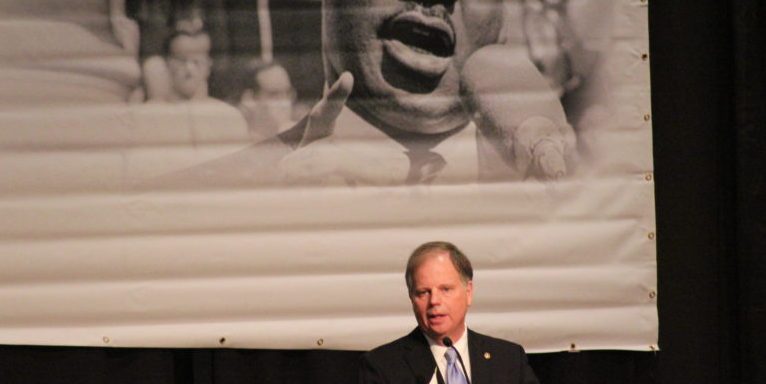
THE BIRMINGHAM TIMES — During his 20-minute speech Jones spoke about the importance of justice and equality for all and why the American Dream and Dr. King’s Dream should be a shared vision.
“Together we have a responsibility to continue fighting for the American dream, Dr. King’s dream,” Jones said. “…to ensure that Alabama and our nation live up to the ideas of equality and justice.
“That doesn’t just mean justice in a courtroom,” he said. “…it means that children growing up in every community should have the same opportunities to succeed.”
The senator spoke in a packed Birmingham Jefferson Convention Center (BJCC) North Exhibition Hall filled with city leaders, organizers, activists, and citizens celebrate King Jr. Day.
Congresswoman Terri Sewell, Birmingham Mayor Randall Woodfin, Birmingham City Council President Valerie Abbott, Jefferson County Commission President Pro-Tem Sandra Little Brown and Tuscaloosa Mayor Walt Maddox were among the officials on the dais.
But it was Jones who commanded the attention of the audience, many of whom helped get him elected to the Senate.
“I’m here today [as Senator] and it’s because you believed in me,” he said. “You believed in Alabama, you believed in this country, and you believed enough to devote your time and energy and enthusiasm to make my election possible.”
Jones said the breakfast is a chance to remember the sacrifices of not only King, but other foot soldiers who fought for justice. “People like Rev. (Joseph) Lowery, Jimmie Lee Jackson, the great Fred Shuttlesworth, Ralph Abernathy and my dear friend and colleague, John Lewis,” he said.
He also honored women who fought for freedom and justice.
“(These men) stood shoulder to shoulder with courageous women like Coretta Scott King, Recey Taylor, Rosa Parks, Virginia Foster Durr, Amelia Boynton (Robinson) and Annie Lee Cooper,” he said. “And in today’s climate we need to make sure that we recognize the courageous women of the Civil Rights Movement.”
Jones pointed out the critical need of the Children’s Health Insurance Program (CHIP), which he supports and the first bill he sponsored was to make sure funding remains in place for the program.
“Taking care of our children is not just an investment for their future, it is an investment in all of our futures.”
He talked about how “those who speak the loudest and gain strength through fear rather than consensus and compromise” let CHIP expire putting 150,000 Alabama children at risk.
“They refuse expand Medicaid, threatening the health of 1,000,000 Alabamians and the security of our rural hospitals,” he said. “They watched as children from certain zip codes got access to better education, and they did it generation after generation.”
He also pointed out that a lot of the rhetoric causing division is coming from the White House especially “when the President of the United States uses language that is not only beneath his office, but the antithesis of the values that we hold as Americans,” Jones said. “Every time we are faced with what seems like insurmountable difficulties we have risen to the occasion to confront it head on, and make no mistake, we will do it again.”
The senator pointed to the gains made by foot soldiers and King when faced with obstacles.
“Reject hatred, violence and fury,” he said. “We need to listen and learn from one another. We need to seek common ground even when it seems impossible.”
Jones concluded his speech by saying change in America will require “foot soldiers of today to make change.”
“It’s up to us, it’s our challenge,” he said. “After standing on that stage on Dec. 12 [election night] I know you know what to do.”
Jones said he didn’t have all the answers, “but I know that it will take more than gathering for breakfast once a year.”
The breakfast also included a unity candle lighting, a dance tribute from dancer Deitra Streeter to the song Rise Up by Andra Day, and 9-year-old Sergeant Jones who eloquently quoted King’s “I Have A Dream” speech from memory and with the crowd joining hands and singing “We Shall Overcome.”
OAKLAND POST — Oakland businessman and community leader, Cestra “Ces” Butner, pledged another $500,000 to East Bay College Fund in front of 600 scholars, mentors, and volunteers during the organization’s 2018 Winter Retreat at Oakland Technical High School on January 4th.
With an initial $500,000 pledged last year, the CesTRA Butner Family Foundation has now gifted $1 million in scholarships for Oakland youth. East Bay College Fund will administer the scholarships and provide wraparound support services to help scholars stay on track to earn their college degrees.
As the evening’s keynote speaker, Butner also shared stories from his upbringing, including his parents’ insistence that he complete college, and his learnings as the former owner of Oakland-based Horizon Beverage Company.
“It has been a great year for me. I ended up selling my business and it afforded me an opportunity to fund the CesTRA Butner Family Foundation…dedicated to education and to provide it for Hispanic and black kids in Oakland,” said Butner. “That’s why I’m pleased to announce that I’m prepared to give another half million dollars.”
Diana Chavez, a freshman at UC Davis and one of Butner’s 20 2017 scholars, presented him with an award on behalf of East Bay College Fund and his commitment to equity in education in Oakland.
“Ces is such a role model for Oakland, and most importantly for all the young people who heard his announcement at our retreat,” shared East Bay College Fund’s Executive Director, Diane Dodge. “Ces’ gifts are so meaningful for our students, and what’s even more inspiring is how meaningful it is for him to give back to his community. He really embraces his ability to serve Oakland youth, and I’m honored to partner with him.”
By Sheila Edwards Lange, Ph.D.,President, Seattle Central College
THE SEATTLE MEDIUM — On my desk, like many of you, I have a mousepad.
On my mousepad is a picture of African American students at work in a segregated classroom in 1945. Above that picture is the word OPPORTUNITY. Below, it reads, “Being able to see past traditional barriers and having an intense belief in your ideas and abilities will help you take advantage of any opportunity.”
I purchased this mousepad on a visit to the National Civil Rights Museum, mere feet from where Dr. Martin Luther King Jr. was killed 50 years ago.
Although that mousepad is a mundane detail in my day-to-day work, it is a daily reminder of the fight for opportunity at the heart of Dr. King’s work. That mission is as important now as it was 50 years ago. And, as an educator, it is a mission that I am connected to and responsible for.
In the simplest terms, education is a civil right. Access to education is access to opportunity. It is the path to career advancement. The key to closing the income gap. It can drive equity in housing. It is a proven determinant of overall health and wellbeing. It will mold the future African American leaders of industry, politics and social justice.
But as I look at the state of our education system, it’s abundantly clear that our work in securing educational equality is far from finished.
We live in a state with one of the nation’s most regressive tax structures and an education system so chronically underfunded that the Washington State Supreme Court demanded that our legislature find billions of dollars to support schools by 2018. Beyond just securing the funds our schools need, we face an uphill battle to ensure these funds are distributed equitably to the schools that need it most.
With only one in five workers in STEM (science, technology, engineering and mathematics) careers identifying as black or Latino, we face a diversity problem and growing income gap in the region’s most lucrative careers. Closing this gap will require educational innovation and proactive policies from employers to create new paths to high-paying jobs.
And with Seattle’s changing economy and skyrocketing cost of living, these pressures will only continue to build.
That is not to say that we haven’t made incredible progress. As a community, and as a country, we have come a long way since Dr. King’s death in 1968. The fact that I, an African American woman, the granddaughter of a sharecropper and a maid, am writing this from behind a college president’s desk is a testament to that progress. But in the 50th year after Dr. King’s death, I would like to challenge our community to rediscover his sense of urgency and reignite the resolve and focus that fueled the progress of the 1960s civil rights movement.
Together, we can make Seattle an example to our nation of what is possible when education is accessible. We can define equal opportunity. We can prove that fostering professional communities made up of diverse cultures, backgrounds and perspectives is not only the right thing to do socially, it is the recipe for innovation.
I invite you to join the Seattle Colleges to help make educational equality a reality. If you are a business leader, consider partnering with us to find the employees your company needs to thrive. If you are a parent, introduce your kids to the affordable, local opportunities provided by the Seattle Colleges. If you are a teacher or guidance counselor, help your students see that a great postsecondary education can begin with community college.
Together we can create a future full of opportunity. As a community of educators, business leaders, parents, voters and activists, it is time to fulfill Dr. King’s vision.



 The scholarship is offered three times a year, corresponding with LSAT test dates. Key dates are below: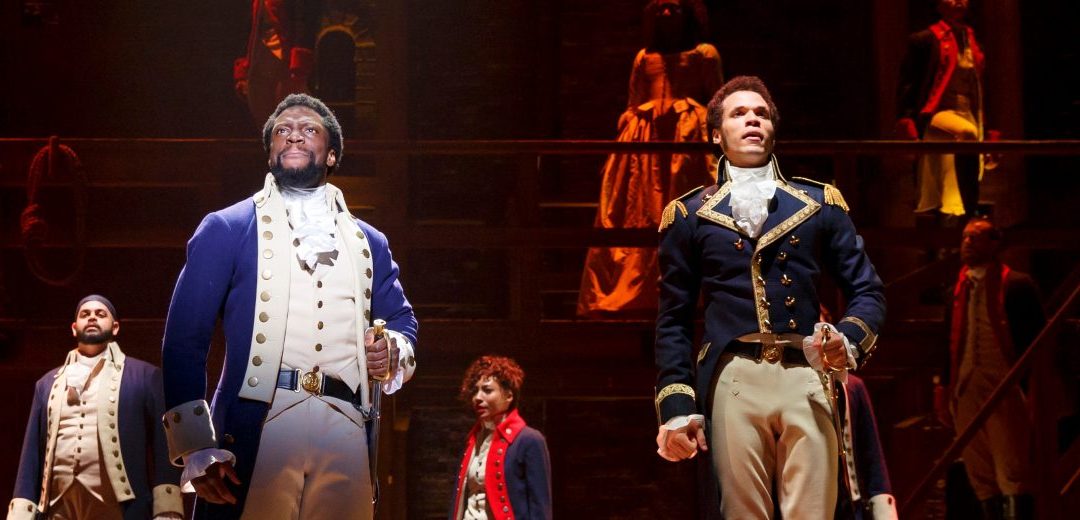




 by Liza David