WAVE NEWSPAPERS — CULVER CITY — It will be easier than ever before for Culver City high school students to earn college credit right on their own campus thanks to a new agreement with West Los Angeles College to offer college and career access pathways through dual credit courses in computer science, technical production for theater, and architecture.
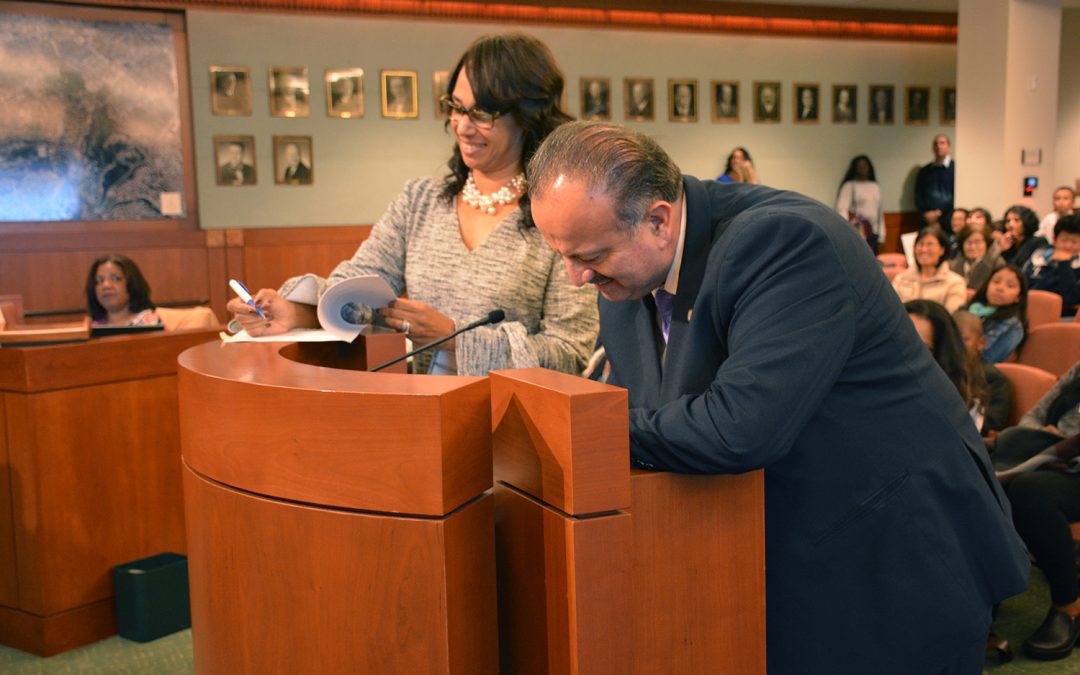
The AB 288 agreement, signed at the Culver City school board meeting Jan. 23, allows students to take classes provided by West L.A. College at Culver City High School and Culver City Park High School, to earn college credit. Those classes will fulfill both diploma and college degree requirements and will be offered tuition-free.
“We are very excited about this new AB 288 partnership that allows our students to take dual enrollment classes and earn high school and college credit simultaneously,” Culver City school Superintendent Leslie Lockhart said. “This is yet another way that we can offer students a chance to follow their career goals and get a head start right on our high school campuses.”
“Reaching them where they are is critical to helping our young people connect to college and succeed in higher education and the workplace,” said Sydney Kamlager-Dove, president of the Los Angeles Community College District Board of Trustees. “This partnership reduces barriers to entry by allowing high school students to become comfortable with college processes from the familiar place of their high schools, and it’s tuition free — that’s a win-win for all.”
“This demonstrates how both institutions working together can capitalize on their strengths to increase access to college and meet the needs of students in the communities we serve,” LACCD Chancellor Francisco Rodriguez said. “I look forward to more of these signings across our nine colleges.
“West L.A. College has offered concurrent enrollment courses at Culver City High for years,” said Aracely Aguiar, the college’s vice president of academic affairs. “Through the AB 288 partnership, classes can be offered as dual enrollment for high school students to get high school and college credit simultaneously. Working with Culver City Unified, are creating pathways in computer science, technical production for theater, and architecture that lead to employment.”
“In one year, West Los Angeles College will celebrate its 50th year.” college President James M. Limbaugh said. “If you know anything about the college’s history, you know that Culver City’s residents and school board were instrumental in the establishment of this campus that serves Culver City, West Los Angeles and other surrounding communities.
“So we are particularly pleased and excited to be entering into this agreement that expands our partnership with the outstanding Culver City schools.”
Assembly Bill 288 was signed by Gov. Jerry Brown in October 2015. Introduced by Assemblyman Chris Holden, D-Pasadena, it allowed community colleges and nearby school districts to enter agreements for the purpose of offering or expanding dual enrollment opportunities for students who may not already be college bound or who are underrepresented in higher education, with the goal of developing seamless pathways from high school to community college for career technical education or preparation for transfer, improving high school graduation rates, or helping high school pupils achieve college and career readiness, according to the state Chancellor’s Office.
THE CHRONICLE — WASHINGTON (NNS) — The Navy joins the nation in celebrating the history of African American Sailors and civilians during African American/Black History Month, Feb. 1-28.
This year’s theme is “African Americans in Times of War,” which recognizes the contributions African Americans have made to the nation during times of war from the Revolutionary War to present-day conflicts.
ALNAV 007/18 encourages commands to participate in heritage celebrations and special observances throughout the year that honor the contributions, unique histories and cultures Navy’s diverse Sailor and civilian team.
This month’s observance has its origins in 1915 when historian and author Dr. Carter G. Woodson founded the Association for the Study of Negro Life and History. Dr. Woodson and the association initiated the first Negro History Week in February 1926. Every U.S. president has officially designated the month of February as National African American/Black History Month since 1976.
“We should celebrate our unique backgrounds because each Sailor brings something different to the fight and this makes us a stronger, more lethal team,” said Rear Adm. John Fuller, commander of the Carl Vinson Strike Group and one of Navy’s African American flag officers. The strike group is currently deployed to the Western Pacific.
African American Sailors and civilians play an integral role in the success of the Navy as part of the One Navy Team. African Americans serve in every rank from seaman to admiral and perform duties in nearly every rating in the Navy. Currently, African Americans make up 17 percent of all Navy personnel, or roughly 64,000 Sailors. This includes more than 58,000 enlisted and 5,000 officers. Further analysis shows 17 percent of E-8 and E-9 Sailors are African Americans that hold a range of leadership positions. Nearly four percent of flag officers are African American Sailors.
A breakdown by gender indicates there are currently over 45,000 African American males and more than 18,000 African American females currently serving in the Navy.
“Those serving today owe our success to the veterans who transformed our Navy into a more diverse force,” said Fuller.
According to the September 2016 “One Navy Team” memo from Chief of Naval Operations Adm. John M. Richardson, actively being inclusive and open to diverse perspectives will produce leaders and teams who learn and adapt to achieve maximum possible performance, and who achieve and maintain high standards, be ready for decisive operations and combat.
Diversity also influences various thoughts, ideas, skill sets, and experiences which ultimately helps increase the effectiveness of the Navy. Integrating Sailors and civilians from diverse backgrounds enables the Navy to recruit and retain the nation’s top talent from a wide pool of skilled personnel.
The Navy supports minority youth development and encourages the pursuit of careers in science and industry through science, technology, engineering and math (STEM) programs. The Navy also partners with organizations including the National Naval Officers Association, the National Society of Black Engineers, and Historically Black Colleges and Universities (HBCU) in support of African American service members and civilians.
A complete educational presentation, including a downloadable educational poster on African American/Black History month, can be requested from the Defense Equal Opportunity Management Institute (DEOMI) by email at deomipa@us.af.mil.
WAVE NEWSPAPERS — COMPTON — Celerity Achernar Charter School was given a much-needed exterior makeover Jan. 27. Housed in a part of the city that can be considered dreary and industrial, peppered with auto repair shops and residential houses, the school brightened its surroundings with a colorful call-to-action piece of artwork.
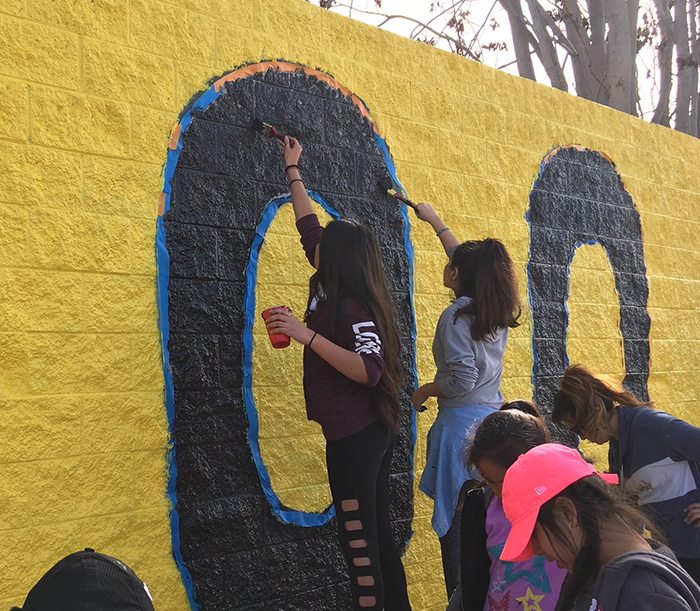
Beautify Earth, a nonprofit whose mission is to put an end to blighted walls by empowering artists, encouraging social responsibility and instilling community pride in impoverished or neglected neighborhoods, hosted more than 100 volunteers and students at a painting party. Equipped with bright colored enamel, paint brushes, roller pins, ladders, painter’s tape, gloves and upbeat music, mural artist Ruben Rojas taught eager volunteers how to paint the wall outside of the school’s playground in neat letters that spelled out Just Do Good.
“All we ask is that you bring your energy, your giving spirit, sense of community and we’ll show you the rest,” Rojas said. “The best part about painting murals is the different hands involved with the final picture. It warms my heart to see people giving of themselves to making their community, this school, a better place then when they left.”
The Beautify Earth education project seeks to create positive environments through inspirational murals, instructed by professional artists, offering a hands-on approach for participants to express their creativity as well as learn new techniques.
The common thread between the volunteers was that one person doing something could make a huge difference. Mothers came with babies, fathers with their daughters and teachers with their students, all in an effort to do something to directly beautify their community.
“There is a lack of goodness around here and we could use more of it,” volunteer Zee Johnson said. “One person can make an impact and as they say, living is giving. You can take, take, take or you can start to give. Why do I volunteer? Because I know that I have to do my part.
“I can’t think of a better way to be active in change,” Johnson added. “Once you’ve put some work into building something or creating a lasting mural, you take more pride in your surroundings. It becomes contagious.”
Included in the makeover were the lines on the basketball court which got brisk strokes of improvement by the steady-handed members of the Compton Initiative, another participating nonprofit whose mission includes the physical restoration of Compton homes, schools and churches.
“I’m out here volunteering because this is my school,” said Rico Sanchez. “I’m an eighth grader here so what I’m doing right now is helping me and my friends.
“I never realized how many people even cared about us to come and do this.”
Since 2006, the Compton Initiative has beautified more than 550 homes, 372 buildings at 30 schools, 35 church buildings, 31 public spaces, two medical clinics and 134 murals.
“I volunteer because everyone has to do their part,” Sumby Kuti said. “If people just show up and do their part, we’ll be in a much better position.
“I’m so glad that so many people showed up today. That’s the start.”
The Bureau of Labor Statistics, under the U.S. Department of Labor, conducted a survey in 2015 that showed more than 62.6 million people provide some type of volunteer service; the first being of service to a religious sector and the third is for their community. People choose to volunteer for a variety of reasons.
For some, it offers the chance to give something back or make a difference to the people around them. For others, it provides an opportunity to develop new skills or build on existing experience and knowledge.
For this group of painters, it was about beautifying Compton.
“Compton is one of the most underserviced communities in Los Angeles so to say that this community needed it is an understatement,” Neal Bledsoe said. “I believe it is my duty to take part in making this neighborhood beautiful again. Why not take the power back?
“We have to realize that we all live in the same city and although L.A. is still very divided, I’m here today planting that seed that I hope will grow so that others will join me and come together. When you stand on the other side of the street or turn that corner and see this mural, you can’t help but feel some kind of pride.”
THE CHICAGO CRUSADER — Did you know that there are 400,000 black men who have master’s degrees? I didn’t think so. That was just one of the many things I learned at a book signing and discussion of the newly released Guide for White Women Who Teach Black Boys.
Organized by RIISE, or Resources in Independent School Education founded and led by Gina Parker Collins, the event brought together independent school parents as well as educators and administrators to hear and participate in a powerful discussion.
Unfortunately, most of the narrative around black men is deficit focused, and the stereotype is what many believe.
The National Newspaper Publishers Association’s ESSA Awareness Campaign is focused on informing and engaging parents, educators, elected officials and opinion leaders about efforts and policies aimed at closing achievement gaps for students of color and low-income students.
Poverty is the worst form of violence. — Mahatma Gandhi
Poverty is like punishment for a crime you didn’t commit. — Eli Khamarov
Poverty is brutal, consuming and unforgiving. It strikes at the soul. — Charles M. Blow
Last August, I introduced the first column in a six-part series declaring that “poverty is not a character flaw,” but rather a math problem (and so much more). The math problems identified during the course of the series focused on America’s substantial inequities in employment, education, housing and transportation.
Then, in the final column, I began to explore the idea that, in addition to being a math problem, poverty is “so much more.” Poverty is an unrelenting assault on humanity, a wicked scourge that can have a decidedly detrimental effect on the health and wellness of those caught in its steely grasp.
In this new six-part series titled “We already know that poverty is a math problem. So, what else is it?” I will explore the impact that poverty has on the physical, psychological, emotional and spiritual well-being of people.
The series will conclude with an attempt to tackle Ruby K. Payne’s intriguing notion of the hidden rules among classes, which she describes as “the unspoken cues and habits of a group.” She adds that here in the United States, such a concept is often “recognized for racial and ethnic groups, but not particularly for economic groups.”
Still, before I begin to address these issues over the next couple of months, I would like to briefly discuss some of the inherently unique obstacles that people living in poverty face, which are generally unbeknownst to others. I am reminded of a passage from James Baldwin’s essay “Fifth Avenue, Uptown,” where he writes:
“Anyone who has ever struggled with poverty knows how extremely expensive it is to be poor, and if one is a member of a captive population, economically speaking, one’s feet have simply been placed on the treadmill forever.”
A half-century after these words were composed by the legendary writer and activist, New York Times Op-Ed columnist Charles M. Blow revisited Baldwin’s assertion, noting that while its “original intent” was related to monetary matters (namely paying more for lesser goods), he has personally “always considered that statement in the context of the extreme psychological toll of poverty.”
To his point, consider some of the decisions people in poverty make that others couldn’t bear to imagine, like choosing between buying food, paying the light bill, or purchasing prescription medications. In fact, the threat of unexpected costs or the potential of a personal or family crisis likely figures in every choice made by those below the poverty line.
The truth is that poor households don’t have the luxury of planning for the future. For those in poverty, sometimes the day’s only objective is to survive into tomorrow.
These are just some of the reasons that the life expectancy of someone who is poor is 10 to 15 years less than someone who is not. Or why many in poverty are forced to find more than one job, often working longer hours than most and performing back-breaking work for insufficient pay. Far too many of our fellow citizens live in substandard housing, can’t find or afford nutritious food, lack access to quality health care, and are consigned to underfunded public schools.
The stress of poverty, as demonstrated by a number of recent studies, plays havoc with the physiological, psychological, emotional and spiritual health of millions of Americans each and every day. Pure and simple, poverty is violence and it should not stand.
As Dr. King famously said upon winning the 1964 Nobel Peace Prize, “I have the audacity to believe that people everywhere can have three meals a day for their bodies, education and culture for their minds, and dignity, equality and freedom for their spirits.”
Yes, indeed.
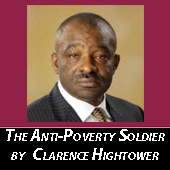
Clarence Hightower is the executive director of Community Action Partnership of Ramsey & Washington Counties. Dr. Hightower holds a Ph.D. in urban higher education from Jackson State University. He welcomes reader responses to 450 Syndicate Street North, St. Paul, MN 55104.
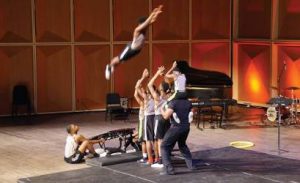
[/media-credit] O.N.F.Y.A.H. African dance and drum ensemble.
MILWAUKEE COURIER — Thousands gathered at the Marcus Center of Performing Arts on Sunday, Jan. 14 to celebrate the life of Dr. Martin Luther King, Jr. From 1 pm to 3 pm, local elected and community leaders gave speeches on Dr. King’s legacy, and Milwaukee Public School students delivered speeches and displayed artwork inspired by Dr. King.
Other than Atlanta, Milwaukee is the only other city that has celebrated Dr. King’s birthday since 1984. Each year, Milwaukee Public Schools students in grades K-12 participate in an art, essay and writing contest that honors Dr. King’s legacy. This year’s theme was “take a stand for truth and justice.”
[/media-credit] Milwaukee Flyers Tumbling Team.
MPS Superintendent Dr. Darienne Driver was one of the communityleaders who spoke this day.
“We have had 5,000 students participate in the preliminary contest, and 56 won,” she said. “Our young people are finding ways to get active in our community.”
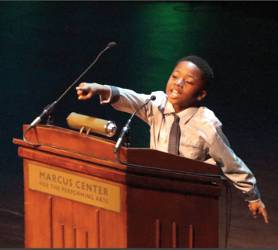
Amir Johnikin, grade 3, was the first place speech winner for the 3-4thgrade category. He attends Elm Creative Arts Elementary School. Without a paper in his hand, he was one of the first to share his entire essay on stage. He stated that the same streets that Dr. King marched were the same streets where his father’s life was taken. He also mentioned African Americans like Sandra Bland, who died at the hands of police officers.
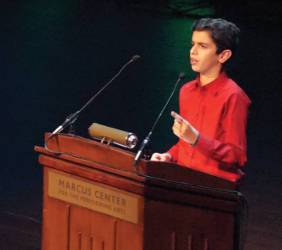
[/media-credit] Ameen Atta, winner of the 9-10th grade speech category speaks against the racism he has experienced as a Muslim.
“King had a dream that people of all races would co-exist in peace,” he said. “I challenge you to stand up for what you believe in, I challenge you to stand up for justice, and I challenge you to stand up for truth.”
Tenth grader Ameen Atta feels especially passionate about the theme when it comes to Islam. Atta won first place in the 9-10th grade speeches category.
“As a Muslim, I stand against violent, senseless acts against Islam,” he said.
He also said that it is “disgusting” to hear “hateful remarks and proposals by leaders of our community.”
“If it’s African Americans, more police. If it’s Hispanics, build a wall. If it’s a Muslim, travel ban,” he said. “But if it’s none of the above, even if the person is the deadliest mass shooter in the history of our country, the only proposal is to send thoughts and prayers to the victim.”
[/media-credit] Amir Johnakin, winner of 3-4th grade speech category challenges the audience to stand up for justice.
Mayor Tom Barrett was one of the first to speak when the event began. He believes that although Dr. King has helped bring social and racial justice to our country today, our current president is not doing so.
“Rather than having an individual who is appealing to our better angels, we have someone who is not appealing to our better angels but to our lesser angels,” he said.
In addition to contest winners, Milwaukee Tumblers, O.N.F.Y.A.H, United Indians of Milwaukee and Latino Arts Strings performed during the multi-cultural salute portion. After the event ended, the art winners were honored in a reception at the Bradley Pavilion.
OAKLAND POST — Laney College’s latest tiny home prototype will house two homeless students beginning this spring semester.
Laney College carpentry presents the Pocket House at Capitol Hill. Right to left: Digital fabrication instructor Marisha Farnsworth, Laney student Kim Gordon, Congressperson Barbara Lee, Laney students Daniel Ticket, Miguel Vega, and Rick Rothbart.
Laney’s carpentry department has achieved success building tiny homes. They won a contest hosted by Sacramento Municipal Utility District for a tiny home they built in 2016. Councilmember Abel Guillén spearheaded a collaboration between the City of Oakland and their department with an $80,000 grant to Laney carpentry to build a tiny home prototype for mass production.
The latest model of the Laney-made tiny homes is the Pocket House Model M. It was delivered to West Side Missionary Baptist Church by Martin Kauffman, a truck driver who donated his services.
Art Ramirez is an electrician who will also donate his services to get the tiny home’s water and electricity up and running.
Rev. Ken Chambers said the 200-member Interfaith Council of Alameda County supports this project, and has a goal to house 1,000 people this year.
But the first step is to work with Laney coordinators to interview and select students in need of the home each semester. The parking lot the tiny home sits in is already a safe car park, and Chambers is taking steps toward being able to pay a stipend to the selected students for overseeing the lot. The church will also offer access to health and employment services.
Chambers hopes to create a system that can be replicated throughout Oakland and have a deep impact on the unsheltered communities it holds.
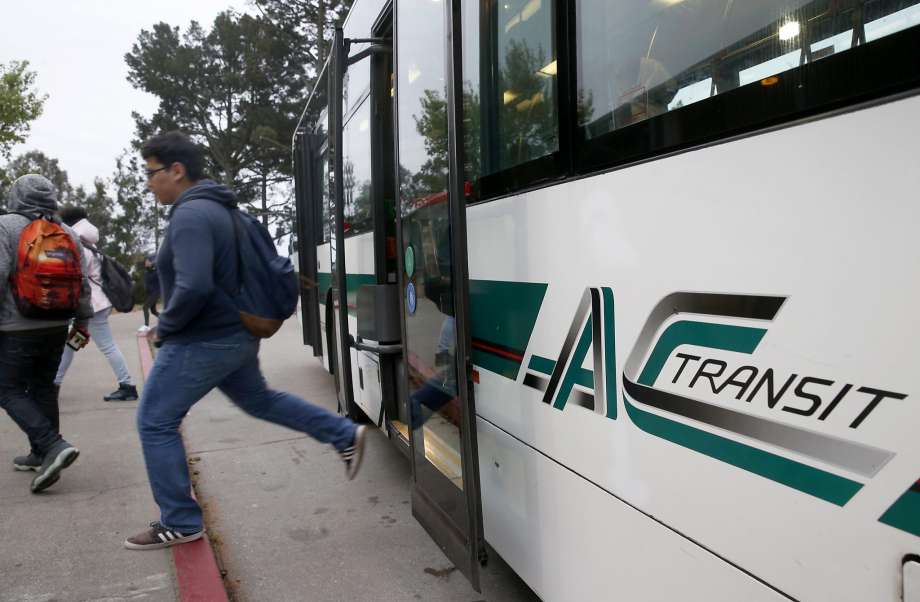
THE OAKLAND POST — The Oakland Unified School District and AC Transit have announced that bus transportation service to Montera Middle School, Skyline High School and Community Day School will be extended through June 2019.
“This extension gives our families assurance of both agencies’ commitment to support their transportation needs and to find solutions together,” said Board of Education Member Nina Senn.
Finding a longer-term solution will take time and an extension into 2019 gives us breathing room to do so,” she said. “We are very grateful for AC Transit’s and our state legislators, Senator Nancy Skinner, Assemblymembers Rob Bonta and Tony Thurmond’s … partnership and collaboration as we work through this process.”
Said AC Transit Board President Elsa Ortiz, “AC Transit is proud of our decades-long partnership with OUSD and honored to know that our service will remain a passport for East Bay students.
“In collaboration with OUSD, we devoted the past year to developing cost savings that minimized changes to ‘school-tripper’ bus lines, while working with stakeholders on the financial commitments that now protect supplementary bus service through the close of next school year,” she aid.
Twenty-five African American high school students from Atlanta are heading to Harvard this summer as part of the Harvard Debate Council’s residential summer program.
The Art Institute of Atlanta, where the surprise announcement was made, awarded the students $10,500 in scholarship money to attend the prestigious program. An additional $88,000 needs to be raised to support the students’ tuition, room and board, and travel. Donate here.

 WAVE NEWSPAPERS — CULVER CITY — It will be easier than ever before for Culver City high school students to earn college credit right on their own campus thanks to a new agreement with West Los Angeles College to offer college and career access pathways through dual credit courses in computer science, technical production for theater, and architecture.


 By Robin White Goode, blackenterprise.com