THE CHAMPION — More than 85 percent of black male fourth-graders in the United States are not proficient in reading, according to the 2013 U.S. Department of Education Nation’s Report Card. A program recently instituted by the DeKalb County Public Library (DCPL) will attempt improve that number by bringing books into the barbershop.
Barbershop Books is a national program designed to bring books written for children ages 4 to 8 into barbershops so they can begin to identify as readers.
DCPL is the first Barbershop Books sponsor in Georgia and has one barbershop—ITNOJ Barbershop in Scottdale—on board as a host site. And DCPL is doing everything it can to make the program a success.
“We wanted our barbershops to just be a host site, and we would take care of everything else. So we purchased the bookshelf and we also purchased the books that go on the shelf,” Teresa Totten, DCPL adult programming and services coordinator told The Champion. “Going forward, whenever they need to replenish the shelf with books, that’s our job.”
Why would the shelf need replenishing? Because the library is allowing readers who like a particular book to keep it.
“If they see a book, if they pick up a book and they really love that book, we told the shop owner to let them have it,” Totten said.
ITNOJ Barbershop owner Todd Cofield told The Champion the program has been well-received in his shop.
A small shelf sitting along the wall next to the barber chair inside ITNOJ has books aimed at elementary school-aged children, but both Totten and Cofield want to see the program grow beyond its intended limits.
“We expanded [the age range],” Totten said. “We want to cover zero to adult, because we really want to encourage everyone to read. We also tell adults, if you’ve got a little one with you who’s not at an age where they can read yet, read to them. We just want to create that space of community reading in the barbershop.”
Cofield, who grew up in a house with six siblings who all read together as a family, knows the power of reading. He wants to encourage a sense of a reading-based community in his shop. He said he hopes to soon have a larger shelf of books aimed at children of all ages, and add computer terminals, so school-age children can do research and work on homework.
“I want this to be a place where anyone can come and learn and grow,” he said.
And Cofield’s ambition has the full support of DCPL. Though the library won’t be involved in anything outside of providing books for the shelf, it’s already working to provide books for older audiences and has plans to expand the program to three more DeKalb County barbershops by the end of January.
DCPL also has the full backing of the DeKalb County Library Foundation for any funding it may need to grow the program as large as it can become.
“We’re gonna start with just the four locations and see what the demand is,” Totten said.
DCPL will work with host sites to track frequency of replenishments, specific demands for books and other feedback from children and parents who use the program to try to hone it to the specific audience in DeKalb County as much as possible.
“We’re also thinking we might want to have at least one location in a salon,” Totten said. “We want our little girls to read too.”
Totten said she hopes to launch a salon location in the first quarter of this year, possibly as early as February.
Cofield hopes the program expands into all areas of DeKalb County.
“Most people want to raise their children and they want to do right,” he said. “We’re really the same people raised with different belief systems, but morally, we want to do the same thing.”
Though he sees the goals as congruent, he said there aren’t enough people in his community willing to take matters into their own hands to make those goals a reality. He hopes Barbershop Books can be one tool to change that.
“Especially in the African-American community, we wait on the church to do stuff for us,” he said. “But we’ve got to be the church. We’ve got to make the change come. And the first thing you need for change is knowledge. You need knowledge.”
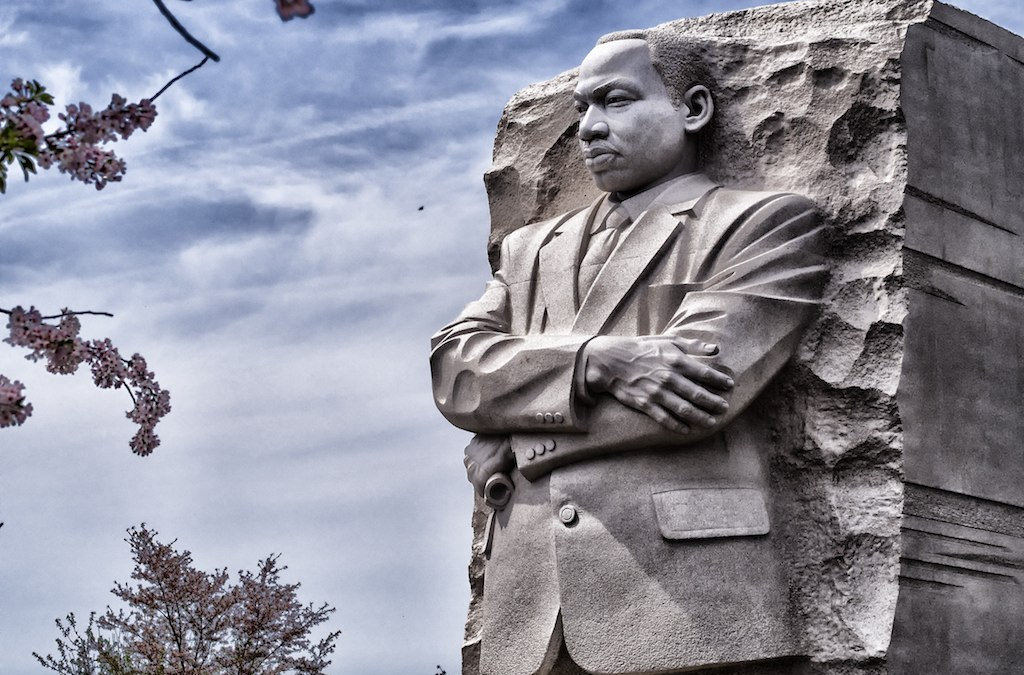
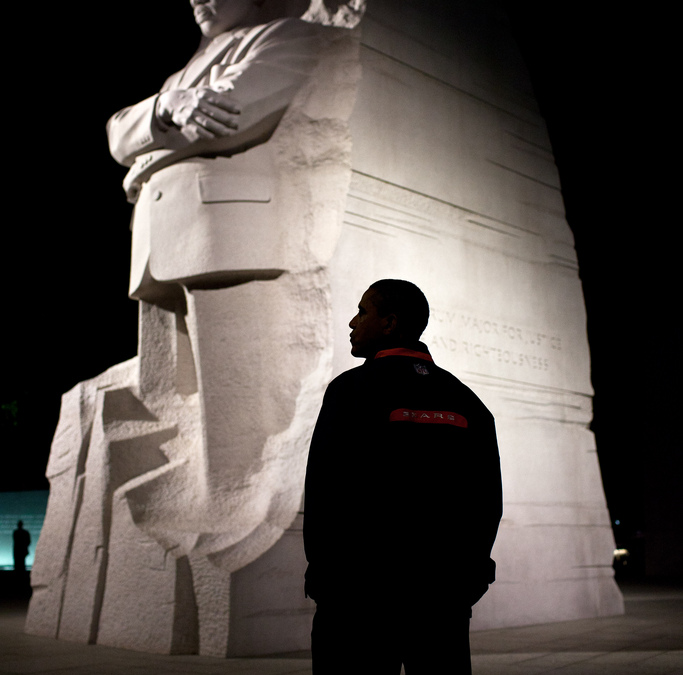
NORTH DALLAS GAZETTE — While the nation remembers Dr. Martin Luther King, Jr. on Monday, nearly 50 years after his assassination, former Civil Rights Activist Rev. Dr. DeForest B. Soaries, Jr. will close out the Urban Specialists MLK Day “Course Correction Conversation” event in Dallas by calling for a new leadership that unifies our nation one neighborhood at a time.
[/media-credit] Rev. Dr. DeForest B. Soaries, Jr. is scheduled to speak Monday evening at MLK Day event in Dallas.
This event will bring together victims of violence, public figures, lawmakers and the community for an honest, open discussion about the widening divides in America and how we can reunify our country.
“This event exemplifies what Dr. King’s legacy is all about. This movement is so imperative to the African American community because Urban Specialists and Bishop Omar Jahwar are fighting to make just as much an impact, if not greater, on senseless violence as Dr. King did for equality and social justice. Fifty years later, our number one problem is violence,” says Rev. Soaries, former national coordinator of Operation PUSH. “Those who are most effective in stopping violence are those who once inflicted violence, working with locked arms along side of those that have been victims of violence.” Soaries plans to commend the anti-violence leaders for the work they are doing in Dallas, New York, Chicago, Baton Rouge, Baltimore, Atlanta and Indianapolis that will attend this event. He will liken them to the local 1960’s leaders that were peers and colleagues in the Civil Rights Movement.
Urban Specialists (US) leverages the experience of ex-gang members, former offenders, and professionals to reduce gang violence and increase community opportunities in Dallas. Sponsored by Stand Together, this event will provide a safe environment for dialogue in hopes of ending senseless violence and revitalizing citizenship in the spirit of Dr. Martin Luther King, Jr.
“Healing begins when we stop shouting at each other and start listening to each other,” said Bishop Omar Jahwar, Founder and CEO of Urban Specialists. “I have learned through my work and experience, it is possible for youth to stay alive and thrive in a hostile environment.”
Rev. Soaries will be the close out speaker of the event. Also participating in the “Course Correction Conversation” will be former NFL player and Hall of Famer Deion Sanders and singer, songwriter and producer Rico Love. The family of the late Alton Sterling, a 37-year-old black man, who was shot several times at close range while held down on the ground by two Baton Rouge Police Department officers in Baton Rouge, Louisiana will also attend the event.
MINNESOTA SPOKESMAN-RECORDER — Dr. Rev. Martin Luther King Jr. gave his famous “I Have a Dream” speech at a time where the words he spoke were radical, important, and needing to be both heard and said. Fifty-five years later, we still have so much farther to go.
I echo Dr. Martin Luther King Jr.’s words — 55 years later; our communities are still not free. We are still fighting against economic disparities, unequal pay for work, and an achievement gap that is hurting the youngest of us. But, I also echo Dr. King’s words when I say I have a dream. I have a dream for our community that lifts up all of us:
[/media-credit] Senator Bobby Joe Champion
A dream of better opportunities for employment — for an environment where local businesses can thrive and hire community members for jobs that pay a living wage.
A dream of better education for all of us — from our youngest students to the people who never thought they would make it to college, to those that have earned a degree and are returning to our communities to give back to the people that gave so much to them.
A dream of stronger relationships with our police force, and of an unwavering commitment from our public safety officers to protect and serve all of us.
A dream of true equity that moves our entire community forward, that moves all of Minnesota forward.
This continues to be our hope, and it is the hope that I carry with me to my work in St. Paul. As we head into session, I will carry these dreams with me and I will work as hard as I possibly can to make them a reality, to make our community proud, and to make our city and our state a remarkable place for everyone.
MINNESOTA SPOKESMAN-RECORDER — “We have also come to this hallowed spot to remind America of the fierce urgency of now. This is no time to engage in the luxury of cooling off or to take the tranquilizing drug of gradualism. Now is the time to make real the promises of democracy.” – Dr. Martin Luther King, Jr., quote from his “I Have a Dream” speech, August 28, 1963.
Tina Burnside
Most people only remember the last lines of Dr. Martin Luther King, Jr.’s famous “I Have a Dream” speech. But the quote above, also from that same speech, is what I want to focus on in thinking about the future of the City of Minneapolis and the State of Minnesota.
Our community, city and state face serious problems of poverty, racial inequality and economic disparity. Minnesota ranks as the second-worst state for racial inequality for Black people with glaring disparities in which Blacks are incarcerated at higher numbers, have lower incomes, higher unemployment, and lower home ownership than Whites.
We can no longer take the “luxury of cooling off” to study the problem. We already know there is a problem. What we need are real solutions. Policies must be crafted in partnership with business, government and the community. This partnership must include Black voices and leadership.
We can no longer create solutions without listening to the people who are experiencing the problems, and we can no longer tell Blacks and other people of color that change must come gradually, or to wait.
It is 2018 — 55 years after Dr. King delivered his famous speech. As Dr. King said, we must be reminded of the urgency of now. There is no time to “cool off” or proceed gradually. Now is the time to make the promises of democracy a reality and not just a campaign slogan, soundbite or hashtag.
Tina Burnside is a civil rights attorney and writer.
MINNESOTA SPOKESMAN-RECORDER — “He who passively accepts evil is as much involved in it as he who helps perpetrates it. He who accepts evil without protesting it is really cooperating with it.” —Rev. Dr. Martin Luther King
[/media-credit] Andrea Jenkins
What is evil in this world? Racism, sexism, poverty and war. These are the evils that I am concerned about, protest about, and work each and every day to eliminate.
Last month, I had the amazing opportunity to visit the Smithsonian Museum of African History, in Washington D.C. with my family. When you enter the building you embark onto a large elevator that holds about 75 people, and it’s not until you go down three and half stories that you realize it was designed to replicate the feeling of being crammed into a slave ship. Then you actually enter the bowels of a replicated slave ship; I tried holding back the tears, and did for a while.
The journey goes through slavery, the Civil War, and reconstruction (which is where the tears began to fall). I learned that during this period there were many Black elected officials all over the country, prolific in the South. Blacks (more than 100 Blacks held public office after the Civil War) served on city councils and as state legislators, and there were mayors, congressmen and U.S. Senators.
Having recently been elected to serve on the Minneapolis City Council, it really hit me hard what an enormous responsibility I have taken on. Because about five years after the Civil War, the KKK was born, and gerrymandering and voter suppression through violence created an environment that made it impossible for Blacks to continue to build political power.
Each generation has a responsibility to move human history forward. Witnessing the journey that African Americans have been on since arriving on the shores of the Atlantic Ocean was a deeply moving moment. We have consistently, persistently and diligently tried to bring America closer to realizing the true meaning of its creed.
Those hopes, dreams and prayers were manifested in Dr. King’s life and work. But the work continues, and this is the vision I have for our “Beloved Community.”
“Reconstruction,” in Encyclopedia of African American Culture and History. v.4. New York: Macmillan Library Reference USA, 1996.
MILWAUKEE COURIER — On Tuesday morning, Ha Ha Clinton-Dix arrived at Benjamin Franklin Elementary to launch his foundation’s first ever HERO Headquarters. He was welcomed by students and teachers alike with cheers, excitement and, above all, a sense of appreciation.
“It’s a dream come true,” Clinton-Dix said. “[I get] to be an icon kids look up to in school, not just football.”
Clinton-Dix plays football for the Green Bay Packers. Currently, he’s their safety and sports jersey number 21. In addition to playing in the national league, he’s in his senior year of college and attends the University of Alabama, where he’s studying criminal justice according to ESPN.
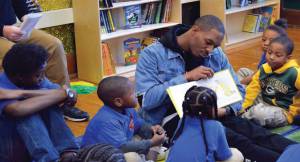
Ha Ha Clinton Dix, read students a book while sitting in the HERO Headquarters.
It’s clear that education is a priority of his and he’s working hard to make it others too. He recently started the Ha Ha HERO Foundation which aims to provide students who face economically challenged lives with the proper resources and motivation to continue their education and lead positive lives, according to the foundation’s website.
As part of the initiative, the foundation and its sponsors, Quarles & Brady and Houghton MifflinHarcourt (HMH), reached out to schools to bring a HERO Headquarters to them.
Ha Ha’s HERO Headquarters is the name allotted to the room or space the foundation revitalizes. In the case of Benjamin Franklin Elementary, they found a storage room and turned it into an “oasis” for reading. There are roughly 600 books, bean bag chairs and other resources designed to create a peaceful atmosphere.
“Reading has always been a passion of mine,” he said.
HMH provided the books and gave an additional to each child as a gift, as part of their efforts to promote, “lifelong learners.”
During the launch, Clinton-Dix spoke to the students about the importance of education. As they waved their yellow and green pom-poms he told them how he was once like them.
He explained that as a child he didn’t put a lot of effort towards his education, instead he played the role of class clown, assuming he’d catch up on school “later on.”
When later finally came, Clinton-Dix found himself struggling. He wished someone had pushed him harder like how he’s pushing younger generations.
Clinton-Dix managed to secure a spot at the University of Alabama, and learned how to balanceschool work and football.
“I had to prove myself,” he said, “as a football player and a student.”
Katie Perhach, from Quarles & Brady, stressed how Clinton-Dix is “truly providing the spark” these students need. In addition to providing resources, he’s a good role model.
“You are a leader on the football field and off the football field,” Perhach said.
As promised, Clinton-Dix played several games of tic-tac-toe with the students.
As part of the event, Clinton-Dix also read to a select group of students Curious George Joins The Team, where George plays games with his friends. This resulted in a few matches of tic-tac-toe of Clinton-Dix versus various students.
Principal Sara Hmielewski likewise expressed her gratitude to Clinton-Dix. She’s looking forward to seeing the progress the children make and is happy Clinton-Dix can be their icon.
“Just get reading,” she said, “We need to have our students reading.”
Before the students returned to class, Clinton-Dix sat down on the carpet in the HERO Headquarters, answered their questions and gave them advice.
“I had a dream, I had a goal, I had somewhere I wanted to be,” he said.
He also told them to listen to their teachers, attend class on time, stay focused, stay dedicated, be respectful and “be the best you can be.”
He knows better than most, just how far their education can take them.
“One day I know football will end,” he said, “but my education and degree will never be taken away from me.”
In this upcoming year, Clinton-Dix plans to not only finish his education but open two more HERO Headquarters which will continue encourage kids in years to come.
MILWAUKEE COURIER — When Dr. Martin Luther King Jr. helped organize the Montgomery Bus Boycott, he was not hoping to win a Nobel Peace Prize.
When his family was in danger and their house was bombarded with bottles and flames, having a street named after him wasn’t even a thought.
When he marched amongst thousands and gave his monumental “I have a Dream Speech,” he wasn’t speaking to go into the history books.
Dr. Martin Luther King Jr. fought for peace and justice in a country where freedom rang, yet separate but equal was the norm.
There were plenty of people that wanted to kill him and the other “colored folk” reversing the racist tides of Jim Crow, yet he worked until the last seconds his life was taken.
In 1983, Martin Luther King Jr.’s birthday became a national holiday. The day is observed every third Monday in January, and it focuses on keeping King’s legacy alive. The day is meant to teach our youth about the strides we have made and the struggles we still face, and to celebrate Dr. King’s life and legacy.
Just as Milwaukee’s own Dr. Martin Luther King Jr. Drive inches closer and closer to its full potential, it is a beacon of hope for other neighborhoods in the city that also emit positive energy for long-awaited change.
As for MLK Day 2018, there are several meetings and events scheduled across Milwaukee, which happened to be one of the first cities to originally celebrate the National holiday.
Some are using the day to celebrate, others to educate and also to congratulate.
The Marcus Center for the Performing Arts will be hosting the 34th Annual Dr. Martin Luther King Jr. Birthday Celebration on Sunday, Jan. 14. The program will take the stage at Uihlien Hall and highlight the communities’ youth, who every year interpret Dr. King’s words through an art, speech and writing contest.
Other organizations celebrating include: United Indians of Milwaukee, Latino Arts Strings, Milwaukee Flyers Tumbling Team, O.N.F.Y.A.H, MPS’ Milwaukee High School of the Arts Jazz Ensemble and more. The event will conclude with the Paulette Y. Copeland Reception in Bradley Pavilion.
The MLK Library will host a day’s worth of family friendly events including: arts and crafts, voter rights presentations, and live events like spoken word poetry with Kavon Cortez Jones and traditional African dance with Ina Onilu Drum and Dance Ensemble.
The Milwaukee YMCA will host the largest Dr. Martin Luther King, Jr. Day event in Wisconsin. The 21st Annual Celebration Breakfast in honor of Dr. Martin Luther King, Jr. brings together elected officials, advocates and the community to celebrate those pushing the envelope for change and opening doors for everybody in every community.
“Today we celebrate those who have demonstrated a longstanding commitment to making our community a better place for all. Now more than ever the spirit of community service can help heal our differences through a common cause—giving back and strengthening the places where we live, work and play is something we all can agree on,” said Shaneé Jenkins vice president, social responsibility & strategic partnerships for the YMCA of Metropolitan Milwaukee.
Both the Hunger Task Force and Employ Milwaukee will be honored for their longstanding commitment to making the city a better place for all by supporting health, wellness, diversityand inclusion.
The breakfast program will also recognize the winners of this year’s Dr. Martin Luther King, Jr. Spoken Word Contest. The three finalists in each age category (5-9 years, 10-13 years and 14-18 years) were selected after writing an original spoken word piece based on the theme, “We must learn to live together as brothers or perish together as fools.”
DEFENDER NEWS NETWORK — Believing that “black is beautiful,” an important mantra of self-acceptance and self-love, could pay major dividends in school, a new study finds.
An article in the Journal of Blacks in Higher Education focuses on a new study from Sheretta Butler-Barnes, a professor at Washington University in St. Louis, which finds that young black women with “strong racial identity” are more likely to be academically engaged, curious and persistent.
The survey looked at 733 black middle and high school girls in “three socio-economically school districts in the Midwest,” according to the JBHE.
The study, “Promoting Resilience Among African American Girls: Racial Identity as a Protective Factor,” was published on the Child Development journal website and found that feeling positive about being black, along with feeling supported by their schools, correlated with the girls’ greater academic motivation.
Researchers also found that feeling good about your racial identity could act as a buffer for students in “hostile or negative” academic environments.
“Persons of color who have unhealthy racial identity beliefs tend to perform lower in school and have more symptoms of depression,” Butler-Barnes noted.
“We found that feeling positive about being Black, and feeling support and belonging at school, may be especially important for African-American girls’ classroom engagement and curiosity,” Butler-Barnes added. “Feeling connected to the school may also work together with racial identity attitudes to improve academic outcomes.”
That study’s findings appear to support another recent study, from the University of Washington, which found that cultivating pride in black culture and identity led one group of girls at a Seattle-area middle school to express greater confidence. More than that, both the girls and their teachers reported a stronger connection to their school and greater involvement.
As the University of Washington website notes, the participants in the study took a 12-week course that combined mindfulness teachings with a cultural-enrichment curriculum. Not only did the girls identify more strongly with their black heritage, but their positive feelings toward other black people also increased significantly.
This cultural pride translated to stronger “humanist” beliefs among the girls—“a belief that they fit in with people of all races, that their racial heritage has value in society and that their race should not exclude them from being part of the larger community,”according to the UW website.
The study’s author, Janine Jones, who heads UW’s psychology program, notes that “there are a lot of girls who check out in school when they feel like they’re not seen, not understood or invested in by school personnel. There are a lot of negative perceptions of African-Americans, and the perception they receive is that it’s not a good thing to be black.”
Jones continued: “We may think it’s easier to avoid it than to address it. But if we start addressing oppression by countering it with the humanness of who these kids are, we’re more likely to keep them engaged and feeling a sense of belonging.”
LOS ANGELES WAVE — It’s pretty cool to have an international star athlete pay a visit to your school. It’s downright awesome if you can get more than one world-class athlete to show up and hang out with you while you’re getting your exercise in.
The students at Trinity Street Elementary School looked like they were having the times of their young lives when Olympic star Rosalyn Bryant (now Rosalyn Clark) and Paralympic gold medal winner Breanna Clark made their way to the playground on a brisk December morning to help them participate in some physical fitness activity.
The goal, like all the visits that the mother and daughter engage in, is to bring more awareness of the importance of moving, eating right and enduring physical activity. Bryant and Clark are just two of the vessels that bring that message from the Ready, Set, Gold! program, which is in 55 schools around the city of Los Angeles. The mother and daughter tandem worked in sports.
Bryant competed and won a silver medal in the 4 by 400 meter relay at the 1976 Olympics. For four straight years, Bryant (1976, 1977, 1978, 1979) was the top U.S. 400 meter female runner in the country. She was also America’s No.1 in that race in 1983, according to Track & Field News.
Forty years after her mother found Olympic glory in Montreal, Clark stamped her own name on the international scene when she became the 2016 Paralympics 400-meter champion.
Trinity Street Elementary School Principal Jorge Villalobos said Ready, Set, Gold! has been instrumental in helping increase the rates of student participation.
“The Ready, Set, Gold! program … I wasn’t here when it was established; the principal prior was the one that established the program, but we’ve noticed the increase in the participation,” Villalobos said. “We have a runner’s club in the afternoon. We have about 150 kids that stay after school in the runner’s club and do that Monday through Friday.
“A lot of that has to do with the motivation that the Olympians give the kids.”
Villalobos seemed to get motivated himself on this particular day as he jumped rope, ran through cones and did other drills that his students participated in. Bryant and Clark are hoping their stature as world-class track and field athletes will have some kind of positive affect on the students they visit with through Ready, Set, Gold!
For Bryant, this sort of thing is old hat for her. She has been a longtime advocate for youth wellness and has been a part of Ready, Set, Gold! for quite some time.
“I started when it first started,” Bryant said. “I’ve been with the program since it first started 10 years ago.”
Bryant, who now works for the Los Angeles Police Department, said that extra push for students to be more wellness-conscious is essential.
“It’s amazing because these kids need it, especially these days,” Bryant said. “They need people talking to them about health, about good nutrition, about staying in shape, because all of it goes hand-in-hand to become a healthy adult, and to keep it going as life continues.”
Clark, who is autistic, said the mission for what she and her mother are working to achieve is pretty straight forward.
“My experience is brand new and wonderful,” Clark said. “The joy I get is telling them about nutrition, about health, also about staying in shape.”
Bryant, who served as Clark’s coach up to the Paralympics, has a special of her own in that she is certainly proud of what her daughter has been able to achieve, despite the hurdles that laid in front of her.
“It’s very exciting to have my daughter be an Olympian, especially seeing that she has autism,” Bryant said. “This is something I could never have dreamed of, I could never imagine it. So, for it to be taking place, it’s just super.”
Submitted by Jesse Williams, Rep. Marvin Pendarvis & Dr. Carol Tempel
THE CHARLESTON CHRONICLE — When voting to build a new Center for Advanced Studies at North Charleston High School, instead of Garrett Academy of Technology, board members added that they would continue to invest in improving the quality of education at Garrett. In order to hold the school board accountable, the Quality Education Project (QEP) encourages the board and stakeholders to consider solutions that are outlined below since a thorough revision of the academic and vocational curriculum at Garrett is urgent and necessary.
In order to ensure greater and more diverse student attendance, the Garrett campus should be open to a growing middle school population in North Charleston. The prospects of building a middle school building to cater to area students and to build a strong pipeline into the trades programs should be considered, given the fact that two standalone high schools already exist.
Key questions about the vocational curriculum must also be addressed. Garrett is poised to offer a new Curriculum and Instructional Model for Twenty-first Century Career and Technology Training. This program should offer Landscaping and Design, Renewable Energy Technology, Finance and Entrepreneurial Leadership, Hospitality and Tourism, Early Childhood Education, Culinary Arts, Automotive Mechanics and Auto Body, Mechanical Building Trades, and Transportation, Distribution and Logistics. This vocational training offers the necessary skills for full employment in the Lowcountry that not only prepares students for the current job market but the future workplace as well. It is vital that vocational programs are aligned with the strengths of the local economy and Lowcountry employers who are committed to hiring local graduates. These trades and the overall academic program at Garrett are intended to complement the CAS at North Charleston High School to avoid duplication.
At the same time, questions about the academic curriculum are warranted. The new Garrett High School could offer a rigorous college preparatory curriculum to appeal to those students who are on the waiting list at Academic Magnet and others interested in a college track. To meet the unique academic and vocational needs of Garrett, adopting an International Baccalaureate (IB) program, which has solid academics with a career and technology component beginning in Middle School, is one constructive way to meet the unique needs of Garrett. The IB Program should offer college-level training in foreign languages, math, sciences, and the humanities that will translate into college credit at local and state institutions. The IB program also promises to differentiate itself from the programs offered at North Charleston High School.
Given the appeal this curriculum will have, it is worth considering how the new Garrett Middle and High School is governed. A traditional neighborhood public, partial-magnet (non-charter) school offers the best avenue for public participation and transparency. Any new program should not be run by a charter organization or Meeting Street Academy, or any other program that privatizes or takes away public and district oversight of the school. Garrett will therefore serve a broader school population that focuses on the local North Charleston community.
These solutions offer the beginning of a very important discussion in regard to the quality of education that the school district and school board has promised to the Garrett community. As the community and district officials contemplate a model for Garrett, QEP calls on district leadership to make a public commitment to an academically viable Garrett, to share all plans they are contemplating, and to provide a timeframe to enact these reforms. The public and communities impacted are far too often left in the dark, wondering about specifics concerning district plans. This leads to a lack of transparency and mistrust of the school board and district. As an organization committed to quality public education, QEP feels that these points of discussion are consistent with the ideals of quality public education and that Garrett can reflect these standards. With collaborative support, these inquires can inspire a model for the district, if not the entire state of South Carolina to follow.



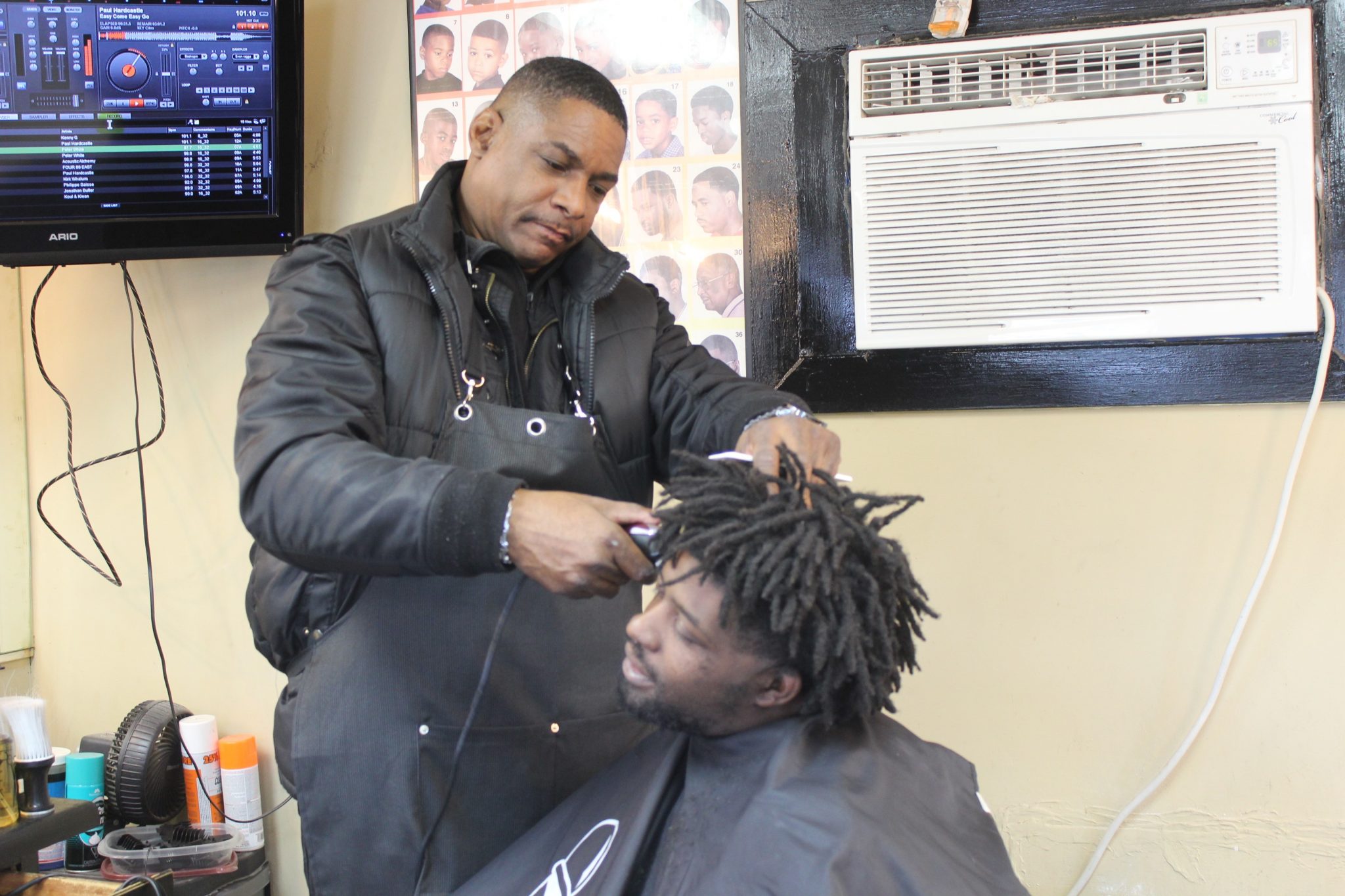 Barbershop Books is a national program designed to bring books written for children ages 4 to 8 into barbershops so they can begin to identify as readers.
 Cofield, who grew up in a house with six siblings who all read together as a family, knows the power of reading. He wants to encourage a sense of a reading-based community in his shop. He said he hopes to soon have a larger shelf of books aimed at children of all ages, and add computer terminals, so school-age children can do research and work on homework.











 LOS ANGELES WAVE — It’s pretty cool to have an international star athlete pay a visit to your school. It’s downright awesome if you can get more than one world-class athlete to show up and hang out with you while you’re getting your exercise in.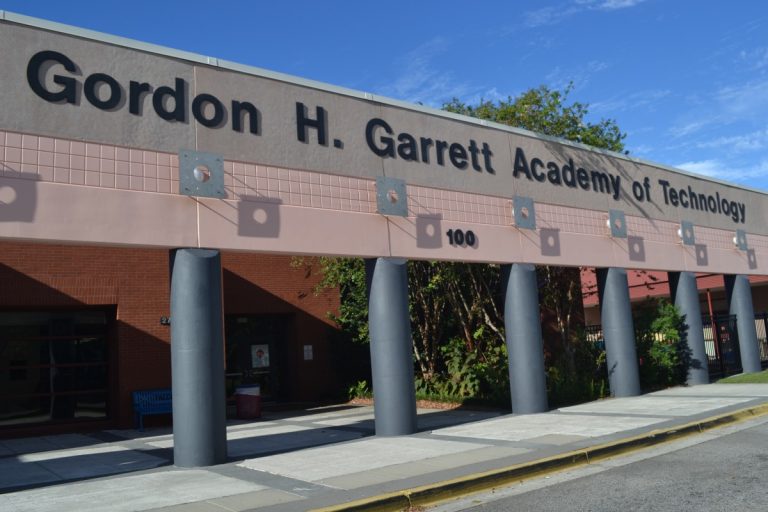
 Submitted by Jesse Williams, Rep. Marvin Pendarvis & Dr. Carol Tempel