U.S. Secretary of Education Betsy DeVos took over the Education department, first and foremost, to move the ball forward on school choice, her long-time passion. She’s been in the job less than six months, but already, time may be running out to get a sweeping school choice initiative over the finish line, at least this year.
One big reason: There have been broad, school choice proposals floated, but no details.
The Trump administration has been signaling for months that it may push for a federal tax credit scholarship program, allowing individuals and companies to get a break on their taxes if they donate to a scholarship-granting organization. That could help low-income or special needs students cover private school. But it’s July, and there aren’t specifics on that. (Sources say that there could be details soon, however.)…
There’s been a ton of confusion lately about whether and how states can incorporate science, social studies, and other subjects into their systems for rating schools under the Every Student Succeeds Act.
The upshot is that, yes, states can indeed use science, social studies, the arts, and other subjects beyond reading and math for accountability. But there are some caveats when it comes to just how they do that. (More below.)
First, some background: U.S. Secretary of Education Betsy DeVos got pushback last month when her team told four of the 17 states that have submitted ESSA plans so far Connecticut, Delaware, Louisiana, and Tennessee that their vision for incorporating science into their accountability plans didn’t pass muster. Advocates for science teachers sent DeVos’ team an angry letter, saying they thought this was a poor policy choice...
Most states are using the Every Student Succeeds Act as an opportunity to measure student growth, not just straight-up performance on tests. And states are broadening their accountability systems to include factors beyond reading and math to comply with a requirement in the law, with many choosing to rate schools in part on whether or not they prepare kids for college and the workplace, according to a review of state plans commissioned by the Collaborative for Student Success and Bellwether Education Partners. The review is aimed in part at helping to pinpoint promising practices in state plans so that states can learn from one another.
The 30 experts including former state chiefs, policy wonks, and civil rights advocates who reviewed plans for Bellwether and the Collaborative also found that five of the 17 states who have submitted ESSA plans so far considered the performance of historically overlooked groups of students in school ratings.
And they found that, with the exception of New Mexico and Tennessee, states aren’t doing a great job of explaining how they plan to intervene in low-performing schools. In fact, the review gave New Mexico whose state chief, Hannna Skandera, departed after the plan was submitted high marks overall. But reviewers found that states such as Arizona and Michigan were lacking in information…
U.S. Secretary of Education Betsy DeVos and her team are giving states and districts an extra year to comply with new financial transparency requirements in the Every Student Succeeds that are aimed at shining a light on how much schools spend on each student. And at least one key civil rights group is unhappy about the delay.
ESSA calls for states to report per-pupil expenditures for all their schools on school report cards for the first time beginning in the 2017-18 school year. The requirement was intended in part to help local policymakersâand the public figure out if there are significant spending disparities between schools that serve high percentages of poor kids and other schools, and whether schools that lag behind in student achievement are getting as much money as more successful schools.
When ESSA passed, civil rights advocates were excited about the new transparency around per-pupil spending. But school superintendents and state leaders warned that providing that sort of detailed data on such a tight timeline could be a tough lift. The Education Department is giving states until the 2018-19 school year to begin putting the per-pupil expenditure information on their report cards…
Connecticut, Louisiana, New Jersey, Oregon, and Tennessee got preliminary feedback Friday from the U.S. Department of Education on their plans to implement the Every Student Succeeds Act, which must be approved by Secretary of Education Betsy DeVos.
So will this round of feedback give fans of local control another case of heartburn? From our quick review, that seems less likely. (But we’ve reached out to some state advocates for their take.) Noteably, though, the department isn’t questioning whether any state has set “ambitious” goals, as it did with Delaware’s plan. And it doesn’t seem to have a problem with the way Louisiana and Tennessee have relied on Advanced Placement and dual enrollment to determine school ratings, even though that too, was an issue for Delaware. Scroll down for more detail…
The U.S. Department of Education responded to these concerns at the end of last week, publishing a list of Frequently Asked Questions that seeks to explain exactly what its letters to three states, the first feedback states have gotten from the Trump team on ESSA, actually meant when it comes to DeVos’ approach to the law. The document may not clear up every question states and others may have, however. More on that below…
The commission, which made the move on Friday, plans to take a closer look at civil rights enforcement across the government, including the Departments of Justice, Health and Human Services, Labor, and Housing and Urban Development.
The panel is particularly concerned that the Trump administration is seeking to cut the budgets of the civil rights arms of these agencies. And it is bothered by statements by some cabinet officials, including U.S. Secretary of Education Betsy DeVos, that the commisssion says may demonstrate that the Trump administration isn’t going to take civil rights enforcement seriously. (DeVos is, in fact, the only cabinet official the statement mentions by name)…
Now the Council of Chief State School Officers is expressing concern that some of the Trump Team’s feedback to states would actually go beyond the scope of the law…
Seventeen state plans to implement the Every Student Succeeds Act have passed the U.S. Department of Education’s initial completeness check and are ready for peer review, the next step in the approval process, the department announced Friday.
“Today’s announcement is a big win for ESSA implementation. I am committed to returning decisionmaking power back to states and setting the department up to serve the support and monitoring roles intended by Congress,” U.S. Secretary of Education Betsy DeVos in a statement. “The department worked with states to ensure their plans included all statutorily required components laid out in the…
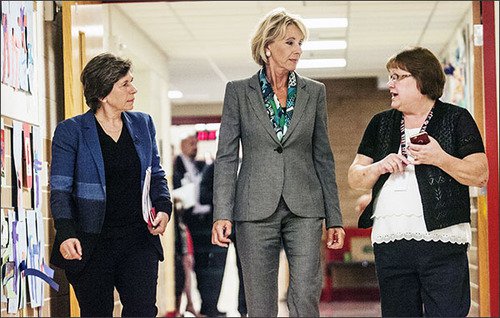
Van Wert, Ohio — Long-time adversaries U.S. Secretary of Education Betsy DeVos and American Federation of Teachers President Randi Weingarten spent more than four hours touring this rural Ohio district together Thursday. Both were still alive and well by the end of the day.
And so were the deep divisions in this corner of the country over K-12 education and President Donald Trump.
Even as DeVos and Weingarten counted model dinosaurs with preschool students, watched high school students demonstrate their robotics know-how, and chatted with teachers about social-emotional supports, small groups of protestors from both sides of the political divide gathered…