UPDATED — Under the Every Student Succeeds Act, states get to decide what goals to set for student achievement, how to gauge schools’ academic progress and quality, and more. (Explainer on the law here.)
But in some of the 12 plans that have already been submitted to the U.S. Department of Education, elements are still to be determined. Some states didn’t completely spell out their student achievement goals. Others didn’t say exactly how much each individual factor would count toward schools’ overall ratings. And others proposed school quality indicators they didn’t fully explain. (Much of the up-in-the-air information concerned student achievement goals….
One of the big goals of the Every Student Succeeds Act was to give districts way more control over their federal funding, in part by creating a new block grant aka the Student Support and Academic Enrichment Grants or Title IV. Under the law, districts can use the money for a whole smorgasboard of things: student safety, dual enrollment, dance instruction, training teachers to use technology, hiring school counselors.
And the funding, a whopping $1.6 billion, was supposed to flow to districts through a formula, meaning that pretty much every district in the country would get a piece of it. The districts would have serious latitude in deciding the dollars are spent.
It may not quite work out that way, at least not this year…
One of the parts of the Every Student Succeeds Act that excited educators the most was the chance to look beyond test scores in gauging school performance, to factors like absenteeism, access to advanced coursework, and even grit.
There are some common themes, at least among this first batch. For instance, chronic absenteeism is super popular. In fact, five states Connecticut, Delaware, the District of Columbia, Illinois, Massachusetts, Tennessee are all using it in some fashion. (We will be updating this post periodically as more plans come in.)…
In case you missed it, states turned in the very first batch of plans for the Every Student Succeeds Act this week. We have links to all nine of them here. And a number of advocacy groups and research organizations haveâor are planning to createâsome ESSA resources for states and advocacy groups.
Next Monday, states will begin officially submitting their plans for the Every Student Succeeds Act to the U.S. Department of Education. And then comes the, umm … fun part. Those plans will be examined through a wonky-but-important process known as “peer review,” in which a team of educators and experts essentially takes a close look at a state’s vision, to see if it complies with the law.
On Tuesday, the Education Department now controlled by Team Trump released guidance spelling out exactly what those reviewers should be looking for. File this under technical-but-good-to-know: The guidance only covers “Title I” (the main section of the law that includes accountablity, school improvement, testing, and more), Title III (the portion of the law that deals with English-language learners), and the portion that deals with homeless students. The other programs in the law, including Title II (which governs many of the teacher portions of the law) will be reviewed by the department.
First, a quick look at how the peer-reveiw process is supposed to work, according to ESSA: The “peers” are selected by the department. And according to the law, they can include parents, teachers, principals, other school leaders, representatives of state educational agencies, school districts, and the broader community, including the business community. They can also include researchers who are familiar with standards, assessments, and accountability, as well as folks with expertise in meeting the needs of disadvantaged students, children in special education, and English-learners…
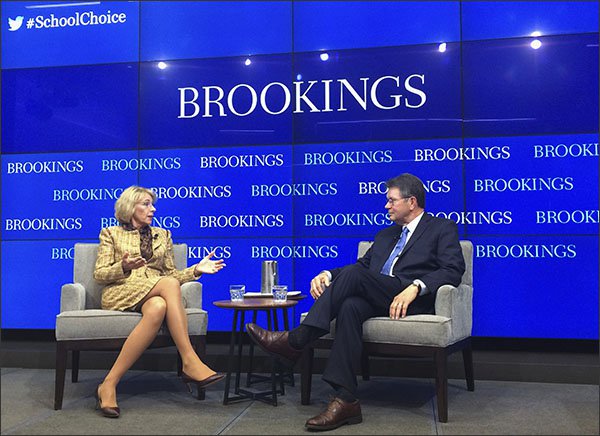
U.S. Secretary of Education Betsy DeVos told an audience at the Brookings Institution Wednesday that she wouldn’t necessarily approve every state’s plan for the Every Student Succeeds Act right off the bat. And at the same event, she continued to push her favorite policy: school choice.
DeVos didn’t say specifically that states would have to embrace choice in their plans in order to pass muster with the department. But the juxtaposition still had some folks nervous, including Sen. Patty Murray, D-Wash., who told Politico that she hopes DeVos “clarifies her comments and makes it clear that she does not plan to threaten states or hold their proposals hostage unless they conform to her privatization agenda.”
So, could DeVos legally reject a state’s plan because it didn’t include choice, even if she wanted to?
Short answer: No. That would be a violation of ESSA.
Longer answer: Both Democrats and Republicans who worked on ESSA say doing that would violate the long, long list of prohibitions on the Education Department’s authority in the law, one of which says the secretary can’t tell states what kinds of interventions they can or can’t use with their lowest-performing schools.
To be sure, there are definitely parts of ESSA that choice lovin’ states and districts can get excited about. The law allows states to set aside Title I money for course choice, free tutoring, and public school choice. It permits states and districts to offer public school choice to students in struggling schools, or turn low-performing schools into charters or magnets. And it gives 50 districts the chance to try out a weighted student funding pilot. The pilot could smooth the way for choice programs in districts that are interested in creating them, but doesn’t have to be used for choice.
Importantly, though, all those things are totally and completely optional.
DeVos can use her megaphone as education secretary to draw attention to the parts of ESSA that states and districts that are gung-ho on choice can use to their advantage. But she can’t reject a state’s application if they say thanks-but-no-thanks to setting aside some Title I funds for course choice.
“She can cajole, plead, request, etc. but she cannot require,” said a Senate GOP aide who worked on ESSA.
And that interpretation is bipartisan. Anne Hyslop, a former Obama administration official who worked on ESSA and is now at Chiefs for Change, tweeted something pretty similar.
@benjaminjriley short answer: based only on statute, having a hard time finding the hook. Choice is totally optional in title I.
Photo: Education Secretary Betsy DeVos talks with Russ Whitehurst, senior fellow in the Center on Children and Families in the Economic Studies program at the Brookings Institution, on March 29 in Washington.
The program, which helps cover the cost of after-school, summer learning, and extended day programs, provides nearly half the funding for SHINE, or “Schools and Homes In Education,” an after-school program that operates in Barletta’s district, which includes Hazelton, Pa.
Barletta, who worked behind the scenes to make sure the program was authorized under the Every Student Succeeds Act, is not happy about the proposed cut. In fact, he teamed up with Rep. David Cicilline, D-R.I., on a letter to Mick Mulvaney, the director of the White House Office of Management and Budget, asking him to restore the 21st Century Community Learning Centers program.
Later Thursday, Mulvaney was asked about the program during a briefing with White House reporters. He said he wasn’t familiar with SHINE (or it would seem, 21st Century Community Learning Centers). But he said that after-school programs in general don’t have a great track record.
“They’re supposed to be educational programs, right? That’s what they’re supposed to do. They’re supposed to help kids who don’t get fed at home get fed so they do better in school,” Mulvaney said. “Guess what? There’s no demonstrable evidence they’re actually doing that. There’s no demonstrable evidence of actually helping results, helping kids do better in school. … The way we justified it was [are] these programs going to help these kids do better in school and get better jobs. And we can’t prove that that’s happening.”
But Henderson Lewis, the superintendent of the New Orleans School System sees things differently. His district is nearly all charter schools, so he was happy to see an emphasis on public school choice in the budget. But he worries that the decision to cut the 21st Century Community Learning Centers program could hurt many of his students who are benefitting from increased learning time.
“Being able to even extend the school day allowed our students to be in a safe place and be engaged,” Lewis said in an interview, and to try new things, even Zumba classes.
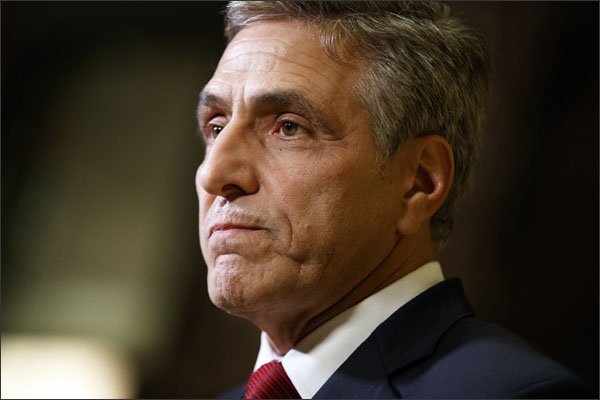
Rep. Lou Barletta, R-Pa., talks with reporters after a meeting in November with President-elect Donald Trump at Trump Tower in New York.
We have answers—both to your wonky questions and the ones you were too embarrased to ask.
Is ESSA still on the books?
Yes. Lawmakers did NOT repeal the Every Student Succeeds Act, they just voted to repeal a particular set of regulations issued under that law, which is actually the latest version of a much older law, the Elementary and Secondary Education Act.
That begs two questions: One, will the Trump administration re-regulate? And two, what exactly would constitute “substantially similar” regulations to the Obama ones that Congress just tossed? (Spoiler: Congress may essentially get to decide whether any new Trump regulations are too much like the Obama regulations to pass muster. More below.)