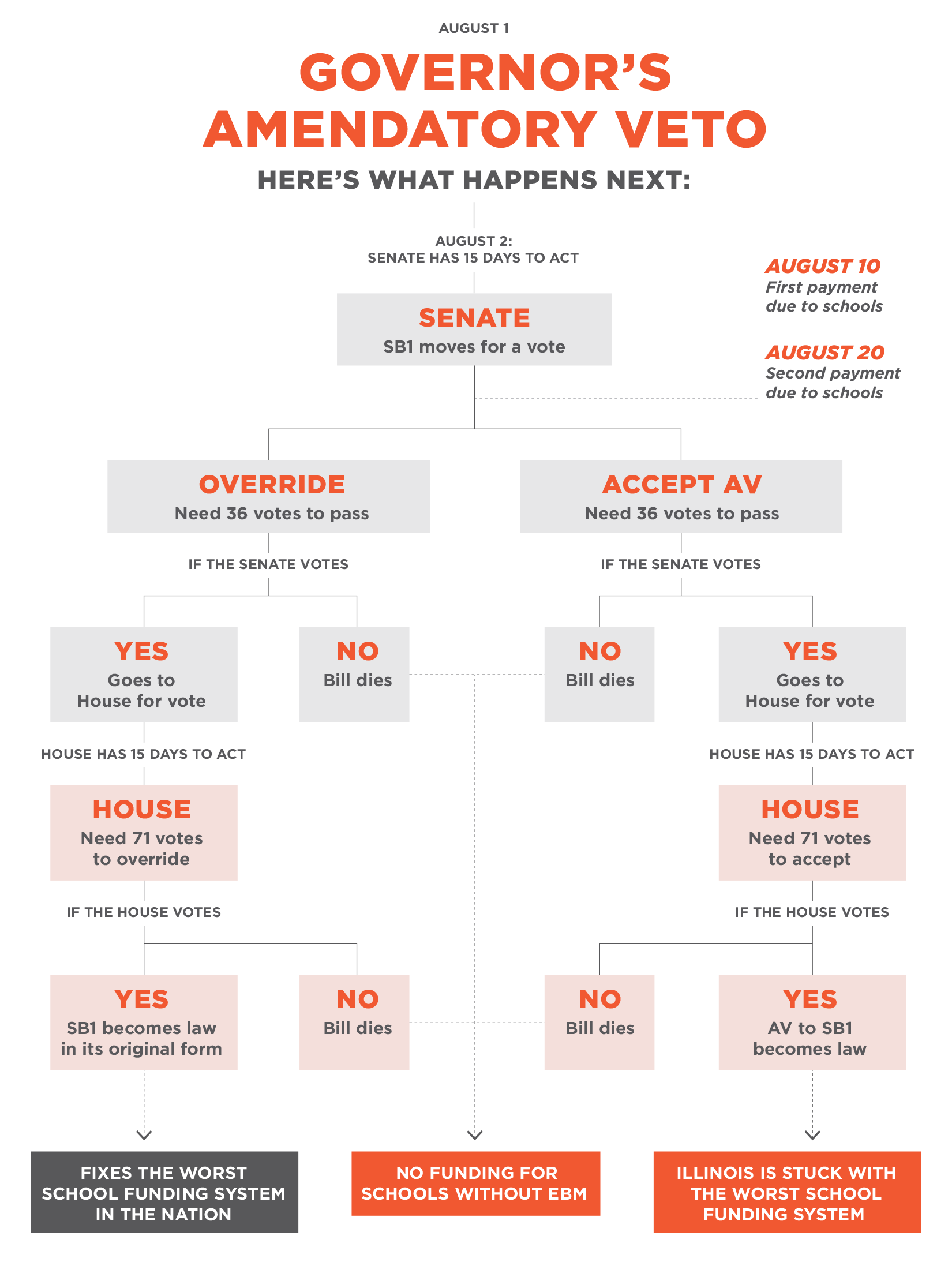
What’s the process for the General Assembly to deal with the governor’s veto?
The Fix the Formula coalition, of which Illinois PTA is a member, has an informative flow chart that explains the process for the General Assembly. The veto starts in the Senate, where senators must vote with a 3/5 majority (36 votes) to either override the veto or concur with it within 15 days. If they can’t get a 3/5 majority, the bill dies and schools will not receive funding until a new evidence-based funding model (EBM) bill is passed. Since such a bill would be passing after May 31 and take immediate effect, it too would require a 3/5 majority to pass.
If the Senate votes to override or concur, the bill then moves to the House, where again a 3/5 majority (71 votes) is needed to pass whatever the Senate voted to do. That means that if the Senate votes to override, the House cannot vote to concur, only override as well. If the House can’t get a 3/5 majority, the bill dies and schools don’t receive funding. If the House agrees with the Senate to override, the new funding formula would be installed, schools would receive funding with the new formula, and Illinois would begin to close its worst-in-the-nation inequitable school funding. If the General Assembly concurs with the governor’s veto, the vetoed version of the bill will become law, and many of the current funding problems would continue or get worse.
Will my school open on time?
Probably. School districts should have some cash on hand to start school, but some districts may not have much in reserve to keep the doors open. Some districts have said they have enough reserves to stay open for the full year, others have said that they can last until around Thanksgiving, and some are struggling to the point where they are already limiting payments to payroll, electricity, water, and other costs needed to keep the school open, but are not purchasing items like pens, paper, or workbooks.
Illinois is also behind in some payments from last year to school districts, which has put a strain on many of them, and without an EBM in place, funding for this year cannot be sent out. SB1 is the only EBM that has passed both houses of the General Assembly after four years of negotiations and compromises. No other EBM bill has even been through committee at this time.
School districts are due their first payment of the year on August 10 and their second one on August 20. The Illinois State Board of Education (ISBE) and the comptroller’s office say they will need about 10 business days to run the evidence-based model to calculate how much each school district will receive before they can cut the checks. That means that those first two payments will likely be missed while the General Assembly attempts to override or concur with the veto.
It is unclear if or how the state will handle those missed payments. They could make them as soon as an evidence-based model is passed into law or pro-rate the missed payments into the remaining payments for the year. Complicating matters is that the comptroller can’t write checks first for the districts that are struggling the worst. All of the school districts must be paid at the same time, which also means that the state has to have the cash on hand to pay all the schools at once.
I’ve heard my school district will get more money from the governor’s veto. Others say we’ll get less. Who’s right?
That’s hard to say, because ISBE has not yet calculated how much school districts will receive under the model created by the governor’s veto. The numbers showing your district receiving additional funding are likely from other proposals that were not passed by the General Assembly.
The governor’s veto eliminated the block grant for Chicago Public Schools (CPS), which is used by CPS to pay for special education, transportation, and other “categorical” spending. Eliminating the block grant cuts just over $200 million from CPS and parcels that money out to all the other school districts in the state, so other than CPS, district may see a bit more money initially. But other changes the governor made to the bill will likely cost every school district money in the long term. One of the key designs of SB1 was that no school district would lose funding from its current level. The governor’s veto breaks that by cutting CPS’s funding.
How does the governor’s veto hurt school district funding in the long term?
Governor Rauner originally stated that he was opposed to the “Chicago bailout” in SB1, and it was anticipated that his amendatory veto would target the CPS block grant for special education and other categorical spending and how pensions are handled for CPS in SB1. When the veto was made public, it went much further than expected. Here are the key changes and how they affect school districts:
Eliminates inflation indexing of costs in the SB1. This was one item Illinois PTA specifically asked for in our testimony in May. SB1 calculates how much money a school district needs to educate a student on a variety of factors, and many of those factors have a set dollars per student amount in the bill. Without accounting for inflation, those values will essentially be cut over time just like an apple doesn’t cost a nickel any more. That means school districts will see cuts in funding even as increasing technology use in the classroom and inflation increase the real costs of educating a student.
Changes the hold harmless provisions. One item critical to Illinois PTA’s support of SB1 was that no district would lose state funding from its current level—the hold harmless provision. The governor’s veto changes the hold harmless provisions from per district to per pupil in the 2020-2021 school year. That may not sound like a big change, but for school districts that have declining student populations, it means they will see less funding even if they are far from being adequately funded by the state. Fix the Formula has an interactive map that lets you see which districts would be affected by this change, almost all of which are outside the greater Chicago area.
Includes TIF districts and PTELL in the properties in the calculation of school districts’ ability to raise money. School districts raise money through property taxes by taxing the Equalized Assessed Value (EAV) of the properties in their district. Tax Increment Financing (TIF) districts remove the value of properties in those districts from school property taxes, so schools do not get any taxes from those buildings. PTELL is Illinois’s tax cap law that limits the ability of school districts (and others) from increasing the total amount of taxes collected to the rate of inflation, even if the value of the property in the district has increased faster than inflation. SB1 recognizes the fact that school districts can’t get some tax money when calculating how much they should be raising to pay for themselves. The governor’s veto includes those TIF properties and ignores the PTELL limitations when making that calculation, so it looks like a school district can raise more money through property taxes and thus needs less state funding. The Fix the Formula interactive map also shows which districts have TIF and PTELL issues (select it in the “Indicator” drop down box).
Moves the CPS pension adjustment out of SB1 and into the pension law. Under SB1, every school district’s pension payments were treated the same way. The state would pick up the normal (current) cost of pensions, including CPS who currently pay for their own pensions, but keep CPS responsible for its legacy (unfunded liability) pension costs. SB1 did recognize that CPS can’t spend the same tax dollar twice, once for legacy pension costs and again in the classroom, so those legacy costs were cut from the calculation of what CPS could raise through taxes, but did not give CPS any money for those costs. This also protected the funding of every other school district if the state were to make them responsible for their own pension costs, as has been considered in recent years with the state’s financial difficulties. The governor’s veto essentially takes money from the classrooms in CPS to pay for pension costs and will do the same for all other districts should they become responsible for their own pensions.
Caps regional wage differences. SB1 put in a cost adjustment calculation to account for regional differences in salaries when calculating the amount of money needed to educate a student. SB1 has a floor for this adjustment to ensure downstate districts with low costs of living could compete with and retain high-quality teachers without wealthier districts outbidding them. The governor’s veto also adds a ceiling to this adjustment, meaning that districts with higher costs of living are penalized by artificially decreasing salaries. As the Fix the Formula interactive map for regionalization shows, this change would cost CPS and districts in the Chicago suburbs.
Illinois PTA believes that these changes by the governor’s veto fundamentally change the basis of the evidence-based model. The veto removes the protections that no school district will lose funding from current levels going forward, which is a critical reason for Illinois PTA’s support of SB1. Illinois PTA cannot support a school funding bill that cuts funding to any district, nor will we support a bill that uses vouchers, even under the guise of “scholarships,” to divert public education funding to private and parochial schools.
What can I do?
Illinois PTA is asking everyone to contact their legislators to encourage them to override the governor’s amendatory veto of SB1. It takes only a minute or two to use our prewritten letter. All you need to do is type in your signature to the letter, and provide your e-mail address, zip code, and street address to identify your legislators and provide them with the ability to contact you (usually just a “thank you for your letter”).
The Virginia Dept. of Education is proposing a new accountability system. Under the new plan, “schools will be identified as requiring either ‘comprehensive support and improvement’ — when school-wide test scores fall short of benchmarks — or ‘targeted support and improvement’ — when a subgroup falls short.” Spokesman Charles Pyle commented that “the state’s accountability program offers parents user-friendly data to evaluate schools, including an online dashboard.”
The Dept. of Education responded to North Dakota’s proposed ESSA plan. State Superintendent Kirsten Baesler noted that “Education Department officials have requested additional information on several parts of the state’s plan, and the department’s evaluation of the plan and notes from the expert peer reviewers who examined it will be made public this week.” The state is required to submit a response by August 21. See the Department’s feedback below:
AUSTIN – Public comments regarding the Every Student Succeeds Act (ESSA) consolidated state plan for Texas are now being accepted by the Texas Education Agency (TEA). The comment period runs through Tuesday, Aug. 29, 2017.
Comments can be submitted via email at essa@tea.texas.gov. The draft plan can be viewed here.
ESSA became law in December 2015, replacing the No Child Left Behind Act. The new law increases flexibility and decision-making authority afforded states, encourages states and schools to be innovative, and holds states accountable for results. ESSA requires federal review and approval of a state consolidated plan, which provides a comprehensive overview of how each state will use federal funds to advance its own goals and visions of success for students.
Since taking office in January 2016, Commissioner of Education Mike Morath has focused on developing systems within the agency that support ESSA implementation through an established TEA Strategic Plan. All work at the agency is now centered around four strategic priorities: (1) recruiting, supporting and retaining teachers and principals; (2) building a foundation of reading and math; (3) connecting high school to career and college; and (4) improving low-performing schools. An overview of TEA’s strategic plan is available on the agency website.
The draft consolidated plan is reflective of input provided to the Commissioner and TEA staff during more than 200 stakeholder meetings statewide over the past 18 months. These meetings have focused on gathering feedback on the broad aspects of the agency’s overall strategic plan, as well as specific input on the development of key policy decisions related to ESSA implementation.
Highlights of the plan now posted online include:
Alignment of state and federal policies – specifically in the areas of accountability and school improvement.
Maximizing flexibility afforded Texas school districts to provide services needed for students.
Strengthening the state’s commitment and support for our most vulnerable populations (including migrant, foster care, homeless, and economically disadvantaged students).
Reinforcing the state’s commitment to the 60×30 plan (developed by the Texas Higher Education Coordinating Board) by aligning long-term academic goals to having 60 percent of students prepared to earn a certificate or degree by the year 2030.
In addition, the draft plan outlines how TEA is using school improvement interventions that align with current state requirements to avoid confusion or duplication of efforts, while also maximizing the impact of federal funds to support improvement strategies.
The ESSA consolidated state plan will be submitted by TEA to the U.S. Department of Education in September.
For more information regarding ESSA implementation in Texas, visit the TEA website.
The Every Student Succeeds Act (ESSA) reauthorizes the Elementary and Secondary Education Act, which is the primary legislation related to federal K-12 education programs. ESSA replaces many provisions contained in the previous reauthorization—the No Child Left Behind Act—to give states more authority in the design of their school accountability systems and to encourage them to use measures beyond test scores to measure school performance. States, districts, and schools also have greater autonomy to design and implement school improvement strategies for struggling schools.
The law, however, continues to require states and districts to track and respond to low performance of schools and subgroups of students within schools. They must also be able to disaggregate the data they use to determine interventions by race and ethnicity, disability status, English language learners, and income. These critical protections ensure that all students—including the most disadvantaged—cannot be ignored.
Sixteen states and Washington, D.C., submitted their ESSA plans—which cover multiple provisions of the law—to the U.S. Department of Education for review during the first submission window. The Center for American Progress reviewed these submissions for their school classification systems and school improvement plans. The summary provides critical context and methodology. The 17 individual state fact sheets break down each state’s school classification system in addition to school improvement timeline, grant structure, types of schools identified, and key improvement strategies.
Laura Jimenez is the director of standards and accountability at the Center for American Progress. Samantha Batel is a policy analyst with the K-12 Education team at the Center.
Alabama’s state superintendent Michael Sentance very much wants to keep his job so he can see the results of months of planning a new course for Alabama’s public education system.
Sentance, whose lack of experience in the classroom made him an unlikely choice for state superintendent last year, recently received low marks on evaluations from members of the state board of education.
He will present his plan to address board members’ concerns at the Aug. 10 board meeting.
Admitting he is not a good communicator in large groups, Sentance sat down with AL.com on Thursday afternoon to talk about the challenges he’s faced in Alabama and, though he lacks confidence he will be able to get his message across, he hopes to stick around and see plans made during the past 11 months come to fruition.
A national coalition of civil rights groups want U.S. Secretary of Education Betsy DeVos to reject Florida’s soon-to-arrive waiver request that will ask to be relieved from key pieces of the Every Student Succeeds Act dealing with the nation’s most vulnerable and historically disadvantaged students.
Approving Florida’s request, activists say, will set a disturbing precedent for other states.
“Sometimes it feels like we’re playing three-card monteor a game of cat and mouse,” said Liz King the Director of Education Policy for The Leadership Conference on Civil and Human Rights. She said approving the waiver request will effectively make ESSA toothless. “Everytime we make progress, someone finds a way to cut it back.”
The waiver, still in draft form, asks for the state to be allowed to forego using minority student subgroups and the results of English-learners’ language proficiency exams in its statewide accountability system. And because Florida education officials say English is the state’s official language, it doesn’t want to conduct standardized tests in recently-arrived immigrant students’ native languages.
Those provisions were the biggest victories for national civil rights activists when ESSA was passed in 2015 and they fear that if Secretary DeVos approves the waiver this fall, other states, eager to break free from decades of federal badgering over the nation’s stagnant achievement gap, would follow suit.
The Florida education agency gathered feedback on the request over several weeks and it’s expected to soon be considered by Republican Gov. Rick Scott. It has broad support from the state’s district superintendents who want to keep the state’s politically volatile accountability system mostly intact.
This week, the Leadership Conference, made up of 23 minority rights groups, sent a tersely worded letter to all 51 state superintendents urging them to follow the law as written rather than follow in Florida’s footsteps.
“Low-income children, children of color, children with disabilities, English-learners, and Native children have been left behind for far too long and deserve no less than robust and thorough state policy to ensure an excellent and equitable education,” the letter said.
The League of United Latin American Citizens (LULAC) also sent a letter to congressional leaders and Secretary DeVos that more specifically urges her to reject the waiver request outright since, they say, the request flies in the face of ESSA’s civil rights legacy and circumvents the state’s legal obligations to English-language learners.
And a group of local civil rights activists in Florida will ask next week for a sit-down meeting with Florida department officials.
The department said in an e-mailed statement that they welcome any feedback to its plans.
“We appreciate everyone who took the time to submit input on Florida’s ESSA draft state plan,” said Meghan Collins, a spokeswoman for the department.
In its waiver request, the department said their accountability system is meant to improve the outcomes of all students, rather than students with a particular ethnicity, special need or language requirement. Instead of English proficiency exams, the state wants to use its English Language Arts test to measure ELL students’ langauge acquisition.
But the civil rights groups say that flies in the face of decades of research regarding how to close achievement gaps between minority students and their peers. Because the state for so many decades segregated its schools and denied a litany of basic education services to minority students and students with special needs, the state is obligated to provide tailored remedies to those groups’ unique needs.
“If this waiver is approved, there will be no accountability whatsover for ELL students’ progress in English Language acquisition,” said Rosa Castro-Feinberg, a civil rights activist, education consultant and former school board member in the Miami-Dade district. “I think the department has been misadvised by folks who are not up on the research related to ELL issues and subgroup accountability issues.”
One out of every 10 students in the state qualifies for ELL services.
The waiver request will create a political dilemma for Secretary DeVos who has been criticized both for her theories on the department’s role in upholding civil rights and her department’s feedback to states’ submitted plans.
“One thing we’re learning through the ESSA implementation process is that too often the decision makers at the federal, state and local level are disconnected from children who aren’t getting a fair shakeout from policy decisions,” King said.
RALEIGH — Since No Child Left Behind became law in 2002, state and local educators have tried to square the figurative circle: letting students learn at their own pace while also making sure they meet rigorous standards.
The debate over NCLB’s replacement, 2015’s Every Student Succeeds Act, ramped up again Wednesday at the monthly meeting of the State Board of Education.
To receive federal education funding, states must create their own ESSA plans addressing challenges with the education system.
Board members discussed the fifth draft of the ESSA plan at the meeting, with a PowerPoint presentation explaining key concepts.Essentially the ESSA draft plan details student performance goals and how the state education agencies and the local education agencies plan to improve those efforts.
“We continue to note that student ownership of their own learning is critically important to the whole concept of personalized learning,” Dr. Maria Pitre-Martin, deputy state superintendent for the N.C. Department of Public Instruction explained.
Personalized learning was a major focus of the discussion, and concerns were raised over how to tailor student assessment to the idea.
Board Vice Chairman A.L. “Buddy” Collins said he saw no difference between personalized learning and what successful teachers were already doing in the classroom.
“It does seem to run contrary to assessment protocols that we have,” Collins said. “Our assessment protocols seem to be premised on everyone reaching a certain point at the same time with the same degree of success.”
Lisa Godwin, the state Teacher of the Year adviser board member, also called for revamping the education system.
“We have to get away from cookie-cutter assessments because our students are individuals,” Godwin said. “Until we start realizing that, we are still going to be in the same shape every year. This is our chance to have a voice.”
Godwin claimed teachers weren’t heard in discussions over ESSA, a belief shared by Bobbie Cavnar, the 2016 Teacher of the Year. Cavnar explained how the board sat down with district superintendents from across the state and heard their proposals on improving student performance. Teachers, principals, business leaders, and parent groups weighed in on their ideas.
“All of that was silenced,” Cavnar said. “I wish Superintendent [Mark] Johnson was here because he keeps saying we need innovation urgently, instead what we are getting is more of the same…This is our chance to be innovative. This is our chance to do something big.”
Johnson didn’t attend Wednesday’s board meeting but was scheduled to be there at a subsequent meeting.
Terry Stoops, vice president of research and director of education studies at the John Locke Foundation, is skeptical of how some board members view the ESSA plan as a means of radically changing the system.
“It is not as if [the federal government] is going to take what is in our ESSA plan and completely change the way we conduct public education in North Carolina,” Stoops argued. “They are going to change the way they report some data and they are going to possibly change the standards by which they administer and report assessments.”
The game hasn’t changed, according to Stoops. The state will tell federal officials what they want to hear in order to collect the check.
“It is sort of the deal the federal government makes where they set forth a bunch of rules and requirements and a condition of getting federal funds is meeting those requirements,” Stoops said. “The federal government is in the business of leveraging money in exchange for certain things. In this case it’s accountability measures.”
The state board has until Sept.18 to submit the ESSA draft plan to the U.S. Department of Education for review.
CHICAGO—ALA Publishing eLearning Solutions announces a new session of our popular workshop, Serving Children with Autism Spectrum Disorder with Lesley S. J. Farmer. This workshop will consist of two 90-minute sessions and take place at 2:30pm Eastern/1:30 Central/12:30 Mountain/11:30am Pacific on:
Thursday, Oct. 5, 2017 and
Thursday, Oct. 12, 2017
Autism is one of the most commonly diagnosed serious developmental disability, and the number of children identified as autistic continues to grow. In this workshop, Dr. Lesley Farmer will take you through the basics of autism, explaining the forms the condition can take and how diagnosed children tend to be unique.
You will learn the library-specific challenges of working with this population, as well as best practices for both interacting with the children one-on-one and making the library environment, as a whole, more friendly. You will learn about resources and instructional strategies for serving this population.
Topics Include:
Identifying youth with ASD and understanding their developmental challenges
Making your library environment comfortable for youth with ASD
Strategies for successful one-on-one interaction
Understanding the print and digital resources available to librarians
About the Instructor
Dr. Lesley Farmer, Professor at California State University (CSU) Long Beach, coordinates the Librarianship program. She also manages the CSU ICT Literacy Project. She earned her M.S. in Library Science at the University of North Carolina Chapel Hill and received her doctorate in Adult Education from Temple University. Dr. Farmer chairs the IFLA’s School Libraries Section and is a Fulbright scholar. A frequent presenter and writer for the profession, she won American Library Association’s Phi Beta Mu Award for library education, the AASL Distinguished Services Award, and the International Association of School Librarianship Commendation Award. Dr. Farmer’s research interests include digital citizenship, information literacy, collaboration, assessment and data analysis. Her most recent books are Library Improvement through Data Analytics (ALA, 2016) and Managing the Successful School Library (ALA, 2017).
Registration for this ALA Publishing eLearning Solutions Workshop is available on the ALA Store. You can purchase registration at both individual and group rates.
ALA Publishing eLearning Solutions Workshops offer a convenient, hands-on learning experience that will help you and your colleagues make the best decisions for your library. This workshop is licensed for use by staff or users of the purchasing institution or library organization.
ALA Publishing eLearning Solutions (ELS) produces high-quality professional development events and materials for the library profession. ELS events cover modern issues on a wide variety of topics in formats that include live workshops, asynchronous eCourses, and print publications. We help ensure that today’s library employees have access to the professional development opportunities they need, whether they are brushing up on the basics or expanding their horizons with cutting-edge tools. Contact us at elsmarketing@ala.org.
PDE Announces ESSA Consolidated State Plan Draft Now Available for Public Comment
Harrisburg, PA – State Education Secretary Pedro A. Rivera today announced the commonwealth’s proposed Every Student Succeeds Act (ESSA) Consolidated State Plan is on the Pennsylvania Department of Education’s (PDE) website and is available for public comment. The plan builds on an 18-month collaboration between PDE and a diverse group of stakeholders from around the state.
“The Wolf Administration, through its Schools That Teach initiative, has been focused on ensuring that all students, regardless of their age, socioeconomic status, or zip code, have access to high-quality educators and schools,” said Secretary Rivera. “Pennsylvania’s ESSA Consolidated State Plan accelerates state-level priorities in these same areas, and helps the state transition from the prescriptive policies and unintended consequences of NCLB to a more student-centered approach.”
To develop the ESSA Consolidated State Plan, PDE:
Assembled four work groups – comprised of teachers, charter school and district level administrators, advocates, civil rights leaders, former policymakers from both parties, and others – to study key aspects of the law and develop framework recommendations;
Commissioned an independent study to examine work group recommendations in the context of academic literature and other evidence;
Testified before the House and Senate Education committees and worked with lawmakers to address plan components;
Held six dedicated town halls in every region of the commonwealth to gather additional stakeholder feedback;
Participated in approximately 30 statewide conferences, professional association meetings, and other forums to reach more than 2,000 Pennsylvanians and present on the state’s ESSA planning and early implementation; and
Consulted with national nonpartisan policy and technical experts (American Institutes for Research, Council of Chief State School Officers, Education Commission of the States) to solicit additional insight, feedback, and suggestions for specific plan components.
Rivera noted that the plan also presents new opportunities for the commonwealth to develop, recruit, and retain a talented and diverse pool of educators, bolsters college and career readiness and effective transition strategies throughout the pre-K to postsecondary continuum, and focuses on student and school equity.
Additionally, the development of the Future Ready PA Index, a new, public-facing school report card that expands the indicators used to measure performance, extends the comprehensive approach to ensuring student and school success. The Index will place additional emphasis on academic growth, evaluation of school climate through a robust chronic absenteeism measure, attention to both four-year and extended-year graduation rates, and assessments of postsecondary readiness.
“The plan represents a collaborative, evidence-based approach to help every student, in every Pennsylvania public school, access a high-quality, well-rounded education,” said Secretary Rivera. “That collaboration continues as we invite stakeholders and members of the public to provide feedback on Pennsylvania’s Consolidated State Plan.”
Rivera added that public comment will close on September 2, and the Department will submit its Consolidated State Plan to the U.S. Department of Education on September 18. Initial implementation of the plan will begin in the 2017-18 school year, with full rollout by 2018-19.
For more information about Pennsylvania’s education policies and programs, or to read the ESSA Consolidated State Plan, visit the Department of Education’s website at www.education.pa.gov or follow PDE on Facebook, Twitter, or Pinterest.


 Last week, Governor Rauner issued an amendatory veto of



 By
By 




 The ESSA State Plan and related materials are now available on the PDE web site at