Back in November, I praised the Obama Administration’s Every Student Succeeds Act accountability regulations for permitting states to use performance indices in lieu of simple, problematic proficiency rates. Such applause is, of course, water under the bridge after congressional Republicans and President Trump repealed those rules and, instead of replacing them, will rely on promises, “Dear Colleague” letters, and other means that fall short of formal regulation.
Yet new praise is in order for Secretary DeVos et al.’s recently released “State Plan Peer Review Criteria,” which explains the process through which state ESSA plans will gain approval or rejection. It, like the regulations that came and went before it, expressly permits accountability systems that measure student achievement at multiple levels—not just “proficient”—using a performance index.
This is an important—even essential—innovation. Despite the good intentions of No Child Left Behind, which ESSA replaced a year ago, it erred by encouraging states to focus almost exclusively on helping low-performing students achieve proficiency and graduate from high school. Consequently, many schools ignored pupils who would easily pass state reading and math tests and earn diplomas regardless of what happened in the classroom—a particularly pernicious problem for high-achieving poor and minority children, whose schools generally serve many struggling students. This may be why the United States has seen significant achievement growth and improved graduation rates for its lowest performers over the last twenty years but lesser gains for its middling and top students.
The Every Student Succeeds Act requires the use of an academic achievement indicator that “measures proficiency on the statewide assessments in reading/language arts and mathematics.” There are, however, multiple ways to interpret this. And earlier versions of Department of Education regulations, under President Obama and Secretary King, seemed to expect states to use proficiency rates alone to fulfill this requirement and gauge school performance. Such a mistake would have merely extended NCLB’s aforementioned flaw.
The move, announced Monday, came after Gov. Rick Snyder signed off on the plan but expressed support for more discussion on “greater transparency in the school accountability portion of the plan,” MDE said in a news release.
“Given Michigan’s historically low performance nationally, we must ensure that our accountability system is transparent, honest, and works for every student in the state,” Snyder said in a statement. “Parents have a right to know their schools are providing a quality education for their child.”
U.S. Secretary of Education Betsy DeVos has 120 days to review and approve state ESSA plans, according to MDE.
The accountability system has been the most controversial element within Michigan’s ESSA plan. At issue has been how the department would show school performance.
Snyder’s administration has expressed support for a report card that assigns each school an overall A-F grade based upon several factors, including performance on state tests and graduation rates.
Members of the State Board of Education don’t want an A-F system. Instead, they favor a dashboard that would show performance in several areas but would not include an overall grade or rating for schools.
MDE’s ESSA plan includes both options, as well as a system that would assign a school a grade for each of the following six categories: student proficiency, student growth, graduation rate, assessment participation, school quality/student success, and English Learning Progress. This option would not include an overall A-F grade for the school.
The state’s ESSA plan says if the Legislature does not implement a new accountability system by June 30, the default system will be the transparency dashboard. Committees in the state House and Senate are currently discussing the creation of a new accountability system.
Besides accountability, other elements in the plan include how Michigan will work to support struggling schools, educator quality and the creation of a new assessment system geared toward measuring “within-year” student growth as well as proficiency
“I said from the beginning of this work that we are going to put forward a plan that is best for the students in Michigan,” state Superintendent Brian Whiston said. “This is how we move forward, and I want to thank all of the passionate people who provided input and helped inform this plan. Let’s all work together now to put the plan into action.”
Here’s some of the main components of MDE’s ESSA plan:
“Defining the purpose of school accountability as providing direct supports to the districts, rather than labeling and sanction.”
“A differentiated response to schools based on their academic need, with the most intensive interventions and supports being provided to those most in need.”
“A true focus on the whole child and the aspects of a well-rounded education, including not only academic subjects like fine arts and physical education, but also areas related to safety, health, school culture and climate, food and nutrition, early childhood, postsecondary transitions, and social-emotional learning.”
“Flexibility in the interventions and actions taken by districts and schools, rather than prescribed certain models or interventions. This plan helps local districts diagnose their needs across the whole child spectrum, identify evidence-based practices, and implement a plan that is tailored to their needs.”
Integration and focus on alignment with early childhood initiatives and goals.
“Educator quality that goes beyond a focus on “highly qualified” (which was required under NCLB), to supporting teachers and leaders throughout their careers.”
“Assessment systems that are designed to measure within-year student growth in addition to proficiency on rigorous content standards.”
“An accountability system that provides clear information to all stakeholders, based on areas that relate to the progress toward being a Top 10 education state in 10 years.”
SCRANTON — As area students prepare for a second week of state tests, exams next year could look different.
The Every Students Succeeds Act, the federal education law signed by President Barack Obama in late 2015, replaces the No Child Left Behind Act and provides flexibility for states. Pennsylvania must submit its finalized plan to the U.S. Department of Education in September.
“It’s a great opportunity and a great responsibility,” Matthew Stem, the state’s deputy secretary of elementary and secondary education, said during a meeting last week in Scranton.
Each spring, third- through eighth-graders take Pennsylvania System of School Assessment exams in English language arts and math. Fourth- and eighth-graders also take the science exams. High school students take Keystone Exams — end-of-course assessments in literature, biology and algebra. The state planned to make Keystone Exams a graduation requirement starting in the 2018-19 academic year, but that could change.
Ideas being reviewed by the state include:
Reducing total PSSA testing time by 20 percent, which could include the elimination of two sections of tests.
Testing students multiple times a year, instead of only in the spring. Some educators worry this would mean the state would dictate the order in which curriculum is taught in schools.
Eliminating double testing for eighth-graders, who take both the algebra Keystone Exam and eighth-grade PSSA.
Giving schools more control over intervention strategies, including allowing mental health and school safety measures as means to increase achievement.
Changing the way school success is measured by moving from School Performance Profile scores to a “Future Ready PA Index.” Along with achievement and growth indicators, schools would be judged by career standards benchmarks, postsecondary transitions and English language proficiency.
The state plans to have a draft of the plan available by early summer.
Assessments could change as early as next spring, with the first identification of schools in the bottom 5 percent — those that must implement intervention strategies — in fall 2018.
Few people attended the meeting in Scranton, held Tuesday evening at the Career Technology Center of Lackawanna County and aimed as a way for the public to provide feedback. CTC employees made up about half of the 10 attendees. Many educators said they were unaware of the meeting, and the Department of Education provided no advance notice to news media because of a “technology snafu,” a spokeswoman said.
The department sent an email invitation to about 400 people, Cheryl Bates-Lee, PDE press secretary, said.
The meeting in Scranton was the final in a series of events statewide for providing an opportunity to the public to learn more about the future of education policy related to ESSA.
Forest City Superintendent Jessica Aquilina, the only superintendent present at the meeting, called ESSA “a step in the right direction.”
Aquilina, who informed all Forest City parents about the meeting, said she appreciates the increased local control and the additional measures for accountability.
“A lot of educators are looking at readiness and what it means to be college and career ready,” she said. “Pennsylvania is taking some steps in the right direction.”
Abington Heights Superintendent Michael Mahon called ESSA a “step forward.”
“We’ve been doing too much testing for years,” Mahon said. “It’s unfair and counterproductive to be losing weeks of time for assessments. … We really do question the need to have a longer exam for the PSSAs than we do for graduate school exams.”
One of the big goals of the Every Student Succeeds Act was to give districts way more control over their federal funding, in part by creating a new block grant aka the Student Support and Academic Enrichment Grants or Title IV. Under the law, districts can use the money for a whole smorgasboard of things: student safety, dual enrollment, dance instruction, training teachers to use technology, hiring school counselors.
And the funding, a whopping $1.6 billion, was supposed to flow to districts through a formula, meaning that pretty much every district in the country would get a piece of it. The districts would have serious latitude in deciding the dollars are spent.
It may not quite work out that way, at least not this year…
One of the parts of the Every Student Succeeds Act that excited educators the most was the chance to look beyond test scores in gauging school performance, to factors like absenteeism, access to advanced coursework, and even grit.
There are some common themes, at least among this first batch. For instance, chronic absenteeism is super popular. In fact, five states Connecticut, Delaware, the District of Columbia, Illinois, Massachusetts, Tennessee are all using it in some fashion. (We will be updating this post periodically as more plans come in.)…
In case you missed it, states turned in the very first batch of plans for the Every Student Succeeds Act this week. We have links to all nine of them here. And a number of advocacy groups and research organizations haveâor are planning to createâsome ESSA resources for states and advocacy groups.
Secretary of Education Betsy DeVos has stirred the pot with her continued advocacy for school choice since taking over the Education Department nearly two months ago. A lot of the discussion has been about how DeVos and President Donald Trump might push for vouchers, tax-credit scholarships, and expanded charter schools. But there’s another option open to DeVos that’s specifically supported in the Every Student Succeeds Act, but often flies under the radar when choice is discussed.
This week, the Andrew half of Politics K-12 teamed up with Curriculum Matters blogger Liana Loewus to look at course choice, also known as course access. We reported on a relatively new Idaho program called Fast Forward, in which each student in grades 7-12 gets $4,125 to spend on approved courses for high school, as well as those that are credit-bearing for college…
Students in the United States are graduating from high school and completing college at the highest rates in decades. On the surface, these growing education levels seem to offer reason to celebrate. But a closer look reveals a widening income and employment gap between high school graduates and their peers who pursue and complete postsecondary education.
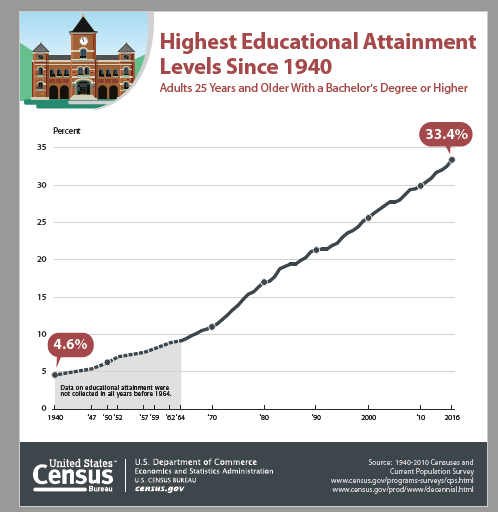
The national high school graduation rate is at an all-time high of 83.2 percent for the Class of 2015. But, if those graduates decide not to continue their education beyond high school, they can expect to earn about half of what their college-educated peers will earn annually. In 2016, adults ages 25 years and older with just a high school diploma earned an average of $35,615 per year, according to new data from the U.S. Census Bureau. By contrast, individuals with a bachelor’s degree averaged $65,482 that year and those with an advanced degree averaged $92,525 per year. (Among individuals 25 years old and older, more than one-third now have a bachelor’s degree or higher. That’s the highest percentage since the U.S. Census Bureau began tracking educational attainment data in 1940.)
This growing income gap reflects fundamental structural changes in the U.S economy. Since the second half of the twentieth century, job creation in the United States has shifted toward industries—such as healthcare, consulting, and business—that employ a high share of workers with postsecondary education. At the same time, the economy has moved away from production industries that historically employed workers with lower levels of educational attainment (construction and manufacturing), according to a report from Georgetown University’s Center on Education and the Workforce (CEW).
Essentially, the nation has shifted from an economy driven primarily by high school–educated labor to one in which almost two in three jobs require some form of postsecondary education or training, says the CEW. Consequently, fewer new jobs are being created for workers with only a high school diploma. Of the 11.6 million jobs created since the Great Recession, 99 percent have gone to workers with at least some postsecondary education, according to the CEW.
Furthermore, many employers want workers with more education. In a survey conducted by CareerBuilder, 37 percent of employers said they now hire employees with college degrees for jobs they once filled with applicants who had only a high school diploma, The 74 reports. Among these “noncollege jobs,” college graduates also are more likely than high school graduates to receive higher-paying positions and positions in management and supervisory roles, according to a report from the Federal Reserve Bank of New York.
The problem, many employers say, is that high school graduates simply aren’t prepared sufficiently to enter the workforce directly after high school. “I wouldn’t assume that more high school diplomas awarded equals a more career-ready workforce,” says Jason Tyszko, executive director of the U.S. Chamber of Commerce’s Center for Education and the Workforce, in The 74. “The opaqueness of those credentials—a high school diploma or even, frankly, a bachelor’s degree—is causing a lot of consternation in the business community. There just isn’t a lot of confidence in what somebody knows or is able to do, or if they’re able to perform the job.”
In a survey conducted by Achieve, 82 percent of employers reported that recent high school graduates had at least some gaps in preparation for typical jobs in their companies (including 48 percent of employers who reported large gaps in preparation). Furthermore, 61 percent of employers said they request or require high school graduates to get additional education or training to make up for gaps in their ability to read, write, or do mathematics.
Moreover, while employers increasingly look for workers with some form of postsecondary education or training, institutions of higher education are not meeting that demand. By 2020, the U.S. economy will fall 5 million short of the number of workers with postsecondary degrees needed, according to another report from CEW.
One obvious solution is for the nation to address the persistent gaps in college attainment rates among young people of color and those from low-income families. While the percentage of young adults of color earning at least an associate’s degree has increased during the past twenty years, the attainment gap between whites and African Americans still is 15 percentage points, while the gap between whites and Latinos is 30 percentage points. Similarly, among 25- to 34-year-olds, 72 percent of those from affluent backgrounds have earned a postsecondary degree or certificate, while just 35 percent of those from low-income families have done so, according to a report released last year as part of the GradNation campaign.
A high school diploma alone no longer guarantees a stable career and middle-class income. In fact, individuals who choose not to pursue postsecondary education or training now find themselves locked out of positions that high school graduates once dominated. As demand for college-educated workers continues to rise, the nation must increase opportunities for students to pursue postsecondary education and training to ensure all young people have a chance at career and life success.
Source: Kristen Loschert is editorial director at the Alliance for Excellent Education.