It was 3 a.m. when an 11-year-old broke into a Miami home while a family was sleeping. He was arrested and sent to juvenile detention for processing.
The day before, he had stolen a car and was caught in a high-speed chase with the police before jumping out of it at 40 miles per hour.
When staffers at the Miami-Dade County Juvenile Services Department advised Director Morris Copeland acutely, “This one, we can’t let this one out, Mr. Copeland,” he took off his jacket and tie and looked the boy square in the eyes, searching for regret — or at least fear.
“I told him, ‘Don’t you know you could have died during one of those incidents? He said … ‘Mr. Copeland, I don’t care nothing ‘bout that … I don’t want to live,’” Copeland recounted.
Looking at a case like this one, Copeland said youth like him have been exposed to traumatic events that leave them hopeless. Copeland avows he refuses to lock up youth under the age of 12 and instead negotiates with the state attorney for an alternative to detention.
“These are not evil men. These are hurting boys. They have been victims over and over again, traumatized to the point that they don’t care anymore,” he said.
Copeland was one of several community leaders who spoke to an audience of students, parents, educators and health practitioners at the Afrocentric Talking Circle “Ubuntu ‘I Am Because We Are’” presented by the School to Prison and Education committees of Miami-Dade’s NAACP.
Following an April 9 shooting in Liberty City that left two boys dead, leaders met on April 14 at Jessie Trice Health System, in Miami to determine how post-traumatic stress disorder may be the cause of what is known as the school-to-prison pipeline.
CHILDREN AND PTSD
“There are more children experiencing PTSD in the inner city than all of the soldiers who came out of the Afghanistan War … but these soldiers can get out; the kids can’t,” said Cornelia “Corky” Dozier, Performing and Visual Arts Center co-founder and one of the event’s talk-back leaders.
Freddie Young, the chairperson of the school-to-prison pipeline committee, gathered experts like Copeland to share research and anecdotal evidence to prove some problematic students aren’t just menaces bound for prison but are children “acting out” – the effects of trauma that was first done to them.
“This notion of expecting kids to bounce back from gun violence and go to school the next day is not a realistic expectation,” said Dr. Roderick King, a pediatrician and assistant dean of public health education at University of Miami medical school.
He echoes the research of Dr. Nadine Burke Harris, a pediatrician who developed methods to screen and treat children suffering health problems attributable to toxic stress and recently published her findings in the book “The Deepest Well: Healing the Long-Term Effects of Childhood Adversity.”
On MRIs of children who experienced trauma, Burke’s team observed a shrinking of the hippocampus, a brain area important for memory and emotional regulation, and an increase in the size of the amygdala —the brain’s fear center.
When a child witnesses gun violence, they experience short-term effects like disruptions in sleep cycles and trouble maintaining social relationships. But the long-term effects are more troubling, King said.
After witnessing multiple, frequent incidents, children may exhibit aggression, out-of-place sexual behavior, self-harm and abuse of drugs or alcohol, all of which can result in potential incarceration.
“So, by the time they’re 16, and they’re dealing with tough life issues, they don’t know how to bounce back because of the cumulative effects of PTSD,” he said.
District 2 School Board Member Dorothy Bendross-Mindingall said there is no easy way to recover from this kind of violence.
HANDLING TRAUMA
“Our students handle trauma differently, and what we as educators must do is to give our children the best education and opportunities to learn and grow,” she said. “Miami-Dade County Public Schools is always ready to provide counseling and support for our students affected by gun violence.”
Copeland also claims that the deeper the kids go into the criminal justice system, “the darker they are,” and he believes it’s his duty and the duty of others in the community to disrupt this cycle by treating children like they’re children.
He reported that in Miami-Dade County, they have made more strides than other metropolitan cities in the U.S., declining from 22,000 juvenile arrests when he started in 1978 to just over 3,000 arrests in 2017.
Further credit goes to the work of people like Edwin Lopez, deputy chief of Miami-Dade School Police Department, who was also invited to speak at the Ubuntu Talking Circle. Lopez, a former Miami-Dade teacher, entered the police force to give students alternatives and, since he’s been there, the school arrest rate has decreased by 50 percent.
“We’ve had a huge culture change in the way we view Hispanic and Black males, who had the highest rate of arrests,” he said.
He cites the civil citation program for misdemeanors, officers now issuing warning and dismissals and re-framing nonviolent felonies as factors for the culture shift and decline in arrests.
“For example, stealing an iPhone is a felony because it’s worth more than $300,” said Lopez. “But when a 9, 10 or 11-year-old steals an iPhone, maybe jail is not the best option for them.”
Lopez said these new policies keep the criminal justice system from being a revolving door, which can produce toxic stress in a student.
“This can make a child more sensitive to threats or challenges and the pleasure and reward center of the brain —the part that is stimulated by cocaine, heroin, tobacco, sex, high-sugar and high-fat foods — can be affected,” said Burke.
TOXIC STRESS
But, even when children resist high-risk behavior, there are still damaging effects due to toxic stress. Young asked adults to take the Adverse Childhood Experiences (ACEs) assessment, first published in 1998, to fully understand how severe or prolonged levels of childhood adversity affected their own lives.
In the talk-back circle, some attendees shared their scores on questions like “Did a household member go to prison?” and “Did a parent push, grab, slap or throw something at you?”
The scoresheet explained that with an ACE score of 4 or more, the likelihood of chronic pulmonary lung disease, asthma, depression and suicide goes up exponentially.
Burke says the reason for the onset of illness is because a child’s stress hormones have to work overtime when placed in dangerous environments.
“Our biological stress response is designed to save our lives from something threatening, and that’s healthy. The problem is that when the stress response is activated repeatedly, it can become overactive and affect our brain development, our immune systems and even how our DNA is read and transcribed,” said Burke.
The research offers some explanation for why trauma victims may commit violent crimes like the ones in Liberty City or even in Parkland. But, the problem, Copeland said, is that oftentimes the residents in urban areas normalize violence, and “it becomes part of our everyday routine.”
Young, Dozier and others working with the NAACP are hoping to give Black communities the voice to express their trauma instead of normalizing it.
“You look at all those kids from Parkland, and they were trained communicators. For us, the arts becomes the voice for the voiceless right now,” said Dozier. “But now we need to teach them to be trained communicators even more so than the way they’re expressing themselves in the music or in the film.”
Leadership and business coach Daphne Valcin said she believes that reaching out for a community of support can help in overcoming childhood trauma like the type she experienced.
Valcin grew up in North Miami Beach witnessing multiple fights by rival gangs and attending a middle school that had a reputation for gun violence.
When she was away in college, she received word that close friends were shot and killed.
Now, at 34, she mentors young people and coaches business professionals on how to redefine their past in order to achieve present success.
“I choose to see people through a lens of hope,” she said.
Affirming its commitment to education in minority communities and careers in science, technology, engineering, arts and mathematics (STEAM), the Ford Motor Company recently presented $20,000 in scholarships to four deserving young girls at the “Tea & Bytes” annual fundraising event benefiting Tech Sassy Girlz, an Orlando-based nonprofit that provides minority girls, grades 6–12, with exposure and access to STEAM fields through college preparation, career readiness, mentoring and hands-on learning experiences.
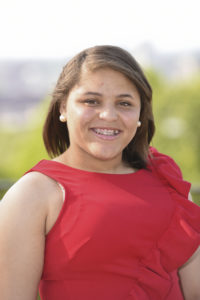
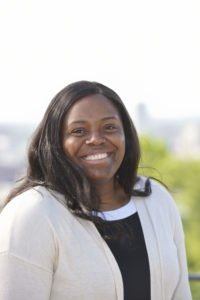
Jenisse Rios of Colonial High School; Naia Butler of Embry Riddle Aeronautical University; Jianna Best of Cypress Creek High School; and Samela Pynas of Oak Ridge High School each received $5,000.
About Ford Motor Company
Ford Motor Company is a global company based in Dearborn, Michigan. The company designs, manufactures, markets and services a full line of Ford cars, trucks, SUVs, electrified vehicles and Lincoln luxury vehicles, provides financial services through Ford Motor Credit Company and is pursuing leadership positions in electrification, autonomous vehicles and mobility solutions. Ford employs approximately 203,000 people worldwide. For more information regarding Ford, its products and Ford Motor Credit Company, please visit www.corporate.ford.com.
By Lynette Monroe (Program Assistant, NNPA ESSA Public Awareness Campaign)
Dr. Tiffany G. Tyler is the president and CEO of Communities in Schools (CIS) Nevada. CIS creates school-based strategies for improving the academic outcomes of students by addressing their basic needs. This work centers on helping school leaders understand the needs of their school populations apart from over-simplified ethnic and income categories.
As a former high school dropout, Dr. Tyler used the motivation from the birth of her first son (she said she didn’t want her son to “have a dropout as a mom.”) to propel her to the highest levels of academia, as an education psychologist. While studying for her dissertation, she happened upon a report detailing circumstances that contribute to student dropouts, as well as preventative practices that retain enrollment. She uses her experiences as a former beneficiary of many of the services she now provides to inform her role as chief Advocate.
“Having the benefit of people, over the course of my return to school, who not only encouraged me to continue my education, but helped in many ways, I now have the opportunity to pay it forward every day,” Dr. Tyler said, speaking of her daily motivation to make a difference.
Dr. Tyler said that her primary responsibility is to shepherd the vision and mission of the organization: to provide children with the resources and support they need to not only graduate, but to lead a successful life. Communities in Schools operates in South Nevada, encompassing 50 schools in the Las Vegas metropolitan area, Marshall County, and Elko County. An impressive 66,720 K-12 students benefit from the integrated services provided by CIS, yet the need still outweighs access to resources.
Dr. Tyler believes in the power of the work, but also in the power of action. In order to really move the needle on reducing dropout rates she believes we need everyone at the table; not only to discuss the challenges faced, but to also develop a course of action for moving forward. Dr. Tyler is consistently looking to partner with stakeholders and other like-minded organizations to bring more assets to schools. She serves as the co-chair of the Juvenile Justice Services Citizens Advisory Committee in Clark County and maintains board memberships on a number of organizations in the community.
The Every Student Succeeds Act, memorializes integrated support services as a successful practice and allows federal use of resources to be leveraged to provide more resources to communities. For the first time in federal education policy, integrated support services are explicitly noted as an allowable intervention for funding and noted as a strategy that districts and states can employ or use to turn around underperforming schools. ESSA recognizes that family and student support play a key role in improving academic outcomes for students.
Dr. Tyler encourages educators to uphold principles like equity, social justice, and community that transcend any one administration. Principles such as these are at the core of legislation like ESSA. Furthermore, parent engagement is a crucial part in ensuring student success.
Parents should see themselves as partners. Parents should show up and share their vision for their children; what they see as their child’s strengths and how they would like to partner in assisting with their challenges. Parents should advocate for what they perceive are their needs.
Dr. Tyler charges parents to get informed about the policies that directly impact their household and remain consistent in their engagement to ensure staff accountability.
Learn more about the Every Student Succeeds Act at www.nnpa.org/essa.
Lynette Monroe is the program assistant for the NNPA’s Every Student Succeeds Act Public Awareness Campaign and a master’s student at Howard University. Her research areas are public policy and national development. Follow Lynette on Twitter @_monroedoctrine.
In honor of National Autism Awareness Month, Sheletta shares her experience as the mother of three children on the autism spectrum.
My son Brandon, after he was diagnosed as autistic, had an appointment with a speech pathologist named Becky at a local children’s hospital. They say it was random and that the computer picked her, but I know now it was divine intervention.
I insisted that my momma tag along for the evaluation since she didn’t believe there was anything wrong with my child and I was just making it all up to get attention for myself. “You won’t trust your daughter,” I chided her, “so I’m gon’ take you with me and let these White folks with some letters behind their names tell you that Brandon has autism. Maybe you’ll listen to them.”
She rolled her eyes and pursed her lips. I ain’t care. She was gon’ go with me to every appointment and every evaluation until she was on board with Brandon’s recovery plan.
When Becky came out to the lobby of the speech center to receive us, she had the biggest smile and the warmest spirit. I knew at that moment that she would be a blessing to my family.
While she evaluated Brandon, she insisted my mother and I stay in the room with her. Unlike other evaluators before her, she wanted to include us in what she was doing.
My ol’ nay-saying momma sat there with her arms folded and her legs crossed looking like the angry Black church usher that she is. Becky didn’t let Momma’s stank attitude intimidate her. She kept on testing. Asking questions. Running trials.
When Becky was done with everything, I could see my momma’s disposition had changed. Suddenly Momma saw what I saw – that my baby, her favorite grandson, had autism and would need intense help to get better.
Becky, being led by the Spirit, addressed my momma right away: “Mrs. Handy,” she assured her, “with the right therapy your grandson can be a normal kid, but it’s going to take a lot of work. But the hardest part is done. You’re no longer in denial.”
My momma couldn’t even breathe she was crying so hard…
Becky told her plainly, “You should be proud of your daughter for bringing little Brandon in as soon as she noticed something was wrong. That doesn’t typically happen with Black parents. Now, my White parents, I’ve had them bring their kids to be evaluated as young as six months old. That means they get treatment and services for their special needs child right away. Then, by the time the little kiddo heads to pre-school, they’ve had three years of therapy, and by then they’ve caught up to their friends.”
“But why don’t Black parents come in sooner?” my momma had the audacity to ask.
“Cause they’re in denial, just like you,” I fussed. “Instead of seeing that something is wrong with our kids and trying to fix it right away, we turn a blind eye.”
“And by the time my Black families start looking for help,” Becky added, “the child is five or six years old and they haven’t had any therapy, they can’t talk, and they’re acting out.”
I put another two-cents in: “Because they can’t talk, they’re in school frustrated and fighting. Now we run to a therapist looking for a miracle when we done missed out on three or four years of good therapy.”
“And early intervention is the key,” Becky reminded us. “The sooner your child gets help, the better the outcome.”
“So what’s next?” I asked Becky. “How do I get my baby to a point where autism is in his past and college and a career are in his future?”
I had been so frustrated prior to meeting Becky. Nobody helped me. Nobody told me what I needed to do. Not one doctor, therapist or specialist threw me a life-line.
Becky was different. She walked over to her desk, got a pencil, some paper and a clipboard that she handed to me and directed, “Write down what I’m about to tell you. This is what you need to do for Brandon.”
With that she laid out the road map for my son’s successful transition from special education to accelerated learner:
Get him into a quality private pre-school a few days per week. Keep him out of special education classes in the public school if you can. Make sure the pre-school teachers are educated and have degrees.
When he does go to elementary school, make sure you have a plan to mainstream him into a regular classroom as quickly as he’s ready for it.
Have him see a good private speech therapist. The public schools will provide some special services like speech and occupational therapy, but if you want the best care, you’re going to have to pay for it.
Find an occupational and physical therapist Brandon can visit once weekly so he can work on his fine and gross motor skills.
Get under the care of a developmental pediatrician and a developmental psychologist for yearly evaluations and medications that may be helpful to curb some of the typical autistic behaviors.
And finally, and most importantly, get him signed up for applied behavioral analysis (ABA) therapy either at a center or in the home. This method of therapy has been proven the most effective at helping children with autism.
I could have kissed that White lady on the mouth. She had just laid out a solid foundation to help heal my child. But after looking over my notes, I asked, “How, Ms. Becky, can I afford this? Private school. Three or four different kinds of therapy. Medication from specialists who may or may not take my insurance—”
She cut me off: “There are scholarships and grants available that will give you the money to pay for everything you need for your child. All you have to do is go online to find them, then apply.”
I left her office with a mission, determined to find help for my baby.
The speech therapist she recommended cost a whopping $800 a month (they so good, honey, they don’t even take insurance; it’s a straight cash payment like the weed man). It didn’t come out of my pocket, though, because I applied for a United Health Care Foundation Grant that gave me $5,000 to cover the cost.
The tab for that applied behavior therapy for Brandon was $900 per month, and that was after our medical coverage kicked in. It didn’t matter because I found the C.A.D.E. scholarship [Children with Autism Deserve Education, a Minnesota nonprofit] and it paid for an entire year.
I continued to find more and more resources. Before it was all over, I raised nearly $50,000 to pay for all the good therapy Brandon needed. I got so good at finding money to pay for stuff, I started holding free workshops for parents who have special needs kids to teach them how to find grant money and scholarships for their children.
And guess what? All the White churches let me in, and they were always full of folks who were looking for financial assistance. Our Black churches would not let me in. Well, that’s not fair to say all of them rejected me; I’m still waiting on the deacon board from a few of them to get back with me.
And remember, I’m doing this for free!
Now, after three years of quality therapy like them White folks be getting, my child is in a regular kindergarten classroom. He’s reading, doing math, giving me eye contact, talking and talking back.
Yes, honey, he is a typical five-year-old boy. Today, right now, you can’t tell he had been diagnosed with autism.
God is good. I’m glad He chose me to be this bright little boy’s mommy. Brandon has hope and a bright future, and I’m thankful to Ms. Becky for giving me the roadmap to get there.
I was home free with Brandon’s recovery – or so I thought. I must have done too good a job, because the Lord decided to choose me two more times. My daughter Cameron and my son Daniel have also been diagnosed with autism spectrum disorders.
I’m rolling up my sleeves and getting ready to do battle. This time I have all the weapons I need. My family motto: We want our kids healed, not helped!
Sheletta has provided a list of centers in the Twin Cities that provide excellent care to children who have been diagnosed with autism spectrum disorders. In addition, she’s provided links to all the scholarships and grants that are available to pay for therapy and medication. See below for details.
The deadline for HBCU students to submit an application for the 2018 Discover The Unexpected Journalism Fellowship, or DTU, is April 30.
The DTU Journalism Fellowship includes:
8-week multi-city journalism fellowship working with National Newspaper Publishers Association (NNPA) newspapers in Atlanta, New York City, Washington D.C. and Norfolk.
$10,000 scholarship and a $5,000 stipend for living expenses provided by Chevrolet
access to an all-new 2018 Chevrolet Equinox for a road trip of a lifetime!
This is the first year DTU is open to all HBCUs. DTU was launched at Howard University in 2016. Last year, the program expanded to include Clark Atlanta University, Morehouse College and Spellman College.
The DTU Fellowship is looking for HBCU studentswho are multi-media savvy and have a passion for storytelling.
DTU Fellows will be assigned to write stories that spotlight positive and powerful people and events. The Fellows will be responsible for all aspects of storytelling: writing, videography, photography, research, on-camera reporting and social media posting.
The Fellows will be placed in two 3-person teams. Over the course of the internship, each team’s road trip will take them to two different cities where they will spend four-week intervals working alongside experienced staff at NNPA member newspapers.
The participating NNPA newspapers are: The Washington Informer, The Atlanta Voice, The New Journal & Guide in Norfolk, and The New York Amsterdam News.
Any student who is at least 18 years of age, attending an HBCU in their sophomore, junior or senior year and majoring in journalism or mass communication is encouraged to apply.
Students are required to submit:
Resume with GPA
Video submission
Technology/social media profile
Writing sample
The completed applications and video submissions will be screened and evaluated to select six DTU Fellows based on application scores.
Students can apply for DTU 2018 through April 30th on the program’s website, www.nnpa.org/dtu
Several years ago, Dr. Renaldo Blocker was reflecting on the importance of mentors in his life. “We realized that we were fortunate to have a support system throughout our academic and professional career.” Blocker is a Mayo Clinic healthcare systems engineering assistant professor.
“We were fortunate to have these people in our lives… Many of our peers did not.” Blocker wanted to help other students benefit from such support – and more. From this emerged “Why You?”
The support system Blocker envisioned back in 2003 included mentoring, but, he explained, it was “way more than that.” In 2011, he and Dr. Antonio Daniels co-founded the “Why You?” Initiative, Inc. (YU?), a Minnesota-based nonprofit organization.
The program was about more than providing resources: It’s about “connecting with other people who can help me move forward in my life.” Blocker added, “We still have those same mentors [and the] same support system today that continually challenges us to move forward and become even better and brighter.”
Asked about the group’s title, Blocker recalled, “We were trying to come up with a good name. We said we should be asking a rhetorical question and we came up with ‘Why You?’ We are questioning the students on why me [to] help them understand that they are needed, [they] are unique, they are valued, and they have a sense of purpose for the greater community. They don’t realize that.”
Originally from Atlanta, Georgia, Blocker is a first-generation college graduate with degrees in computer science and industrial and systems engineering. “We provide a support system for students either younger than us [or] older than us,” he said. “As we become more educated, we provide a theoretical and conceptual framework in how we approach it.”
He said that of the estimated 180 students participating in the program, nearly half are males. All are from low-income backgrounds. “We have students in 17 states. We don’t have branches. Ages range from 15-year-olds to the oldest person in the organization, who is 47 years old.
“Eighty percent of our budget comes from me and the co-founder; the other [20] percent comes from our friends,” Blocker said of the group’s funding. Last year, his organization received several grants, including one from the St. Paul Foundation “that helped with our programming,” he reported.
Blocker said there are monthly webinars, which usually begin in May and run through September. He added there is also an on-line ConFab being planned for this September.
“We have students across the board,” he continued. “A lot of our students are STEM [science, technology, engineering and math] majors — about 40 percent. We have students who are in the arts and humanities, pre-law [and] medical school.
“We are more of a long-term engagement that includes not just high school and undergraduate students – we do the gamut. We try to tackle high school students and post-high school students, the ones that maybe graduate from high school but need someone in their life to show them and support them through a higher pace.
“Former U.S. President Barack Obama’s ‘My Brother’s Keeper’ initiative does fall in line in what we do,” he said.
Why You? held its first in-person ConFab last month in Minneapolis expecting about 180 people, but nearly 200 persons showed up, said Blocker. “I thought the numbers would be real low because it was our first time. We were surprisingly pleased with the turnout.
“They [the conference participants] thought it was an excellent event and said they would like to come again. People came away feeling empowered. The purpose was for all those students that we serve [to have] an opportunity to come to Minnesota and actually meet some of their mentors face-to-face for the first time.”
There is no formal requirement to participate in Why You? “We have an on-line application process that we open up in June and November,” Blocker concluded. “The only requirement is that we want students to want to be helped. If those students don’t want to be helped, we can’t reach out to help them.”
Earlier this year, Mayor Randall L. Woodfin invited Birmingham City Schools’ students, children of city employees and students attending other schools in Birmingham to reflect on what inspires them about the Magic City. Students could draw anything from their favorite park or school to their community and even the mayor for the “My Birmingham. My Mayor. And Me’’ art contest.
There were more than 200 entries from grades kindergarten to 12th. Judges were impressed by the submissions, which included colorful charcoal pieces, collages, paintings, colored pencil works and even a sculpture of the mayor. On Tuesday, April 17, Woodfin recognized the first-place winners during the Birmingham City Council meeting. Woodfin congratulated each student and thanked them for showcasing what they loved about the city.
“All of these submissions show the tremendous talent of students in Birmingham. I thank each student for dedicating their time for the contest, each teacher for guiding them through the process, and every parent for supporting their child in this endeavor,’’ the mayor said.
This month’s visit to City Hall was a first for Zaiderick Hayes, a fifth grader at Avondale Elementary School. He said he got the idea to create a collage for his winning piece after doing research on the internet. Zaiderick included some of his favorite places in Birmingham and a hand-drawn image of the mayor.
“It wasn’t hard. It took two days to draw the mayor,’’ said Zaiderick, whose art work has won other awards. At Avondale Elementary, an award-winning piece he did for a different contest will be featured on the school T-shirt next year.
Said Principal Courtney Nelson: “I’m proud of Zaiderick and all of his accomplishments. He is an art legend at Avondale.’’
Art work by students receiving first, second and third place will be on display on the third floor of City Hall through April. Art work by all other students will be on display at various libraries that part of the Birmingham Public Library system. To see a list of libraries hosting the art work, please visit www.birminghamal.gov.
This contest was made possible by The Mayor’s Office; Division of Youth Services; Birmingham Museum of Art; Arlington House; Birmingham Public Library; Birmingham City Schools; Birmingham City Schools Dr. Lisa Herring and McDonald’s.
And then there were five. That’s the number of finalists remaining in the NextGen Pitch Competition, for which dozens of students and teachers pitched ideas on how to make a better Birmingham.
Earlier this year, students and teachers submitted application essays that incorporated the following statement: “Birmingham’s bright future depends on ….” A panel of judges narrowed the submissions to six who were then paired with mentors from partner companies to help perfect the ideas and possibly make them realities; that list is now down to five.
On May 3, two students and three teachers with Birmingham City Schools will compete for the grand prize of $5,000; second- and third-place prizes are $1,500 and $1,000, respectively. The finals will be held at the Economic Development Partnership of Alabama building downtown Birmingham. There will be a reception at 5 p.m. followed by presentations at 6 p.m.
Summit Media’s Chuck Faush, who created the event and has partnered with the Birmingham Education Foundation (commonly called the Ed Foundation) and BBVA Compass, said students participating in NextGen are among the most talented in the Magic City.
“Two years ago, we launched an event hoping to recognize and reward those who give of themselves to make all of our lives better,” he said. “During that event, we were amazed that one of our awardees happened to be a student. That made us all realize that we have giants among us who are young and gifted, so we created NextGen to encourage and empower our youth and those who guide them every day.”
J.W. Carpenter, executive director of the Ed Foundation, which is a key supporter of and contributor to the event, said his group knows firsthand that Birmingham City Schools students and educators have fantastic ideas.
“Everyone involved with NextGen believes that we should shine a light on these ideas,” he said. “[We] are collaborating to put the spotlight on the people we should be listening to most when it comes to education: students and teachers.”
Here’s a closer look at the two NextGen student finalists and their mentors, as well as the three teacher finalists and their partners.
Students
Kamil Goodman…NextGen Birmingham teams and group shots at Vulcan Park in Birmingham Alabama Wednesday, April 18, 2018. (The Birmingham Times / Frank Couch )
Kamil Goodman, a 16-year-old A.H. Parker High School sophomore, proposes a leadership roundtable that will include youth leaders and elected officials in Birmingham. She is partnered with Zhaundra Jones of the Community Foundation of Greater Birmingham, “a permanent charitable endowment to drive positive change,” according to cfbham.org.
In her pitch, Goodman writes that the roundtable will serve as an opportunity for elected officials to fully engage with and hear the voices of young people in the city: “Elected officials will be able to hear how youth feel regarding violence, education issues, employment, and how to retain youth in Birmingham after graduating from high school or college.”
“Youth leaders have a voice and desire to be involved in the growth that awaits Birmingham,” she continues. “… This engagement will allow elected leaders to gain a true feeling and understanding of the youth today and create a blueprint for tomorrow.”
Jarvis Prewitt…NextGen Birmingham teams and group shots at Vulcan Park in Birmingham Alabama Wednesday, April 18, 2018. (The Birmingham Times / Frank Couch )
Jarvis Prewitt, a 16-year-old Huffman High School junior, said he’d like to implement a “Makerspace” program in all 43 Birmingham City Schools. He is partnered with Forté of the Ed Foundation, which is “driven by an urgency to help … students reach their potential,” according to edbirmingham.org.
Prewitt writes, “A Makerspace is collaborative learning environment where students and its users utilize technology to invent, experiment, and explore, while being challenged to be creative and think outside of the box while using STEM (science, technology, engineering, and math). [It] … would serve as a virtual classroom where educators take the curriculum or a teacher-led project and utilize it in these labs. To further make the schools more inviting to parents, schools would partner with businesses that specialize in STEM to provide training in the parent-resource center.”
Teachers
Shauntae Lockett Lewis…NextGen Birmingham teams and group shots at Vulcan Park in Birmingham Alabama Wednesday, April 18, 2018. (The Birmingham Times / Frank Couch )
Shauntae Lockett Lewis, a physical education teacher at Minor Elementary School, would like to see a recruitment service for non-revenue-generating sports. She is partnered with Walter Body of the Coca-Cola Bottling Co. United Inc., which “proudly support[s] many civic and charitable organizations serving [Birmingham’s] communities,” according to cocacolaunited.com.
“Everyone is looking for the next LeBron James, but your typical volleyball, soccer, or track-and-field athletes are not getting these looks,” Lockett Lewis writes. “If we offered a process beginning in 9th grade assisting students and parents with the process, we would see more of our non-revenue sports getting into college.”
Christina Sellers…NextGen Birmingham teams and group shots at Vulcan Park in Birmingham Alabama Wednesday, April 18, 2018. (The Birmingham Times / Frank Couch )
Christina Sellers, a kindergarten teacher at Huffman Academy, proposes a Genius MAP nonprofit organization that prepares and pairs students with the college or university of their choice “through mastery, autonomy, and purpose.” She is partnered with Caitlyn Burchfield of Butler Snow Law Office, “among the best nationwide in service—in anticipating needs, in a commitment to help …,” according to butlersnow.com.
“Our mission is anchored in belief,” Sellers writes. “At its heart, our program is sustained by the belief that our expectations and how students perform are positively correlated.”
“Students and parents will meet with a MAP guide every nine weeks to select actionable items that have been made available through partnerships with schools, local organizations, universities, and stakeholders to add to their current MAP module for completion. … Once items have been added to a student’s MAP module, students, teachers, and parents will receive a physical document and MAP legend detailing each activity and opportunity with relevant information, dates, and instructions.”
Kaleena Watts…NextGen Birmingham teams and group shots at Vulcan Park in Birmingham Alabama Wednesday, April 18, 2018. (The Birmingham Times / Frank Couch )
Kaleena Watts, who teaches American literature in A.H. Parker High School’s English Department, has proposed a districtwide student news outlet created for students by students. She is partnered with Valeria Walton Cornner of the Economic Development Partnership of Alabama, “a private, nonprofit organization … that works to attract, retain, and grow jobs in Alabama, while encouraging innovation,” according to edpa.org.
This effort is needed in today’s current political, socioeconomic, and educational climate, Watts writes: “With less than 20 percent of the students in our district reading at or above proficiency level, the student news will serve as a new resource to engage young readers, building better reading skills and habits. The platform … will allow students across the seven high schools … to collaborate in a way that models global business practices.”
The National Newspaper Publishers Association (NNPA), in partnership with Chevrolet, recently announced that the 2018 Discover The Unexpected (DTU) Journalism Fellowship will now accept applications from communications and journalism students attending any one of the Historically Black Colleges and Universities (HBCU) across the country.
In 2016, the DTU Journalism Fellowship launched at Howard University. The following year, the program expanded to include Morehouse College, Spelman College and Clark Atlanta University. Now communications and journalism students at more than 100 HBCUs can apply.
“This year’s program also provides an opportunity for the aspiring, young journalists to look beyond the newsroom for story ideas,” said Michelle Alexander, the diversity marketing manager for Chevrolet. “They will have an opportunity to travel across several states in the all-new 2018 Chevrolet Equinox to discover inspiring stories along the way.”
Hip-hop legend MC Lyte will also return as the program’s ambassador.
For the third year in a row, The Washington Informer and The Atlanta Voice will participate in the program; the New York Amsterdam News in New York City and The New Journal & Guide in Norfolk, Va. will also host DTU journalism fellows.
“DTU fellows will be assigned to write stories that spotlight positive and powerful people and events,” according to a media advisory about the program. “The fellows will be responsible for all aspects of storytelling: writing, videography, photography, research, on-camera reporting and social media posting.”
This year, “the fellows will be placed in two, three-person teams,” the media advisory explained. “Over the course of the internship, each team’s road trip will take them to two different cities where they will spend four-week intervals working alongside experienced staffers at NNPA member newspapers.”
Alexa Imani Spencer, a journalism student at Howard University participated in the program last summer, working at The Washington Informer.
“Working for a historically Black publication helped me to understand the full worth of our institutions, as Black people,” Spencer said. “[The fellowship] helped me to understand that there has always been a voice throughout history that has advocated for us and there will always be somewhere, where we can advocate for ourselves, so long as we continue the legacies of these publications.”
Spencer continued: “The Black Press is an institution that the next generation of young, Black journalists has to preserve.”
Dr. Benjamin F. Chavis, Jr. the president and CEO of the NNPA, said that the third year of the DTU Journalism Fellowship represents significant progress in the NNPA’s ability to tap into the rising genius of African American millennials, exposing them to the power of the pen.
“Journalism has experienced renewed interest in the Black community,” Dr. Chavis said. “There has always been a need to not only report the news of Black America to the world at large, but also to be an advocate for the empowerment of African and African American communities across the United States and around the world.”
Dr. Chavis said that the partnership between the NNPA and Chevrolet is setting a standard for the rest of corporate America.
“This is not about philanthropy, this is more about engaging the African American community through the contributions of Chevrolet to the NNPA,” Dr. Chavis said. “It really strengthens one of the fundamental institutions in the Black community, which is the Black Press.”
Spencer said that the 2018 DTU fellows will not only experience personal growth, but that they will also gain a family by completing the program. Spencer also said that the Black Press represents another avenue, where HBCU students can help the Black community thrive.
Dr. Chavis agreed.
“There are tremendous opportunities [in the Black Press] for HBCU journalism and communications students to not only to make their mark in the profession, but to also provide an invaluable service in the Black community,” Dr. Chavis said.
The deadline to submit applications is April 30. Learn more about the NNPA’s Discover The Unexpected Journalism Fellowship at www.nnpa.org/dtu.
On Saturday, May 12, 2018, the Pasadena Chapter of Alpha Kappa Alpha Sorority, Inc. is sponsoring its 30th Annual Fashionetta Salute to Mothers and Scholarship Luncheon & Fashion Show at the Glendale Hilton from 10 AM – 3 PM. This annual fundraising event will award 10 Scholarships and 5 Book Awards to college bound students from the Pasadena/ Altadena/ San Gabriel Valley area.
The Pasadena Chapter of AKA recently hosted a State of Black Pasadena Community Meeting that highlighted the importance of education in lifelong success. While the importance of an education only continues to be more important, the ability to attain this education is becoming harder. According to the College Board’s “Trends in College Pricing 2017” report, the cost of public school tuition has increased by 213% ($3190 in 1987-1988 to $9970 in 2017-2018). Per the same source, the cost of tuition at a private nonprofit was $15,160 in the 1987-1988 school year, but is now $34,740 in the 2017-2018 school year for an increase of 129%.
At the same time tuition has been increasing, the cost of room and board continues to increase along with the cost of books where a student could easily spend $400 on a single text book. The increase in the cost of textbooks has lead savvy students to take advantage of the opportunity to rent their books and/or leverage a $2500 IRS textbook tax credit.
In order to help college bound students handle these rising costs, the Pasadena Chapter of AKA has awarded scholarships to college bound students since it was chartered in 1960. They are proud to highlight that through the years they have awarded over $250,000 in Scholarships and Book Awards. Students have used these monies to help offset costs so they can attain a much needed education that puts them on the road to lifelong success.
Scholarships will be awarded in the areas of STEAM (Science, Technology, Engineering, Arts and Math), Social Justice/ Economic Development, Special Needs, Most Improved GPA and Young African American Male. Each of the awardees is impressive and come from schools in the San Gabriel Valley. If you want your heart to be fi lled with joy as you hear the amazing stories of our young adults, come out to the 30th Annual Fashionetta Scholarship and Salute to Mothers Luncheon.
You can become a Scholarship Patron and directly increase the amount of the awards that will be given to the 2018 recipients by donating $250 or more. We will give you special recognition at the event, in our Souvenir Journal and on our website. You can make your donation at ‘thepaif. org’. Please call 626.475.7710 with any questions on becoming a Scholarship Patron.
If you cannot join us at Fashionetta, but want to make a difference that is less than becoming a Scholarship Patron, you can go to ‘thepaif.org’ to make a tax deductible donation. Designate it for Scholarship and the monies will make a direct difference in the amount awarded to this year’s scholarship winners.
During Fashionetta, we will also honor the Mother of the Year, have unique vendors available for shopping, enjoy a beautiful luncheon and a Fashion Show. If you want to attend Fashionetta and support our youth, you can go to ‘thepaif.org’ to purchase a ticket. Your support is needed and appreciated. Let’s make a difference together.


 FOR IMMEDIATE RELEASE