The Wisconsin Mathematics, Engineering, and Science Talent Search is an annual competition for middle and high school students from Wisconsin. The organizers create five problem sets each consisting of five unusual and challenging math problems. The solution of these problems does not require advanced mathematical knowledge, just hard work and creativity. The participants have one month to work on each problem set and can send in their solutions via email or regular mail.
Top problem solvers will be invited to participate in the Honors Day Celebration in May, 2018 and will be eligible to compete in the Van Vleck Scholarship. The scholarship will pay $6,000 per year for four years at the University of Wisconsin in Madison.
The first problem set is now available online. Please visit the Talent Search website to access the problems and additional information. If you have any questions about the Talent Search, feel free to contact the organizers at talent@math.wisc.edu.
We asked educators on NEA Today Facebook about the best thing that happened in their classrooms and schools last week. Some raised money with their students for disaster relief, others attended fun school-community events, and a whole lot had break-through moments with their students that sometimes brought tears to their eyes. We can all use a little positivity, so here’s a roundup of the good news they shared:
A discouraged dyslexic third grader has realized he can read the books I have set in a bin for him… and asked for permission to take some of the books to his after school program! This is the boy who normally says thing are too hard and puts his head down!Theresa Early, Fairfax, Virginia
Through the generous donations of my friends, I took my low-income, urban, Boston-area students on a field trip to New York City – the Empire State Building, Times Square, Ellen’s Stardust Diner, Liberty Cruise, Pizza Suprema – because they got the highest growth percentile on our state exam, because they worked their butts off every day in class, reading six more books than were in the curriculum, and because they are AWESOME.Nancy Petriello Barile, Boston, Massachusetts
My two newcomers with very little English yet, and who are both still pretty reluctant to attempt to speak in front of the whole class, enthusiastically volunteered to share their mathematical thinking and strategies during a math session this week. They were beaming from ear to ear with pride… Not only proud of them for putting themselves out there, but also for how supportive and encouraging the rest of the class always is of them. Made my week! Jennifer Gage Moke, Portland, Oregon
My seniors and AP juniors hosted a college and career fair for younger students (5th-10th graders). Each of my students became an “expert” on a college, military branch, or career field he or she hopes to pursue, created a table display and one-page informational handout, then they shared their research knowledge with their visitors. Barb Brown Andres, New Lothrop, Michigan
My first grade students performed All You Need is Love at our monthly assembly. We had picked the song long ago but it was so timely. Children remind all of us how beautiful the world is. They inspire me and drive me to be the best I can be every single day. Marianne Vasquez, Bakersfield, California
We presented a check for $5,100 to fund childhood cancer research at a local charity, the N8 Foundation. I work at the same school as Marianne Vasquez. Our school had a good week. Karen Nguyen, Bakersfield, California
I was subbing this week and when I introduced myself to the teacher she screamed and started crying because I had been her 2nd grade teacher!! I was so touched but felt old! Linda Morgan, Highland, California
During a math review quiz, one group worked together and only missed one question. But better than that was the collaboration. I heard things like, “We both got the same answer, do you agree with us” and “yes, I agree because…”. I was so happy I could cry! Megan Rene, McMinn, Lewiston, Idaho
We had a kindergarten potluck at a local park. It was so fun for the kids, parents and grandparents to have a chance to meet each other. I loved spending time with my students’ families and meeting families from the other K classrooms with my K team. Carol Harris, Steamboat Springs, Colorado
I have a student that is passing a high school math class for the first time… the joy on the student’s face makes all the daily struggles so worth it! Nell Dearing, Carlsbad, New Mexico
Thursday I returned as a volunteer at our highest poverty school to help some of the most dedicated teachers and work with kiddos that fill my heart! Phyllis Schneider Winkley, Vernon, Connecticut
New student came into our classroom and did not have a “rest buddy” of his own for rest time. The next day, a concerned child brought a gently used and carefully chosen stuffed animal of his own for his new friend. Heartwarming! Shelly Hess, Vincent, Ohio
Our association members attended events in the 3 communities that make up our district, raffling off 12 baskets of books, three Kindle fires and three family memberships to the Philadelphia zoo. Raffle tickets were free as prizes were donated by the teachers. Nicole May Armbruster, Aston, Pennsylvania
I got to see a second-grader who is struggling with behavior be a great role model to a first-grader who is struggling with behavior. ^_^Seeing them interact in such a sweet, friendly manner made my heart happy! Sarah Wood, Keizer, Oregon
An email from a parent informed me that her child loves my class and is excited about learning to love reading and writing, a subject she’s struggled with in the past. Joel Elrod Melsha, Orlando, Florida
A student who had done poorly in his first test put forth great effort at home studying, coming for extra help and really focusing during the test. ( that is hard for him). He finished early so I graded his test and it was a perfect test –100%. It was his birthday too. Right from the classroom, we called mom in front of the whole class and celebrate him. His mom was happy and the class applauded him. His smile lit up the whole room. Debra Calle, Bergenfield, New Jersey
A student who is homeless was going to have to transfer schools and be uprooted from all that is stable in his life. Our transportation department figured it out and will be busing him! Autumn Schultz, Toledo, Washington
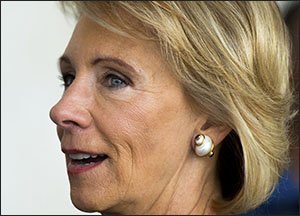
WASHINGTON – U.S. Secretary of Education Betsy DeVos today released the following statement on the announcement of new members to the President’s Task Force on Apprenticeship Expansion.
“Apprenticeships have the potential to offer America’s students the hands-on education needed for today’s in-demand jobs, and expanding these opportunities will prepare them for success in the 21st century economy,” said Secretary DeVos. “As a Vice Chair of the Task Force on Apprenticeship Expansion, I am excited to be part of this Administration’s efforts to strengthen workforce readiness and increase the number of postsecondary pathways available to students. I look forward to working with state and local educators, business and industry leaders and other key stakeholders as we continue our work to put the needs of America’s students and businesses first.”
“To Kill a Mockingbird” is being removed from a junior-high reading list in a Mississippi school district.
The Sun Herald reports that Biloxi administrators pulled the novel from the 8th-grade curriculum this week. School board vice president Kenny Holloway says the district received complaints that some of the book’s language “makes people uncomfortable.”
Published in 1960, the Pulitzer Prize-winning novel by Harper Lee deals with racial inequality in a small Alabama town.
A message on the school’s website says “To Kill A Mockingbird” teaches students that compassion and empathy don’t depend upon race or education. Holloway says other books can teach the same lessons.
Two studies published by Education Next (EdNext) … conclude that parents seem to be happier with their children’s schools when they are able to choose them.
The first study was an analysis of data from the 2012 National Center for Education Statistics (NCES) survey, which was given to a representative sample of 17,166 households. In the survey, the US Department of Education asked parents about their satisfaction with their child’s school. While the data was collected in 2012, it had never been published until the EdNext analysis.
The data showed that the percentage of parents who were “very satisfied” with their children’s schools was higher for parents with students in schools of choice—including charter schools (63 percent), district schools of choice (61 percent), and private schools (81 percent)—than for parents with students assigned to a specific district school (56 percent).
The second study reported on the results of a first-of-its-kind parent satisfaction poll that EdNext conducted last summer, with a representative sample of 1,500 parents. Across all surveyed categories, except “location of school”, the data showed that more chartered school parents were “very satisfied” or “satisfied” than district parents. Similarly, private school parents were more satisfied across all categories than district parents.
The two studies support the hypothesis posed that, “to maintain and enlarge their market share, all schools of choice must satisfy the families who make use of them.” And the consistency between the two is important, according to Paul Peterson, an author on both studies, because “even though [the two surveys] had somewhat different methodologies our findings are surprisingly consistent.”
The findings of these two studies are also consistent with overall national American attitudes towards choice and chartering. Last year’s PDK/Gallup Poll showed nearly two-thirds of Americans are in favor of charter schools, and of permitting parents to select any public school in their district.
Milwaukee Public Schools has begun to pave a way to a better future for young men and boys of color. The Department of Black and Latino Male Achievement (BLMA) was established to address the disparities in academic and life outcomes for young men and boys of color, and to implement programs that improve their lives, according to a press release.
MPS has high hopes that this new department, that officially launched this school year, will be a success.
BLMA is ran by five men who are dedicated to changing the lives of young men and boys. Juan Baez and Lanelle Ramey are directors of BLMA, Paul Moga is the coordinator, David Castillo is the planning assistant and the newest member is Sergio Muniz who will be working closely with the children— each of these men will report directly to Superintendent Darienne Driver.
The department brought out 50 male students of color to Casimir Pulaski High School on Oct. 2 to let the students know this department is an advocate for them, said Ramey.
Ramey along with other members of the department are products of MPS, and he’s happy to be helping young men who were just like him have a better chance at life.
“We do this from our heart,” said Ramey. “I am a product from it (MPS) all the way.”
Ramey began his days with MPS in grade school, and now many years later he’s still in the system, but now with more power to help change things.
Men and boys of color is the focus of this department because the data shows they’ve fallen behind everyone else. Now the department has made it their duty to help these students reach their full potential.
“Change is coming for our boys of color,” said Ramey. “They’re important to us.”
BLMA is in the process of their 100-day plan, which is trying to define what exact activities and curriculum the department will provide not only for the boys of color, but MPS as a whole.
The National Campaign for Black Male Achievement (CBMA) has partnered with BLMA and will be supporting the department through its endeavors.
Ramey and Baez hope to change the media’s image of these young boys and men, and to also show these students how to embrace themselves.
Baez knows by helping these young men and boys it will positively affect the rest of MPS, and other students.
“We’re going to need to need the community’s support with this,” said Baez. “It’s really going to take a family.”
With just a handful of weeks left in this presidential administration, the U.S. Department of Education released a final rule Monday that could have a major impact on how districts spend their federal special education money.
The department’s regulation creates a standard approach that states must use in determining if their districts are over-enrolling minority students in special education compared to their peers of other races. If the disparities are large enough, districts are required to use 15 percent of their federal allotment under the Individuals with Disabilities Education Act on “coordinated, early intervening services” aimed at addressing the issue.
The new rule also requires states to use a standard approach to determine whether minority special education students are in segregated settings more than peers of other races, or if they face more suspensions and expulsions than their peers. Disparities in those areas would also trigger the requirement to use federal money to fix the problem. Though the 15 percent set-aside is for what the law calls “early intervening” services, districts could use that money for students from age 3 through 12th grade, the regulations state.
The requirement will go into effect no later than the 2018-19 school year…
Education Evolving
Originally Published, January 4, 2017
For the past five months, we have followed the development of Minnesota’s state accountability plan as mandated by the federal Every Student Succeeds Act (ESSA). While the US Department of Education (USDE) has defined what must be included in four of the plans’ required indicators, states have the freedom to choose which measures they will include in their fifth indicator, of school quality/student success (SQ/SS).
As we’ve previously written, because of the lack of available data, chronic absenteeism was identified by the Minnesota Department of Education (MDE) as the only SQ/SS measure that’s currently feasible for Minnesota. However, on November 29th, USDE extended ESSA implementation by one year, giving MDE’s Advisory Committee additional time to create a well-rounded SQ/SS indicator that would, ideally, include more than chronic absenteeism.
While most states have not released their ESSA draft plans, thirteen have—Arizona, Delaware, Idaho, Illinois, Louisiana, Maryland, Montana, North Carolina, Oklahoma, Oregon, South Carolina, Tennessee, and Washington. Arizona, Idaho, Montana, and North Carolina, however, do not define what possible SQ/SS measures their state will use.
All of the other states, except South Carolina, indicated that they intend to use chronic absenteeism as one of their SQ/SS measures; with Delaware, Maryland, Tennessee, and Washington using it only for elementary and middle schools.
Two SQ/SS measures were prominent throughout the state’s draft plans—Career and College Readiness and 9th Grade On-Track. Below are descriptions of the measures.
College and Career Readiness Measure
Seven states—Delaware, Illinois, Maryland, Oklahoma, South Carolina, Tennessee, and Washington—have some form of a College and Career Readiness measure that calculates a school’s performance on or access to Advanced Placement (AP), International Baccalaureate (IB), SAT, ACT, Career and Technical Education (CTE), and Dual Enrollment.
South Carolina’s measure is more complex, with high schools earning points based on the percentage of students who meet the College Ready/Career Ready benchmark, which is comprised of several different metrics, such as earning a 3 or higher on an AP exam or meeting ACT benchmarks in mathematics (22) and English (18).
Similarly, Tennessee’s measure, Ready Graduate, is calculated by multiplying the graduation rate and the highest percentage of students who do one of the following:
Score a 21+ on the ACT OR
Complete 4 Early Postsecondary Opportunities (EPSOs) OR
Complete 2 EPSOs and earn an industry certification
Washington’s measure is more prescriptive. It only has a metric for dual credit participation, which is measured by the percent of students who participate in a dual credit educational program.
Delaware is the only state whose measure includes a metric for elementary and middle schools. Specifically, Delaware uses a “growth to proficiency” metric, which measures the percentage of students on track to be at grade level in a given content area within three years.
Minnesota initially considered including a College and Career Readiness measure, but due to insufficient and misaligned data systems, the Technical Committee decided at the October 25th meeting to delay its inclusion.
9th Grade On-Track Measure
Three states—Illinois, Oregon, and Washington—indicated in their draft plans that they intended to use 9th-grade on track as a measure, which is the percent of first-time 9th grade students in a high school who do not fail a course.
Other SQ/SS Measures
Illinois: Early childhood education, which would be measured by kindergarten transition, pre-literacy activities, and academic gains. Unfortunately, the draft plan did not flesh out what “kindergarten transition” would measure, but it did indicate that it might not be ready for the 2017-18 academic year.
Illinois’ plan indicated that they may also use a school climate survey. Currently, Illinois uses the 5Essentials survey, which was developed at the University of Chicago and measures a school’s effectiveness in the following five areas:
Effective Leaders
Collaborative Teachers
Involved Families
Supportive Environments
Ambitious Instruction
Louisiana: Their ESSA Framework included a comprehensive list of SQ/SS measures that were divided into four categories:
Mastery of Fundamental Skills
Serving Historically Disadvantaged Students
Fair and Equitable Access to Enriching Experiences
Celebrating and Strengthening the Teaching Profession
Louisiana’s entire list of SQ/SS measures can be found here.
South Carolina: An “Effective Learning Environment Student Survey”, which would be administered every January to students in grades 4-12 and would include 29 items that measure topics on equitable learning, high expectations, supportive learning, active learning, progress monitoring and feedback, digital learning, and well-managed learning.
We will continue to report on ESSA updates in Minnesota and the country. MDE’s next ESSA Accountability meeting is scheduled for Thursday, January 5th from 5:30-8:00 PM. For more information about MDE’s ESSA implementation plan, visit their website.
Education and the Media – Education Week — Nikole Hannah-Jones, an investigative journalist known for her deep dives exploring race and the resegregation of the nation’s public schools, has been named a 2017 MacArthur Fellow, the so-called genius grants awarded in an anonymous process.
“I’ve known for about a month,” Hannah-Jones said Wednesday, one day after being named among 24 in the 2017 group announced by the Chicago-based John D. and Catherine T. MacArthur Foundation. “You basically get a call out of the blue, and then you can only tell one person. I told my husband.”
The foundation said Hannah-Jones’ work chronicles “the demise of racial integration efforts and persistence of segregation in American society, particularly in education.”
“She combines analyses of historical, academic, and policy research with moving personal narratives to bring into sharp relief a problem that many are unwilling to acknowledge still exists and its tragic consequences for African American individuals, families, and communities,” the foundation continued…



 We asked educators on