

Arkansas ESSA Resources
Contact the Arkansas Department of Education
Tina Smith, Special Projects Director
Arkansas Department of Education
Office of Communications
Four Capitol Mall, Room 305-A
Little Rock, AR 72201
Phone: 501-682-3667
Email: tina.smith@arkansas.gov
What is the Every Student Succeeds Act (ESSA)?
The Every Student Succeeds Act (ESSA) was signed by President Obama on December 10, 2015, and reauthorized the 50-year-old Elementary and Secondary Education Act (ESEA), the nation’s education law that provides opportunity for all students. Read the Every Student Succeeds Act at http://bit.ly/1TFr29X
As part of the Vision for Excellence in Education, Arkansas will define the Arkansas Accountability System and submit the proposal to the U.S. Department of Education(USDOE) for approval. Arkansas is committed to transparent communication with all stakeholders. ESSA Summary
ADE is committed to transparency of the process. Please see the log of meetings and presentations at http://bit.ly/2aKz0ma
Arkansas Accountability System (ESSA) Timeline
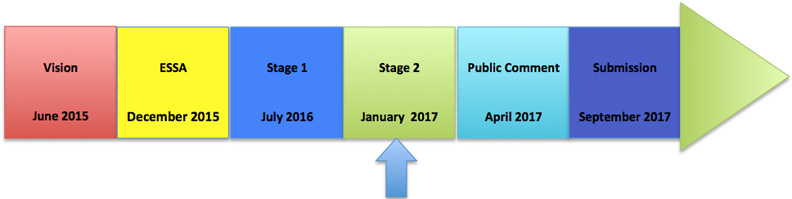
Handout: Arkansas Accountability System (ESSA) Timeline
Stage 1
Please visit http://bit.ly/2bPQ1fP to learn about all Stage 1 activities.
Stage 2
- The Steering Committee will continue meeting on a monthly basis.http://www.arkansased.gov/public/userfiles/ESEA/ESSA_Steering_Committee_Calendar.pdf
- Arkansas Department of Education begins writing the state accountability and support plan, continues to gather stakeholder feedback, and modify the plan based on the stakeholder feedback.
- The Advocates for Students group will provide targeted feedback on the state accountability and support plan through the lens of the students they represent. The advocate groups are: English Language Learner, Special Education Economically Disadvantaged, Race/Ethnicity, Foster Children, Military Dependents, Homeless and Equity for all Students
What is my role as a stakeholder?
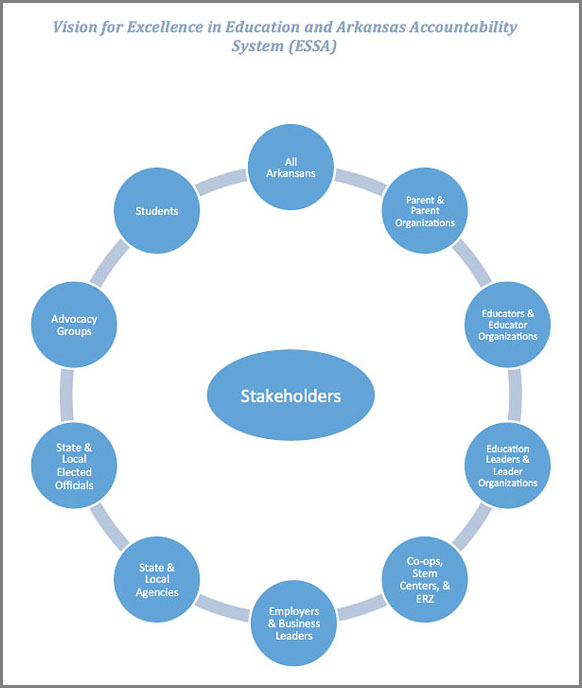
* DOWNLOAD this diagram in PDF format at http://bit.ly/2fbZ1wu.
- Stay Informed. Stakeholders may sign up to receive the most current information about the ESSA process. We invite you to to visit this webpage often for new information. Sign up to receive email alerts to updated information and feedback opportunities regarding ESSA at http://www.arkansased.gov/divisions/communications/stay-informed.
- Get involved. Sign up to be an Ambassador and share the latest ESSA news with your colleagues, community members, friends and family. If you are interested in learning more about being an ambassasor, please complete the requested information and Ms. Tina Smith will be in contact with you. Thanks. View the list of Ambassador Hosted Community Listening Forums.
- Advocate for Students – Committees will be asked to review the Arkansas Accountability System with the lens of student’s subgroups-English Language Learner/Title III, SPED, Economically Disadvantaged, Race/Ethnicity, Foster Children, Military Dependents, Homeless, Equity for All Students. To access the application to be a student advocate, please go to http://bit.ly/2b9yUlC.
- Tune in to Steering Committee Meetings. The Vision for Excellence in Education and Arkansas Accountability System Steering Committee will meet on the last Wednesday of each month (beginning August 31, 2016) at 9:30 am in the Arkansas Department of Education auditorium. The meetings will be open to the public, live streamed, and recorded.
- Access the Steering Committee agenda
- View Steering Committee meeting dates
- Watch the monthly Steering Committee meetings in person or via live stream.
- Learn more about the ESSA Steering Committee members
- View Steering Committee agenda, minutes and videos
- Submit Public Comment. Submit comments, questions, concerns and celebrations regarding ESSA.
Additional Resources
- The Alliance for Excellent Education website offers one-page fact sheets, five-minute videos and a side-by-side chart comparing No Child Left Behind(NCLB) and ESSA.
- The U. S. Department of Education website offers the full ESSA Act, resources, and opportunities to sign up for federal updates.
- The USDOE updated the Transitioning to the Every Student Succeeds Act (ESSA) Frequently Asked Questions on June 29, 2016.
- The National PTA website offers resources for families on the Every Students Succeeds Act (ESSA) at pta.org/ESSA.
- Spanish translations of “Family Engagement Provisions in ESSA” and “ESSA: What does this new law mean for my child?” are available at
ARKANSAS ESSA NEWS

A guide for white women who teach Black boys
THE CHICAGO CRUSADER — Did you know that there are 400,000 black men who have master’s degrees? I didn’t think so. That was just one of the many things I learned at a book signing and discussion of the newly released Guide for White Women Who Teach Black Boys.
read more
Betsy DeVos Opens Up ESSA Pilot Allowing Federal Money to Follow Students
School districts: Interested in having your local, state, and federal funding follow children, so that kids with greater need have more money attached to them? Now’s your chance.
read more
The Outdated Study That Education Reformers Keep Citing
… a close look at the study raises questions about its relevance to modern education debates and the ability of new buzzed-about programs to achieve remotely similar results.
read more
Secretary DeVos Announces New Student-Centered Funding Pilot Program
Washington — U.S. Secretary of Education Betsy DeVos today announced new flexibility for school districts to create equitable, student-centered funding systems under a pilot program authorized by the Every Student Succeeds Act (ESSA).
read more
Secretary DeVos Convenes Higher Education Summit: Innovation Blends Technology and the Personal Touch
“We need to question everything; to look for ways in which we can improve, and embrace the imperative of change.
read more
The Government Shutdown and K-12 Education: Your Guide
Here we go again: President Donald Trump and Congress were unable to reach agreement on temporary spending plan to keep the government open. So the U.S. Department of Education and other government agencies are on a partial shutdown, as of midnight Friday night. This is the first time this has happened in four years.
read more
Report: States Struggle With ESSA’s Requirements for Foster Children
Advocates for children in foster care had good reason to cheer the passage of the Every Student Succeeds Act two years ago. The new law requires schools to break out student achievement data for foster care students so that the public can see how they are doing...
read more
Lawmakers Press Trump to Spend on Public School Infrastructure
A group of lawmakers has told President Donald Trump that new funding for improving school facilities is “essential for advancing student achievement” and should be a part of any broader infrastructure spending plan.
read more
Fast Talkers: Are Kids Getting the Right Message About Good Reading?
Oral reading fluency is a key indicator of reading proficiency. But it’s got some issues, as it’s currently implemented in some schools. One of these is that we have a cadre of kids who are getting the wrong message: we’re teaching them that they can fast talk their way into college and career success.
read more
New Center for Public Education report finds significant student population left “Out of the loop”
While not equally distributed across the country, CPE’s analysis notes, approximately one-half of school districts, one-third of schools, and one-fifth of all students in the United States are in rural areas. Inadequate funding, lower literacy rates, and less access to advanced courses such as AP and STEM classes impact rural students’ achievement, creating significant barriers to their success.
read more
To Rebuild, Rethink and Renew
This past fall I had the opportunity to visit the U.S. Virgin Islands, twice — first, in October, and two weeks later, in the company of Secretary DeVos. There, I saw firsthand the wholesale destruction left by back-to-back hurricanes. The experience was both humbling and uplifting.
read more
When Does Scholarship Give Way to Bombast and Bluster? – Education Week
I’ve now been doing the Education Week RHSU Edu-Scholar Public Influence Rankings for about a decade, striving to recognize scholars who do academically significant research while also contributing to the public square. After all, I’ve long argued that on an issue like education, our impassioned public debates benefit when scholars take the time to engage. Of course, encouraging this kind of activity always runs the risk of introducing perverse incentives.
read more
How Stevie Wonder helped create Martin Luther King Day
THE LEGACY NEWSPAPER — On the evening of April 4, 1968, teen music sensation Stevie Wonder was dozing off in the back of a car on his way home to Detroit from the Michigan School for the Blind, when the news crackled over the radio: Martin Luther King Jr. had just been assassinated in Memphis. His driver quickly turned off the radio and they drove on in silence and shock, tears streaming down Wonder’s face.
read more
Many State ESSA Plans Are ‘Uncreative, Unambitious,’ Analysis Finds
The two-year-old Every Student Succeeds Act was supposed to free states up to go off in bold, new directions on K-12 policy. So did state plans, all of which have been turned into the U.S. Department of Education, live up to that promise?
read more
Inside the ESSA Plans: What Are States Doing About Goals and Timelines?
EDUCATION WEEK — This week, Education Week is bringing its trademark analysis to the remaining state plans for fulfilling requirements of the Every Student Succeeds law. On Monday, we had a look at the states’ proposed “school quality” indicators, the required but nonacademic portion of each state’s plan to judge schools. Today, we’re going to take a look at states’ goals for raising student achievement and their timelines for doing so in the plans awaiting federal approval.
read more