

Arkansas ESSA Resources
Contact the Arkansas Department of Education
Tina Smith, Special Projects Director
Arkansas Department of Education
Office of Communications
Four Capitol Mall, Room 305-A
Little Rock, AR 72201
Phone: 501-682-3667
Email: tina.smith@arkansas.gov
What is the Every Student Succeeds Act (ESSA)?
The Every Student Succeeds Act (ESSA) was signed by President Obama on December 10, 2015, and reauthorized the 50-year-old Elementary and Secondary Education Act (ESEA), the nation’s education law that provides opportunity for all students. Read the Every Student Succeeds Act at http://bit.ly/1TFr29X
As part of the Vision for Excellence in Education, Arkansas will define the Arkansas Accountability System and submit the proposal to the U.S. Department of Education(USDOE) for approval. Arkansas is committed to transparent communication with all stakeholders. ESSA Summary
ADE is committed to transparency of the process. Please see the log of meetings and presentations at http://bit.ly/2aKz0ma
Arkansas Accountability System (ESSA) Timeline
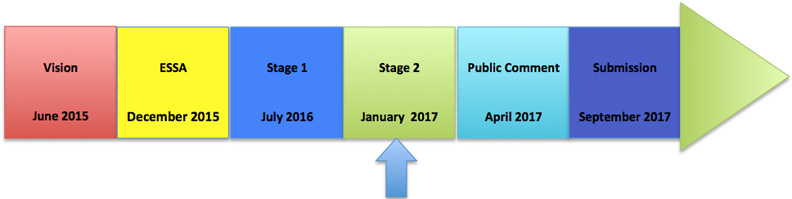
Handout: Arkansas Accountability System (ESSA) Timeline
Stage 1
Please visit http://bit.ly/2bPQ1fP to learn about all Stage 1 activities.
Stage 2
- The Steering Committee will continue meeting on a monthly basis.http://www.arkansased.gov/public/userfiles/ESEA/ESSA_Steering_Committee_Calendar.pdf
- Arkansas Department of Education begins writing the state accountability and support plan, continues to gather stakeholder feedback, and modify the plan based on the stakeholder feedback.
- The Advocates for Students group will provide targeted feedback on the state accountability and support plan through the lens of the students they represent. The advocate groups are: English Language Learner, Special Education Economically Disadvantaged, Race/Ethnicity, Foster Children, Military Dependents, Homeless and Equity for all Students
What is my role as a stakeholder?
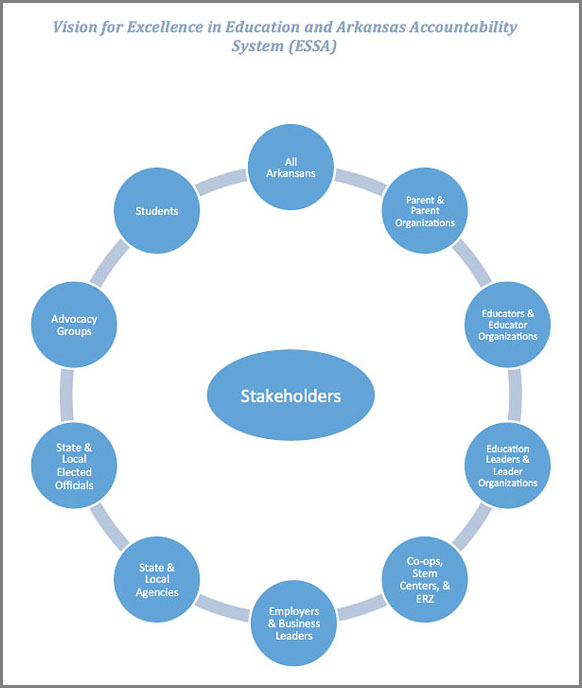
* DOWNLOAD this diagram in PDF format at http://bit.ly/2fbZ1wu.
- Stay Informed. Stakeholders may sign up to receive the most current information about the ESSA process. We invite you to to visit this webpage often for new information. Sign up to receive email alerts to updated information and feedback opportunities regarding ESSA at http://www.arkansased.gov/divisions/communications/stay-informed.
- Get involved. Sign up to be an Ambassador and share the latest ESSA news with your colleagues, community members, friends and family. If you are interested in learning more about being an ambassasor, please complete the requested information and Ms. Tina Smith will be in contact with you. Thanks. View the list of Ambassador Hosted Community Listening Forums.
- Advocate for Students – Committees will be asked to review the Arkansas Accountability System with the lens of student’s subgroups-English Language Learner/Title III, SPED, Economically Disadvantaged, Race/Ethnicity, Foster Children, Military Dependents, Homeless, Equity for All Students. To access the application to be a student advocate, please go to http://bit.ly/2b9yUlC.
- Tune in to Steering Committee Meetings. The Vision for Excellence in Education and Arkansas Accountability System Steering Committee will meet on the last Wednesday of each month (beginning August 31, 2016) at 9:30 am in the Arkansas Department of Education auditorium. The meetings will be open to the public, live streamed, and recorded.
- Access the Steering Committee agenda
- View Steering Committee meeting dates
- Watch the monthly Steering Committee meetings in person or via live stream.
- Learn more about the ESSA Steering Committee members
- View Steering Committee agenda, minutes and videos
- Submit Public Comment. Submit comments, questions, concerns and celebrations regarding ESSA.
Additional Resources
- The Alliance for Excellent Education website offers one-page fact sheets, five-minute videos and a side-by-side chart comparing No Child Left Behind(NCLB) and ESSA.
- The U. S. Department of Education website offers the full ESSA Act, resources, and opportunities to sign up for federal updates.
- The USDOE updated the Transitioning to the Every Student Succeeds Act (ESSA) Frequently Asked Questions on June 29, 2016.
- The National PTA website offers resources for families on the Every Students Succeeds Act (ESSA) at pta.org/ESSA.
- Spanish translations of “Family Engagement Provisions in ESSA” and “ESSA: What does this new law mean for my child?” are available at
ARKANSAS ESSA NEWS

OPINION: Raising Emotionally Competent Children
In a fast-paced, tech-obsessed world, assisting your child with homework can prove a daunting task. New teaching methods are adopted every day. Even professionals with advanced degrees are not necessarily equipped to help children with homework.
read more
ESSA’s Success (or Failure) Is Up to All of Us
When the Every Student Succeeds Act was signed into law two years ago, leaders from both sides of the aisle hailed it as a rare and remarkable display of bipartisanship. The measure represented a significant rollback of the federal government’s footprint in education policy and the dawn of a new era of state autonomy.
read more
Trump Seeks to Cut Education Budget by 5 Percent, Expand School Choice Push
released Monday, would provide the Education Department with $63.2 billion in discretionary aid, a $3.6 billion cut—or 5.3 percent— from current spending levels, for the budget year starting Oct. 1. That’s actually less of a cut than what the president sought for fiscal 2018, when he proposed slashing $9.2 billion—or 13.5 percent—from the department.
read more
Approved Arkansas State ESSA Plan
This document reflects work that began prior to the passage of the Every Student Succeeds Act. In 2015 the Arkansas team began engaging with stakeholders to determine how our agency could better support students, educators, school and district leaders, and communities in their efforts to improve student outcomes.
read more
How Obama’s Education Law Can Help Black Parents Bridge the Education Gap
All parents want the best for their children. We all acknowledge that attaining a high-quality K-12 education is probably the single most important factor that will determine the future life success of a student in the public school systems throughout the United States.
read more
OPINION: Kane: States and Governors Must Collaborate as They Again Learn to Drive Education Under ESSA
With the passage of the Every Student Succeeds Act in 2015, Congress tossed the keys for K-12 education back to states and school districts. However you feel about the expanded federal role in K-12 education since No Child Left Behind was signed in 2002 — whether you saw it as a necessary nudge or federal overreach — that era has officially ended. Our schools need state and local leaders to take the education wheel now. But after 15 years of complying with federal regulations, their driving skills may be a little rusty.
read more
Why You Should Celebrate National School Counseling Week
It just figures that National School Counseling Week starts the day after the Super Bowl. The country gorges on guacamole-covered chicken wings on Sunday, and when America’s most misunderstood group of educators asks for three nacho chips and a high five on Monday, the country is too tired to party.
read more
United Negro College Fund helps students across the nation attend college
MINNESOTA SPOKESMAN-RECORDER — Laverne McCartney-Knighton took on the initiative of helping UNCF raise scholarship funds in June 2017 as the new regional development director of the Minneapolis location. With 24 office locations in the Twin Cities, each is poised to bring in substantial funding to help students across the nation attend colleges. Since raised funds are distributed through the Washington, D.C. office, local offices can focus on fundraising.
read more
OPINION: A nation that does not stand for children does not stand for anything
MINNESOTA SPOKESMAN RECORDER — According to the most recent federal data, more than 13.2 million children — one in five — live in poverty; six million live in extreme poverty; 14.8 million children live in food-insecure households; more than one million homeless children are in our schools; 3.9 million children still lack health insurance; the majority of public school students of all races cannot read or compute at grade level; nearly 700,000 children are abused and/or neglected; nearly 50,000 children are in juvenile justice facilities or adult jails and prisons; and 3,128 children and teens were killed with a gun in 2016, enough to fill 156 classrooms of 20 children.
read more
NNPA, NAACP Sign Historic Partnership Agreement
THE DALLAS POST TRIBUNE — The National Newspaper Publishers Association (NNPA), a trade group representing more than 200 Black-owned media companies, signed a historic, strategic partnership with the NAACP, one of the most influential civil rights group in the world, during the NNPA’s Mid-Winter Conference in Las Vegas.
read more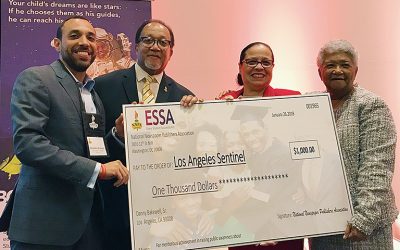
NNPA Publishers Address Equity in Education in their Newspapers
NNPA publishers of the Westside Gazette, the Los Angeles Sentinel and Greater Diversity News were rewarded for their engagement with the NNPA ESSA awareness campaign during the 2018 NNPA Mid-Winter Conference in Las Vegas, Nevada.
read more
The Bureau of Indian Education Is Broken – Education Week
The Bureau of Indian Education recently wrapped up its tribal consultation process on its latest proposed strategic plan “to guide its work and service delivery to [Native] students, schools, and tribes.” While the BIE creates plan after plan intended to restructure, realign, reform, redesign, revise, and redo their education system, in actuality these plans are rarely carried out. The necessary changes to schooling simply remain words written on paper.
read more
Tech Companies Are Buying Their Own Education Research. That’s a Problem – Education Week
Last month, a pair of Apple shareholders demanded in an open letter that the company address growing concerns about children’s addiction to their products. In light of research on the detrimental effects of electronic-media use, investment firm JANA Partners and the California State Teachers’ Retirement System argued, parents need better resources to make sure children are using devices “in an optimal manner.”
read more
The Smartphone Problem Is Worse Than You Think – Education Week
Indeed, the numbers are staggering: According to Common Sense Media’s 2015 Census, on any given day the average American teenager consumes just under nine hours of entertainment media, excluding time spent in school or for homework. This raises the question: Where can learning fit in?
read more
Navy Honors the Contributions of African Americans during 2018 African American/Black History Month
THE CHRONICLE — WASHINGTON (NNS) — The Navy joins the nation in celebrating the history of African American Sailors and civilians during African American/Black History Month, Feb. 1-28.
read more