

Arkansas ESSA Resources
Contact the Arkansas Department of Education
Tina Smith, Special Projects Director
Arkansas Department of Education
Office of Communications
Four Capitol Mall, Room 305-A
Little Rock, AR 72201
Phone: 501-682-3667
Email: tina.smith@arkansas.gov
What is the Every Student Succeeds Act (ESSA)?
The Every Student Succeeds Act (ESSA) was signed by President Obama on December 10, 2015, and reauthorized the 50-year-old Elementary and Secondary Education Act (ESEA), the nation’s education law that provides opportunity for all students. Read the Every Student Succeeds Act at http://bit.ly/1TFr29X
As part of the Vision for Excellence in Education, Arkansas will define the Arkansas Accountability System and submit the proposal to the U.S. Department of Education(USDOE) for approval. Arkansas is committed to transparent communication with all stakeholders. ESSA Summary
ADE is committed to transparency of the process. Please see the log of meetings and presentations at http://bit.ly/2aKz0ma
Arkansas Accountability System (ESSA) Timeline
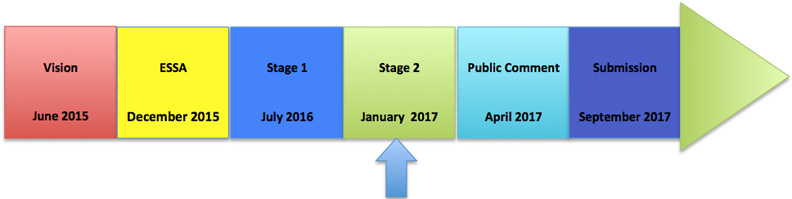
Handout: Arkansas Accountability System (ESSA) Timeline
Stage 1
Please visit http://bit.ly/2bPQ1fP to learn about all Stage 1 activities.
Stage 2
- The Steering Committee will continue meeting on a monthly basis.http://www.arkansased.gov/public/userfiles/ESEA/ESSA_Steering_Committee_Calendar.pdf
- Arkansas Department of Education begins writing the state accountability and support plan, continues to gather stakeholder feedback, and modify the plan based on the stakeholder feedback.
- The Advocates for Students group will provide targeted feedback on the state accountability and support plan through the lens of the students they represent. The advocate groups are: English Language Learner, Special Education Economically Disadvantaged, Race/Ethnicity, Foster Children, Military Dependents, Homeless and Equity for all Students
What is my role as a stakeholder?
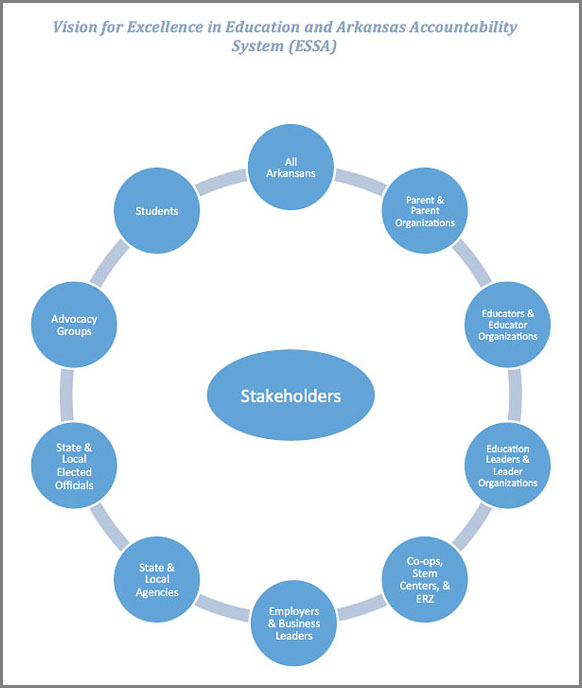
* DOWNLOAD this diagram in PDF format at http://bit.ly/2fbZ1wu.
- Stay Informed. Stakeholders may sign up to receive the most current information about the ESSA process. We invite you to to visit this webpage often for new information. Sign up to receive email alerts to updated information and feedback opportunities regarding ESSA at http://www.arkansased.gov/divisions/communications/stay-informed.
- Get involved. Sign up to be an Ambassador and share the latest ESSA news with your colleagues, community members, friends and family. If you are interested in learning more about being an ambassasor, please complete the requested information and Ms. Tina Smith will be in contact with you. Thanks. View the list of Ambassador Hosted Community Listening Forums.
- Advocate for Students – Committees will be asked to review the Arkansas Accountability System with the lens of student’s subgroups-English Language Learner/Title III, SPED, Economically Disadvantaged, Race/Ethnicity, Foster Children, Military Dependents, Homeless, Equity for All Students. To access the application to be a student advocate, please go to http://bit.ly/2b9yUlC.
- Tune in to Steering Committee Meetings. The Vision for Excellence in Education and Arkansas Accountability System Steering Committee will meet on the last Wednesday of each month (beginning August 31, 2016) at 9:30 am in the Arkansas Department of Education auditorium. The meetings will be open to the public, live streamed, and recorded.
- Access the Steering Committee agenda
- View Steering Committee meeting dates
- Watch the monthly Steering Committee meetings in person or via live stream.
- Learn more about the ESSA Steering Committee members
- View Steering Committee agenda, minutes and videos
- Submit Public Comment. Submit comments, questions, concerns and celebrations regarding ESSA.
Additional Resources
- The Alliance for Excellent Education website offers one-page fact sheets, five-minute videos and a side-by-side chart comparing No Child Left Behind(NCLB) and ESSA.
- The U. S. Department of Education website offers the full ESSA Act, resources, and opportunities to sign up for federal updates.
- The USDOE updated the Transitioning to the Every Student Succeeds Act (ESSA) Frequently Asked Questions on June 29, 2016.
- The National PTA website offers resources for families on the Every Students Succeeds Act (ESSA) at pta.org/ESSA.
- Spanish translations of “Family Engagement Provisions in ESSA” and “ESSA: What does this new law mean for my child?” are available at
ARKANSAS ESSA NEWS

OPINION: Importance of Educators of Color for Black & Brown Students
NNPA ESSA AWARENESS CAMPAIGN — This month, my organization, the National Alliance of Public Charter Schools released its highly-anticipated report, “Identity and Charter School Leadership: Profiles of Leaders of Color Building an Effective Staff” which examined the ways that school leaders of color’s experiences and perspectives influence how they build school culture, parent and community relationships, and effective staff.
read more
OP-ED: Student Loan Debt is a Crisis
THE WESTSIDE GAZETTE — Finances should never be a barrier to graduation, nor should the financial impact of earning a college degree be a barrier for buying a home, saving money, starting a family, and having a good credit score. TMCF prides itself on building pipelines into good paying jobs but we also have to work to ensure that those students are able to truly reap the financial benefits of their achievements without having to pay off years of student loan debt.
read more
Profile in Education Equity: Sharif El-Mekki
El-Mekki is answering his own “nation building” call. In May, he announced that after 11 years as Shoemaker’s principal and 26 years of being inside schools as a teacher or administrator, he was devoting his full attention and time to launching a new Center for Black Educator Development to help address the urgent need to bring more Black educators into Philadelphia’s classrooms and across the nation. “If I’m going to be serious about trying to change the lives of Black educators and hence the lives of Black children, then it just can’t be my night and weekend job,” he said.
read more
COMMENTARY: Is There More to Teaching and Learning Than Testing?
In order for education to capitalize on the strengths and talents of learners and the skills and professionalism of their teachers, what kinds of additional progress measures might be employed?
read more
ESSA: Every Student Succeeds Act
Video explaining the evolution, benefits and implementation of the Every Student Succeeds Act.
read more
OP-ED: Black Studies becomes major factor in social advancement
OUR WEEKLY NEWS — The Black Power movement of the late 1960s helped to redefine African American identity and establish a new racial consciousness. As influential as this period was in the study and enhancement of the African Diaspora, this movement spawned the academic discipline known as Black Studies on our college and university campuses.
read more
Betsy DeVos Approves Testing Flexibility Under ESSA for Two More States
EDUCATION WEEK — U.S. Secretary of Education Betsy DeVos announced that she had approved Georgia and North Carolina to try out new assessment methods for the 2019-20 school year, joining Louisiana and New Hampshire as states to successfully apply to participate in this pilot.
read more
COMMENTARY: Financial Literacy Transforms Students’ Lives. Here’s Where to Start
EDUCATION WEEK: In 2013, the Council for Economic Education (CEE) released a set of rigorous national standards for financial literacy that offer a starting point for elementary, middle, and high school educators to create a meaningful curriculum with the flexibility to determine what works best in their own school day. Schools should also tailor their curriculum to account for cultural differences in the classroom, as well as the specific learning styles of girls versus boys.
read more
DeVos Seeks to Align Education Grants With Trump-Backed Economic Initiative
U.S. Secretary of Education Betsy DeVos wants to put a priority on competitive grants that square with the Trump administration's initiative to improve economic opportunities in distressed areas. In the Federal Register, which is where the U.S. government publishes...
read more
No More Scissors. No More Mail. Box Tops for Schools Goes Digital
General Mills, which founded the program 23 years ago, announced that the program will soon be digital-only. Customers now earn money for their schools by scanning receipts rather than clipping box tops and mailing them in. Participants can download the new mobile app, scan their store receipt, which will automatically analyze which products were box-tops items and tabulate the amount that will be donated to their school of choice. Every box top will still be worth 10 cents.
read more
Educator Spotlight: Donald Hense
Three-quarters of the students enrolled in Friendship schools in D.C. are from Wards 7 and 8, the city’s two poorest areas, and nearly all are African-American. Their achievement is reflected in their continuous improvement on standardized tests. Most recently, Donald Hense and his team celebrated, when five of Friendship’s 12 D.C. schools were rated Tier 1 by the Public Charter School Board – the highest of three ratings a charter school can earn.
read more
States Hunt for Evidence to Underpin School Turnaround Efforts
EDUCATION WEEK — Allendale County’s school district sits in South Carolina’s Lowcountry, in an impoverished, rural region near the coast known as the “corridor of shame” for the chronic poor quality of its education system. Until recently, three of the district’s four schools were considered among the lowest performing in the state.
read more
ESSA’s Growing Pains Evident Amid Progress
EDUCATION WEEK — If the Every Student Succeeds Act were a schoolchild, it would be a preschooler—not much more than 3 years old, making steady progress, but still stumbling a bit along the way.The first major rewrite of the nation’s main K-12 law in more than a decade, ESSA was signed into law at the end of 2015, replacing and updating the groundbreaking—but problematic—No Child Left Behind Act.
read more
COMMENTARY: Assembly Workers and Widgets
Well, how can we feel more professional and less like factory workers producing widgets? First, we must clarify our mission. Students are not widgets. There can be no reject bins for human beings with different needs and varied learning intelligence!
read more
COMMENTARY: Color “Blindness”
Our perceptions of the value of ourselves and others often determine our treatment of and reactions toward those we view as less than or not as valued. Wars are fought over cultural and religious differences. Regardless of the injury, all people’s blood is red and all of us can hurt or grieve, regardless of color.
read more