In 2012, the President’s Council of Advisors on Science and Technology released a report calling for a national effort to produce 1 million more STEM graduates. Science, technology, engineering, and math educators have responded with a sense of urgency, and STEM programs and schools have been developed throughout the United States to better prepare our youths for careers in those fields. STEM curricula experts have begun to integrate student-driven inquiry and a real-world context that add authenticity to class projects and prepare students for future STEM careers. They also encourage educators to connect learning across disciplines.
So how is STEM education still missing the mark, especially at the elementary level? Project-based learning and other practices that support educators in integrating across content areas have benefits, but those benefits will mean nothing if our young people do not enter in STEM fields or majors. These skills and experiences are rich and useful when done well, but secondary to the real roadblock that many American students face. We must look deeper than any new program or initiative aimed at simply increasing interest in STEM careers. We must look at a known problem that we often avoid talking about: the math problem.
“Our students cannot enter into STEM majors if they have a fear of mathematics.”
Read full article click here, may require ED Week subscription.
President Donald Trump has proposed combining the U.S. Departments of Education and Labor. After asking educators for their opinions about the merger, Education Week reported that “educators, by and large, don’t seem to be fans of this idea.” Anthony Carnevale, the director of the Georgetown University Center on Education and the Workforce has a different view. In a June 22 Washington Post op-ed defending the merger, he wrote, “Because education and careers are inextricably bound, we need to take an ‘all one system’ perspective that connects the education and career dots from middle school through college and early careers.”
Carnevale is right that a large majority of students—and their families—value education primarily because they want better careers. In a 2015 national poll of incoming college students from the Cooperative Institutional Research Program, 85 percent of respondents ranked being “able to get a better job” as a very important reason for pursuing a college degree. But he is mistaken when he advocates merging the departments of Education and Labor. Too many of education’s other gifts are at stake.
Education’s purpose is more than career preparation. Leaving curricular decisions up to employers is not healthy for America. For example, Thomas Jefferson’s rationale for supporting public education was the need for an informed citizenry in a healthy democracy. Today, the lack of an informed citizenry may be our country’s biggest problem. Only 36 percent of eligible voters cast ballots in the last midterm elections four years ago.
“Leaving curricular decisions up to employers is not healthy for America.”
Earlier this year, a man named Jack Weldon Patrick passed away in Menomonee Falls, Wisconsin. A long-time lawyer, Patrick was remembered as a family man, an advocate for social justice, and a respected community leader.
One day a check arrived by mail for the Thurgood Marshall College Fund (TMCF) in memory of Jack Weldon Patrick. A few days later, another one arrived, and a few weeks later, another check. Individual donations kept coming to support the work of TMCF and our publicly-supported Historically Black Colleges and Universities (HBCUs) in honor of Jack. His obituary read, “in lieu of flowers the family suggests memorial donations in Jack’s name to causes he cared deeply about.” One of those causes was TMCF.
So many of us outside of TMCF headquarters and Menomonee may have never known Jack as a stalwart of access and opportunity for students attending Black colleges. Many of us aren’t even aware that Jack was part of the reason why in 2016, private giving and contracts earned by HBCUs increased for a second straight year, posting a four-year high of $320 million. But we do know he was a living embodiment of the famous quote by Nelson Henderson: “The true meaning of life is to plant trees, under whose shade you do not expect to sit.”
While philanthropic anonymity is honorable, philanthropic leadership helps organizations like TMCF reach new supporters, encouraging new donor circles to give. Showcasing the faces and stories of those who give is an important tool in cultivating similar donors, encouraging a culture of giving around our campuses. This is a critical strategy that grows an organization’s base of support every year. For non-profit organizations, individual giving is the largest type of charitable gift – four times the amount as the next largest category in 2015, according to Giving USA.
Organizations like TMCF thrive due to the generosity of individuals who believe in our work and want to expand our impact, through monthly and annual donations, as well as the legacy gift. TMCF combines these individuals’ gifts with foundation grants and partnerships with major corporations and government agencies to provide the funds that allow us to transform lives. It takes a philanthropic village to develop young minds, and we are humbled to be good stewards of the resources that our donors and partners entrust to us.
TMCF, its 47 member-schools and the nearly 300,000 students attending them each year, want to play a role in redefining HBCU philanthropy and support. The data on finances and the number of degrees we produce in areas like STEM, education, social sciences and criminal justice already show just how productive HBCUs continue to be in graduating Black students. Seventy percent of our publicly-supported HBCUs attendees are first generation college students (like I was) and eligible for Pell Grants. In comparison, the national average is only 37 percent for all public schools. By providing this quality education, students transform their lives and prepare to enter economically sustainable careers. Now TMCF wants to illustrate that same culture within our giving networks.
Anyone believing in the power of education to transform lives should invest in HBCUs. This includes alumni who want to have a tangible way to support their schools. All people in our networks at work, at church, in our communities, fraternities and sororities, and other circles of activity are worthy of soliciting for support. Age, earnings and personality are not elements for disqualifying those who might be willing to give, or those who have the capacity to do so.
So today, we honor one man—Jack Weldon Patrick—and his commitment to HBCUs, and we thank his friends and family for their continued investment in the work of TMCF. We hope his example encourages others to consider impacting people’s lives by supporting our nation’s HBCUs.
The United States has a math problem, and, like most middle school students sitting down with their homework, we are not finding any easy solutions. Young people in this country are struggling to attain the proficiency necessary to pursue the careers our economy desperately needs. Universities bemoan students’ inability to complete college-level math. Each year thousands of newly admitted college students are placed in non-credit-bearing remedial courses in math, a path that immediately puts them at higher risk of not completing a degree.
Maybe it’s the classics professor in me talking, but I approach this math problem from an unorthodox angle: Latin. In a 2011 article, “An Apology for Latin and Math,” high school Latin teacher Cheryl Lowe made a compelling comparison between the study of Latin and the study of math. Much like Latin, she observed, “math is hard because it builds so relentlessly year after year. Any skill not mastered one year will make work difficult the next.”
High school teachers have discovered that the unrelentingly cumulative nature of the study of Latin and the study of mathematics explains why students struggle to excel in either discipline.
A favorite lament of college and university faculty in quantitative fields is that students cannot perform college-level math. But what is college-level math?
In the world of classics, there is no such thing as college-level Latin. My daughter’s high school Latin teacher uses the same textbook for her class that I have used to teach Latin at Duke University, Whitman College in Washington state, and the University of Southern Maine. It turns out that there are only two differences between high school Latin and college Latin. The first is pace. I tell students that one year of college Latin is the approximate equivalent of three years of high school Latin…
Read the full article here: May require an Education Week subscription.
When the best educators in America traveled to Washington, D.C. for a series of events celebrating innovation in the classroom and to share best practices in K-12 education, they let officials at the Department of Education and the White House know exactly how they felt about the Trump Administration’s current push for school choice programs.
According to edchoice.org, school choice programs allow, “public education funds to follow students to the schools or services that best fit their needs—whether that’s to a public school, private school, charter school, home school.”
In April 2018, the Department of Education (ED) hosted the “Honoring Martin Luther King Jr.’s Drum Major Legacy: Innovative Pathways to Success” celebration; the event was sponsored by the White House Initiative on Educational Excellence for African Americans in collaboration with the Center for Faith-Based and Neighborhood Partnerships.
The Education Department’s MLK Legacy event honored individuals who perform extraordinary acts of service in their communities, specifically those individuals who support high-quality education for children of color. Many of the awardees work with parents or community groups that provide primary care for children; some even provide educational support services outside of the traditional public school model.
School choice became a hot topic during the event, as several attendees were visibly disgruntled at the mention of the controversial approach.
The Trump Administration has proposed to decrease funding to authorized investments for public schools while increasing funding opportunities for school choice programs and private school vouchers. Ninety percent of children in America attend public schools. Increased funding to school choice programs, while reducing funding to public schools is a strategy that leaves behind our most vulnerable students.
Secretary of Education Betsy DeVos has repeatedly said that she’s committed to uphold the intentions of the Every Student Succeeds Act (ESSA), the education law signed by President Barack Obama. However, the prioritization of school choice programs in the proposed FY2019 budget contradicts one of the original intentions of the law: to promote equity and increase access to high-quality education for all students. Furthermore, prioritization of school choice isolates homeless children, migrant children, youth in foster care and children from military families. In fact, ESSA requires that school districts report student outcomes for these groups for the very first time.
The 2018 Teacher of the Year awardees echoed similar concerns during their annual White House visit in April. The top teachers in the country reported that they did not approve of funding private schools at the expense of their most vulnerable, at-risk students.
Every child should be entitled to high-quality education in the United States of America. Every neighborhood school should be equipped to provide high-quality courses and curriculum. Every student should have highly-qualified teachers and a menu of extra-curricular activities to choose from. Until the administration prioritizes the equitable improvement of all schools, their verbal commitment to uphold the original intent of ESSA is just another “alternative fact.”
Learn more about the Every Student Succeeds Act at nnpa.org/essa.
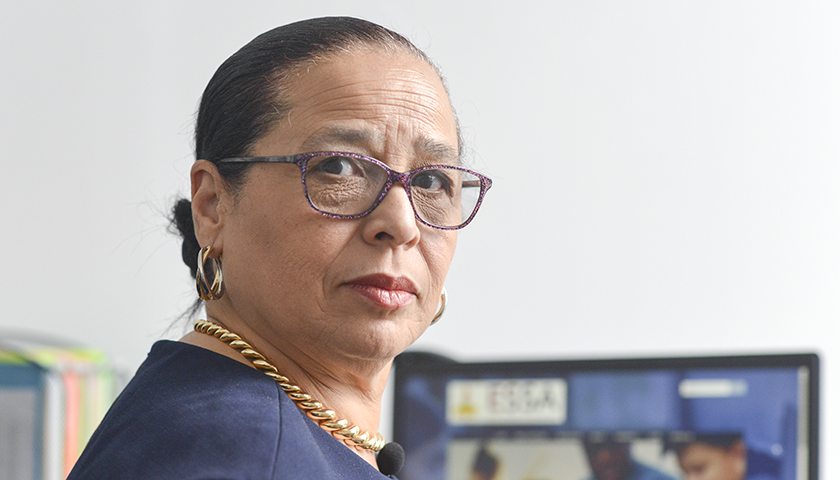
Dr. Elizabeth Primas is an educator, who spent more than 40 years working towards improving education for children of diverse ethnicities and backgrounds. Dr. Primas is the program manager for the NNPA’s Every Student Succeeds Act Public Awareness Campaign. Follow Dr. Primas on Twitter @ElizabethPrima3.
By Dr. Elizabeth Primas, Program Manager, NNPA/ESSA Public Awareness Campaign
When the best educators in America traveled to Washington, D.C. for a series of events celebrating innovation in the classroom and to share best practices in K-12 education, they let officials at the Department of Education and the White House know exactly how they felt about the Trump Administration’s current push for school choice programs.
According to edchoice.org, school choice programs allow, “public education funds to follow students to the schools or services that best fit their needs—whether that’s to a public school, private school, charter school, home school.”
In April 2018, the Department of Education (ED) hosted the “Honoring Martin Luther King Jr.’s Drum Major Legacy: Innovative Pathways to Success” celebration; the event was sponsored by the White House Initiative on Educational Excellence for African Americans in collaboration with the Center for Faith-Based and Neighborhood Partnerships.
The Education Department’s MLK Legacy event honored individuals who perform extraordinary acts of service in their communities, specifically those individuals who support high-quality education for children of color. Many of the awardees work with parents or community groups that provide primary care for children; some even provide educational support services outside of the traditional public school model.
School choice became a hot topic during the event, as several attendees were visibly disgruntled at the mention of the controversial approach.
The Trump Administration has proposed to decrease funding to authorized investments for public schools while increasing funding opportunities for school choice programs and private school vouchers. Ninety percent of children in America attend public schools. Increased funding to school choice programs, while reducing funding to public schools is a strategy that leaves behind our most vulnerable students.
Secretary of Education Betsy DeVos has repeatedly said that she’s committed to uphold the intentions of the Every Student Succeeds Act (ESSA), the education law signed by President Barack Obama. However, the prioritization of school choice programs in the proposed FY2019 budget contradicts one of the original intentions of the law: to promote equity and increase access to high-quality education for all students. Furthermore, prioritization of school choice isolates homeless children, migrant children, youth in foster care and children from military families. In fact, ESSA requires that school districts report student outcomes for these groups for the very first time.
The 2018 Teacher of the Year awardees echoed similar concerns during their annual White House visit in April. The top teachers in the country reported that they did not approve of funding private schools at the expense of their most vulnerable, at-risk students.
Every child should be entitled to high-quality education in the United States of America. Every neighborhood school should be equipped to provide high-quality courses and curriculum. Every student should have highly-qualified teachers and a menu of extra-curricular activities to choose from. Until the administration prioritizes the equitable improvement of all schools, their verbal commitment to uphold the original intent of ESSA is just another “alternative fact.”
Learn more about the Every Student Succeeds Act at nnpa.org/essa.
Bruce Fuller, a sociologist at the University of California, Berkeley, works on how schools and civic activists push to advance pluralistic communities. He is a regular opinion contributor to edweek.org where he trades views with Lance Izumi, on the other side of the political aisle.
This blossoming spring of teacher uprisings—marching on state capitols, winning hefty pay raises—cheers any citizen who knows that robust societies depend on vibrant schools.
But arid summers may await the nation’s educators, as the Trump-tweaked U.S. Supreme Court seems ready to eviscerate these same teacher associations who battle each day for better schools.
While hearing oral arguments in the Janus v. American Federation of State, County, and Municipal Employees Council 31 case in February, justices voiced skepticism over compulsory union dues, the life blood of local associations that mobilize the nation’s 3.2 million teachers.
Still, it’s the wildcat strikes moving across the nation—ignited mostly by young and passionate teachers—that may reshape the future of labor unions…
Read the full article here: May require an Education Week subscription.
On Thursday, May 17th, marked an historic milestone in American history. Regrettably, most Americans were totally unaware of the 64th anniversary of the landmark 1954 Supreme Court case, Brown v. Board of Education of Topeka, in which the justices ruled unanimously that racial segregation of children in public schools was unconstitutional.
Leon D. Young
Brown v. Board of Education was one of the cornerstones of the civil rights movement and helped establish the precedent that “separate but-equal” education and other services were not, in fact, equal at all.
In 1896, the Supreme Court ruled in Plessy v. Ferguson that racially segregated public facilities were legal, so long as the facilities for blacks and whites were equal. The ruling constitutionally sanctioned laws barring African Americans from sharing the same buses, schools and other public facilities as whites — known as “Jim Crow” laws — and established the “separate but equal” doctrine that would stand for the next six decades.
But by the early 1950s, the National Association for the Advancement of Colored People (NAACP) was working hard to challenge segregation laws in public schools and had filed lawsuits on behalf of plaintiffs in states such as South Carolina, Virginia and Delaware. In the case that would become most famous, a plaintiff named Oliver Brown filed a class action suit against the Board of Education of Topeka, Kansas, in 1951, after his daughter, Linda Brown, was denied entrance to Topeka’s all-white elementary schools.
In his lawsuit, Brown claimed that schools for black children were not equal to the white schools, and that segregation violated the so-called “equal protection clause” of the 14th Amendment, which holds that no state can “deny to any person within its jurisdiction the equal protection of the laws.” The case went before the U.S. District Court in Kansas, which agreed that public school segregation had a “detrimental effect upon the colored children” and contributed to “a sense of inferiority,” but still upheld the “separate but equal” doctrine.
When Brown’s case and four other cases related to school segregation first came before the Supreme Court in 1952, the Court combined them into a single case under the name Brown v. Board of Education of Topeka. Thurgood Marshall, the head of the NAACP Legal Defense and Educational Fund, served as chief attorney for the plaintiffs. (Thirteen years later, President Lyndon B. Johnson would appoint Marshall as the first Black Supreme Court justice.)
At first, the justices were divided on how to rule on school segregation, with Chief Justice Fred M. Vinson holding the opinion that the Plessy verdict should stand. But in September 1953, before Brown v. Board of Education was to be heard, Vinson died, and President Dwight D. Eisenhower replaced him with Earl Warren, then governor of California.
Displaying considerable political skill and determination, the new chief justice succeeded in engineering a unanimous verdict against school segregation the following year.
In the decision, issued on May 17, 1954, Warren wrote that “in the field of public education the doctrine of ‘separate but equal’ has no place,” as segregated schools are “inherently unequal.” As a result, the Court ruled that the plaintiffs were being “deprived of the equal protection of the laws guaranteed by the 14th Amendment.”
Although racial minorities have made several educational advancements since Brown v. Board of Education, the decision failed in a wholesale dismantling of school segregation. In New York City, for instance, more than half of public schools are reportedly at least 90 percent Black and Hispanic, and in Alabama nearly a quarter of black students attend a school with white enrollment of one percent or less.
Many civil rights advocates even point to what they believe is a “resegregation” trend. According to a report issued by the Economic Policy Institute, low-income black children are currently more racially and socioeconomically isolated than at any time since the 1980s.
In honor of April being National Autism Awareness Month, Sheletta Brundidge shares the first of a two-part story chronicling her discovery that three of her four children were on the autism spectrum.
My son Brandon was two years old when our autism journey began. He was playing with a couple of toys in the restroom while I was nearby bathing his then-one-year old sister Cameron (I was pregnant with their soon-to-be-born baby brother Daniel at the time). She was splashing around in the tub having fun and I guess he decided he’d look for a neighboring body of water to splash around in, too.
Brandon made a bee-line for the toilet and took a nose dive. Being a germaphobe I yelled out, “Noooooooooooo!” before sprinting over to pull his head out of the bowl. His face was wet, his hair was damp and he was as happy as he could be.
I immediately took Cameron out of the tub and put Brandon in, scrubbing him as hard as I could trying to get those toilet germs off his face. I remember looking at him in the eye and pleading “Son, don’t play in the toilet, okay?”
He looked beyond me with a blank stare, as if I wasn’t standing there. I knew instantly something was wrong. The light that had been in my son’s eyes was dimmed ever so slightly.
He couldn’t figure out what I was saying to him, and worse yet, he didn’t know how to respond. He began babbling and looking around as if imaginary butterflies were capturing his attention. He couldn’t give me direct eye contact.
“Oh no,” I thought, “Something is wrong with my baby!” Then I wondered, “How long has this been going on?” I blamed myself for not noticing sooner. How could I not see that my son was slipping into darkness?
I was working full-time, raising a growing family, being a mom, a wife, a daughter, an employee. I was busy keeping my house clean and too preoccupied with chores to have a handle on my child’s mental development.
I hadn’t taken a moment to notice —until my son dunked his head in a toilet — that he wasn’t behaving like a normal two-year-old.
He was lining his food up and not eating it. He was still drinking from a bottle.
He wouldn’t make eye contact. He was babbling instead of talking. He didn’t respond to his name when I called for him. I missed all the warning signs. I ignored all the clues.
My. Son. Had. Autism.
I cried. I stopped eating. I got down to 96 pounds. I was curled up in the fetal position under the table, unable to do anything except feel sorry for myself. My momma had to come and take care of my kids. I couldn’t even fold laundry or brush my teeth, because, of course, I made it all about me. I’m a narcissistafter all.
Somehow I thought I had failed as a parent and caused my son to have autism. So, instead of getting busy finding help for my child, I cowered in fear of what life had to offer a Black boy with special needs.
Since he couldn’t speak, would the police shoot him if he didn’t respond to their commands?
Would he ever be able to get a job and support himself? What about college? Without words, could he find a wife?
All the dreams I had for little Brandon were taking a nose dive out of the freakin’ window.
I had decided, that at age two, my son’s life was over and there was no hope for him.
But God reached down and snatched me out from under the kitchen table and said: “I chose you!” My spirit awakened and I realized this was a blessing: Of all the women in the world, God picked me to be Brandon’s mother. What an honor that He selected me to be the shepherd of this little life.
I had to get it together for my baby, so he could live out his God-given destiny and reach his full potential. It was all on me to get it done.
First I went to the folk closest to me for assistance. But since I didn’t have friends who had kids with special needs, nobody could tell me what to do. I tried to call on my family but that quickly backfired.
My momma brushed off my suspicions about Brandon having autism as just me being dramatic. “Ain’t nothing wrong with that damn boy. You just looking for attention; he gon’ talk when he gets ready. Your cousin Meme didn’t talk until she was 3.”
My grandmother outright blamed me for everything, “If you had just got an epidural during your pregnancy,” she quipped, “the boy would be fine now. But you wanted to do that natural childbirth [expletive]. He probably ain’t get no oxygen to his brain. That’s why he ain’t talking. It’s your fault, Sheletta.”
Since family and friends wouldn’t come to my rescue, I turned to the professionals.
Everything that I read about having an autism diagnosis said early detection and intervention is the key to success. So I made an appointment at a children’s hospital to get Brandon evaluated and tested for autism.
After three hours of checking out my son, the doctor stepped out of the room and declared, “Yep, you were right, your child has autism. Have a good life.”
Now what? What do I do with my special needs child? Does he need a prescription to keep him from flapping his hands? Or some speech sessions a couple times a week to help him learn how to talk? They didn’t give me one damn referral — not even a tip on what kind of therapy he needed or how I could go about getting services for Brandon.
I didn’t know what to do or where to turn, but I kept hearing God say, “I chose you!”
I knew this was gon’ be a “Roll up your sleeves — against all odds — me and my baby against the world” situation. So I went to my husband Shawn and asked if I could quit my job.
Without the worry of working every day, I dedicated my life to learning more about autism spectrum disorders and looking for ways to heal my child.
I didn’t want to get help for him. Forget help! I wanted Brandon healed from this autism diagnosis, so he could grow up to be the man God designed him to be without deficit or deficiency. I prayed for God to send the answer and He did.
But in the meantime, both Cameron and my newborn son Daniel were diagnosed with autism as well.
Next week, Sheletta encounters an angel who guided her through the proper therapy and medication to heal her son Brandon from the effects of his autism diagnosis. She will provide a blueprint for other parents to find services for their special needs children and scholarships that are available to pay for it all.
For two decades, as part of repeated research studies, thousands of participants from diverse backgrounds have watched the same video of college students playing basketball in a circle. Participants are told to count how many times the students wearing white shirts pass the basketball. Stunningly, roughly half of the participants become so distracted trying to count the passes that they completely miss something extraordinary: a student dressed in gorilla suit who walks into the middle of the scene and thumps her chest before walking out of the frame nine seconds later.
In the world of neuroscience, this phenomenon of being oblivious to the obvious is called “inattentional blindness.” This occurs any time we as human beings fail to notice a fully visible but unexpected object because our attention was on another task, event, or activity.
Inattentional blindness is an important concept to keep in mind now that the 2017 National Assessment of Educational Progress results for reading and mathematics for 4th and 8th grades have been released.
As many feared, results were extremely disappointing across the board. Nevertheless, there are already reams of analysis of certain subgroups highlighting the stubborn achievement gaps within the mesmerizing categories of students’ race and family income. For example, despite the fact that only 37 percent of all 4th graders were at or above “proficient”—further evidence that poor reading performance crossed all racial boundaries—the dominant reaction to the scores continues to focus on the black-white achievement gap…
Read the full article here: May require an Education Week subscription.


 By Gina Picha



 By Dr. Elizabeth Primas

 By Bruce Fuller, Opinion Contributor