Democrats: Are you already missing the Obama administration’s Education Department?
Now you don’t have to go far for an Arne Duncan or John King fix. A small group of former Obama political appointees who worked to promote Race to the Top, Investing in Innovation, and many of the president’s other greatest (or worst, depending on your take) edu-hits have put together a website, Education44.
Liz Utrup, who worked in the communications office during Obama’s tenure, is one of the driving forces behind the site. It also has roots in Education Post, the advocacy organization run by Peter Cunningham, who worked as a top aide to Duncan when he was secretary…
When it comes time to do their taxes, millions of educators have had the satisfaction of checking a box that saves them some money, and isn’t available to people in other professions. The tax bill proposed by House Republicans would eliminate the $250 deduction teachers can claim for classroom supplies—and educators aren’t taking to it kindly.
We spoke with Internal Revenue Service officials to try to get a handle on what exactly the tax law says and what it means for teachers. Here’s some of what you need to know about the “educator expense deduction.”
1. Who can take the tax deduction? And what can they take it for?
K-12 teachers, principals, counselors, and aides who worked in schools for at least 900 hours a year (or an average of about five hours a school day) can currently take the tax deduction.
They can deduct up to $250 annually for books, supplies, computer hardware and software, and “other supplementary materials” that they purchased for their classrooms and were not reimbursed for by their district. They can also deduct for any out-of-pocket professional-development expenses. Health and physical education teachers can also use the deduction for athletic supplies.
Two educators who are married and filing jointly can deduct up to $500 a year (though no more than $250 a person).
The deduction is somewhat unusual in that it’s “above the line,” meaning teachers don’t have to itemize to get it. It comes directly off of their taxable income…
Librarian Holly Peele contributed to this report.
Read the full story here. May require an Education Week registration or subscription.
As a School Ambassador Fellow with the U.S. Department of Education, I had the opportunity to help plan and coordinate a visit for First Lady Melania Trump and Secretary Betsy DeVos to Orchard Lake Middle School in West Bloomfield, MI. The school was selected because they had pledged their commitment to anti-bullying initiatives promoting inclusion and acceptance. Orchard Lake Middle School prides itself on diversity and anti-bullying programs, so the principal and staff knew that they would be a good fit for FLOTUS’s bullying prevention platform.
Breaking Bully Stereotypes
I have spent the last decade focusing on breaking bully stereotypes and shifting the conversation around such a critical topic, so I jumped at the chance to be part of this work at a national level. Most of the bullying I faced as a student occurred in middle school, so I was shocked to see it happen with my third graders. The most surprising part, however, was when I realized which students were doing the bullying. Some of my sweetest, smartest, and most seemingly innocent kids were often the ones doing the most harm. I see the same trends and patterns with every class.
One thing these kids all have in common is that they do not see themselves as bullies since they do not resemble the exaggerated characters in TV and movies. No one is a bully all the time, and this misconception makes it hard for kids to accept their actions as bullying behavior. This problem can be perpetuated in any school lunchroom when kids are left feeling isolated and excluded, while the classmates doing the excluding don’t understand the harm they cause. Effective anti-bullying initiatives can really help change those dynamics, and having the First Lady and Secretary share that message really helps kids pay attention.
Students Realize the Magnitude of the Event
I was able to be at the school for most of the day, hours before the special guests arrived. I could feel the energy in the building as students buzzed with anticipation. It was fascinating to watch all that happened behind the scenes and the planning and manpower it took to execute a one-hour visit. But the students reminded me why this event was so important. While the adults were scurrying around making sure things were running smoothly, the middle schoolers were enjoying the moment, recognizing the magnitude of what was happening. They knew their school was being highlighted and it meant they were doing something right, and that is an empowering feeling.
Sharing a message with kids about the importance of compassion and kindness is something that everyone should stand behind, and that day, everyone did. It is a big deal to have the First Lady and Education Secretary of the United States at their school, and this is something that these kids will remember for the rest of their lives. I am quite sure they will also remember that no one should eat alone either.
Melody Arabo is a 2017-18 Washington School Ambassador Fellow.
Photo at the top: A student takes a selfie with First Lady Melania Trump. (Melody: “They say a picture is worth a thousand words, but the picture at the top is worth a million smiles. It perfectly captures the joy that was felt in the room by students who realized they were experiencing a once-in-a-lifetime moment.”)
LANSING, Mich. – School counselors must now dedicate 50 hours of the current 150-hour professional development requirement on coursework and program instruction to better assist students with college preparation and career selection under legislation signed today by Gov. Rick Snyder.
“Equipping students with the tools and resources they need to decide on a career path and finding the right avenue to get them there is critically important for long-term success,” Snyder said. “This bill helps school counselors better serve students by expanding the focus on the diverse career and educational options that are available.”
House Bill 4181, sponsored by state Rep. Brett Roberts, requires school counselors to devote 50 of their currently required 150 hours of professional development to improving the college preparation and selection process (25 hours) and on career counseling (25 hours). Career counseling includes, but is not limited to, exploration of military career options, professional trades, and other technical or occupational careers requiring post-secondary industry-specific credentials. The updated requirements will apply to individuals renewing their school counselor credentials two years after the effective date of January 2018. It is now Public Act 151 of 2017.
Snyder also signed six additional bills:
House Bills 4547 and 4548, sponsored by state Reps. Klint Kesto and Patrick Green, respectively, amend the Michigan Vehicle Code of Criminal Procedure to extend the date that the blood alcohol content (BAC) related to operating a vehicle while intoxicated must remain at 0.08 until October 1, 2021. Under previous law, the BAC would revert back to 0.10 on October 1, 2018. The bills are now Public Acts 152-153 of 2017.
HBs 4170, 4171, 4173 and 4174, sponsored by state Reps. Jim Tedder, Laura Cox, Hank Vaupel and Leslie Love, respectively, make amendments to the Michigan Public Health Code. HB 4170 creates the Physician Orders for a Scope of Treatment (POST) Form, which will serve as an advance care planning tool for patients. The bill directs the Department of Health and Human Services to establish a committee to determine the content of the POST form, rules and a follow up committee. HB 4171 permits a guardian to execute, reaffirm and revoke a POST form, under certain conditions. HB 4173 requires an adult foster care facility to comply with a POST form. If the facility is unable or unwilling to comply they must make every reasonable effort to refer or transfer the patient to another adult foster care facility. HB 4174 outlines that if a health professional has notice of a do-not-resuscitate order and is aware of a POST form that contained a medical order in regard to the initiation of resuscitation, the health profession would have to comply with the most recent order or form. The measures are now Public Acts 154-157 of 2017.
MEDIA CONTACT: Meghan Frick, GaDOE Communications Office, (404) 463-4246, mfrick@doe.k12.ga.us
November 8, 2017 — The Georgia Department of Education has named five local school systems as pilot participants in its new Economic Development Partnership (EDP) program. Pilot work will begin with Whitfield County, Marietta City, Newton County, Muscogee County, and Wayne County this school year, with plans to roll out to all interested school systems in the 2019-2020 school year.
The EDP program seeks to promote improved relationships between local school districts and business/industry. The program, which is loosely modeled on GaDOE’s STEM and STEAM certification for schools, aims to meet the workforce development needs of Georgia’s current and future employers and expand opportunities for students. The designation is endorsed by the Georgia Economic Developers Association (GEDA).
“We have been pleased to partner with the Georgia Department of Education in the development and rollout of the Economic Development Partnership,” GEDA President Kevin Shea said. “We are excited about the potential for an improved partnership with school districts and GEDA member economic development organizations throughout the state of Georgia, to enhance communication and opportunities for business and quality of life and place.”
Alignment of common priorities among education and industry leadership is a central tenet of the program. Pilot systems will work with Department staff to ensure smooth program delivery and broad applicability across the state.
“It’s our primary goal and responsibility to equip students with the tools they need to live successful, rewarding lives after they complete their K-12 education,” State School Superintendent Richard Woods said. “As the primary emphasis for so many businesses has shifted from physical location to future talent, it’s critical that we facilitate a stronger connection between our educational system and the business/industry community. The EDP program will make that connection an ongoing reality in Georgia’s public schools.”
The Economic Development Partnership will include required leadership trainings and a review of local Career Pathway offerings, as well as components that can be scaled or modified to fit individual communities.
“The ability of CTAE to keep up with changes in technology and workforce trends is dependent on building and maintaining open lines of communication and lasting partnerships with business and industry,” said Dr. Barbara Wall, State Career, Technical, and Agricultural Education (CTAE) Director.
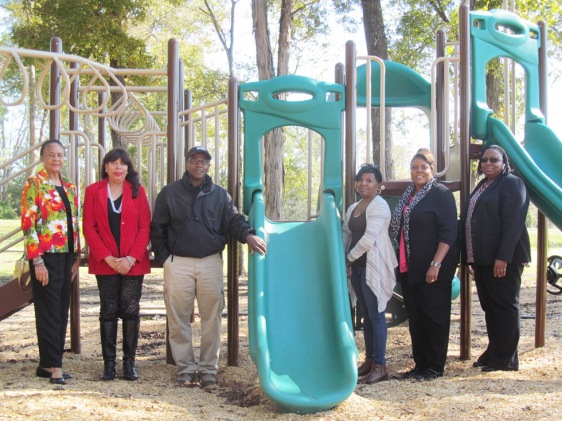
Shown above at the Eutaw City Park L to R: Mt. Hebron Coalition Members Severe Strode, and Johnni Morning, Eutaw Mayor Raymond Steele, Extension Secretary Mary Beck, Extension Coordinator Lovie Parks and Expanded Food and Nutrition Educational Program Director Mary Henley.
GREEN COUNTY DEMOCRAT — The Eutaw City Park on Lock 7 Road now has state-of-the-art playground equipment, secured with an AlProHealth grant through Auburn University Extension Program coordinated by Greene County Extension Coordinator Mrs. Lovie Parks. The grant also provides fencing around the park grounds. “The total investment in the park by Auburn Extension exceeds $40,000,” stated Ms. Parks.
According to Eutaw Mayor Raymond Steele, this project has been in the works for some time.
“We are also committed to adding a concession stand and a large pavilion with restrooms to make the park comparable to other state-of-the art parks in the state,” he said.
The playground unit will be available to children, ages 12 and under, from 7:00 a.m. until sundown. He noted that the park is also available to the community for special events such as reunions, birthday parties and more, by contacting the city for reservations.
Other benefits to Greene County by the Auburn Extension Program include providing the benches on the old courthouse square in Eutaw.
The Mt. Hebron Coalition has also benefited from an ALProHealth grant. The SCORE Center, originally organized by Betsy and Reola Bizzell, received funds for exercise equipment and other related live well programs. The SCORE Center is open to the community, serving seniors as well as youth. Johnni Morning, a Mt. Hebron Coalition Member, stated that along with the exercise equipment, internet service is also available at the Score Center. She noted that the public is invited to join the exercise program on Monday, Wednesday and Friday, at the SCORE Center (old Mt. Hebron Pre-School) from 4:30 – 6:30 p.m. ages 18 and older. Marvin Childs serves a president of the Mt. Hebron Coalition.
Mrs. Parks emphasized that a big component of the Auburn Extension program is building unity, bringing families and the community together. “The goal of ALProHealth includes increasing physical activity, improving nutrition, reducing obesity, and preventing and controlling diabetes, heart disease, and stroke by promoting community wellness,” she stated.
The Extension Program also sponsors after school programs, community gardens and various live well programs, partnering with churches and community groups.
JACKSON, Miss. (AP) — A state takeover of the Jackson school district is back on the table, less than a month after Mississippi Gov. Phil Bryant decided he wanted a more collaborative approach to its problems.
A Mississippi Department of Education panel on Wednesday decided to recommend to the state Board of Education that as many as three districts be folded into a new statewide achievement school district aimed at improving academic performance.
The panel recommended that Humphreys County and Noxubee County schools get top consideration when the board votes in December. But the panel recommended that the board secondarily consider Jackson. Like Humphreys and Noxubee counties, Jackson has been rated an F for two straight years by the state. Also like those two, more than half its schools are rated F.
“We need to provide the board options,” said state Superintendent Carey Wright. “We’re making recommendations, but they’re just that…”
Opinion by Carol McCall — Much is written — especially nationally — about what is happening in education in Louisiana. We should be cheering for our students and teachers as we do for our athletes and their coaches. By critically important measures, Louisiana has experienced and continues to experience major wins in education.
For more than 20 years, the state has been moving for higher standards and accountability. Now led by state Superintendent John White and his staff at the Department of Education, Louisiana has been nationally recognized for progress in a number of key areas.
Teacher preparation: Recognized by the Council of Chief State School Officers, Louisiana has built a collaboration between PreK-12 and higher education institutions for teacher preparation programs that include a year-long teacher internship program, to increase competence prior to entering the classroom.
Curriculum-driven reform: According to an article by national education policy journal Education Next, Louisiana’s education administration “has quietly engineered a system of curriculum-driven reforms that have prompted Louisiana’s public school teachers to change the quality of their instruction in measurable and observable ways.” These advances are unmatched in other states.
High school graduation rate: In 2005, 54 percent of Louisiana students graduated from high school, and now that number has significantly increased to 77 percent. These results come amidst a five-year push by Louisiana’s Department of Education to increase the number of graduates earning employer-validated “Jump Start” credentials and early college credits…
Carol McCall is chairwoman of the Education Committee for Citizens for 1 Greater New Orleans.
A new class at Rutland Middle School involves everything from goats and innovative plant-growing systems to drones and wood projects. The Macon school started its agribusiness program this year, and around 275 students are already involved.
It’s a connections class that students in grades six, seven or eight can take. Andrew Reeves and Robbie Bartlett came from Houston County schools to become the agribusiness teaching team this year. Rutland Middle is one of the only middle schools in the state to have two agribusiness teachers, Principal Richard Key said.
Wisconsin Department of Public Education An American Education Week Guest Editorial by State Superintendent Tony Evers
American Education Week, Nov. 13-17, focuses attention on the importance of educating our kids: the next generation and the future of our democracy.
As a former teacher and school administrator, I can tell you there’s something magical that happens in a classroom. The special and rewarding “click” when a child reads aloud for the first time, grasps a new math concept, or keeps at a research project even when it’s difficult. But, it’s not magic. The business of education is hard work.
Teachers need to master their subject area, understand child development, and know how to teach. To really be successful, they must get to know their students and form personal, trusting relationships. Sometimes reaching a kid takes toughness. Sometimes the child needs tenderness. And, sometimes an educator doesn’t know until years later that they had just the right balance for a particular student.
But it’s not just the teacher and the students that make education what it is today. Our schools are centers of their neighborhoods. Often times in Wisconsin, the school is what holds a small rural community together. It’s school-community involvement that can truly bring success for our kids. That interest from the neighbor without kids in school, the business owner, the civic leader — these relationships cement the importance of education in our communities and bring local solutions to strengthen our school systems.
So we observe American Education Week to remind ourselves that preparing kids to graduate ready for college and careers is a community effort that takes time, takes money, and takes the passion of educators who devote their lives to teaching kids. Support your local schools. They are building the future.



 November 8, 2017

 I have spent the last decade focusing on breaking bully stereotypes and shifting the conversation around such a critical topic, so I jumped at the chance to be part of this work at a national level. Most of the bullying I faced as a student occurred in middle school, so I was shocked to see it happen with my third graders. The most surprising part, however, was when I realized which students were doing the bullying. Some of my sweetest, smartest, and most seemingly innocent kids were often the ones doing the most harm. I see the same trends and patterns with every class.



 JACKSON, Miss. (AP) — A state takeover of the Jackson school district is back on the table, less than a month after Mississippi Gov. Phil Bryant decided he wanted a more collaborative approach to its problems.