The Shawn Carter Foundation Scholarship provides financial support to high school students as well as undergraduate students entering college for the first time. The purpose of the scholarship is to help under-served students who may not be eligible for other scholarships.
Students who have either graduated from high school or earned their G.E.D. may apply. Minimum grade point average is 2.0. Students must have a strong desire to go to college and earn their degree. Students must also have a desire to give back to their communities.
Students up to age 25 may apply. The scholarship can be used for tuition, room and board, books, fees and other college-related expenses. All high school seniors, undergraduate students at two-year or four-year institutions and vocational or trade school students are eligible.The scholarship fund was established by Gloria Carter and and her son Shawn Carter, better known as Jay-Z, to offer a unique opportunity to students who have been incarcerated or faced particular life challenges but still want to pursue higher education. The program gives them a chance that most other programs do not offer. The Carter Foundation is a firm believer in helping young people not only reach their career goals but also establish a secure future.
The deadline for this scholarship is on April 30th, and the award amount ranges from $1,500 – $2,500.
DALLAS — L. G. Pinkston, Seagoville, South Oak Cliff and Wilmer-Hutchins high schools have been preliminarily selected to receive a grant for the 2018–2020 Pathways in Technology Early College High School (P-TECH) Success Grant program.
“Dallas ISD, Dallas County Community College District, University of North Texas Dallas and 63 industry partners are committed to working collaboratively to ensure that students graduate with workplace skills which will provide a clear pathway from high school to college to career,” said Israel Cordero, Dallas ISD Deputy Superintendent of Academic Improvement and Accountability. “The receipt of the P-TECH Success Grants further enhances educational opportunities for our students.”
A total of 14 schools in Texas have been preliminarily selected to receive the grant from the Texas Education Agency. The purpose of the 2018–2020 P-TECH Success Grant Program is to solicit grant applications from eligible applicants who will spend 28 months strengthening and refining current practices that will advance their existing P-TECH campus to distinguished levels of performance, as measured by the P-TECH Blueprint.
“Campuses will utilize funds from the P-TECH Success grants to enrich the curriculum and reinforce workplace learning skills,” said Usamah Rodgers, Dallas ISD Assistant Superintendent of Strategic Initiatives and External Relations.
Dallas ISD’s 18 P-TECHs offer students a chance to earn up to 60 college hours or an associate degree as they earn their high school diplomas. Learn more here.
What’s “Your Big Idea” about the First Amendment? One high-schooler will win a $2,000 scholarship by sharing their ideas about free speech in an Instagram video.
The SC Bar Young Lawyers Division (YLD) is sponsoring its third annual “Your Big Idea” Scholarship Competition this spring. To enter, students must complete an application and answer one of five prompts about the First Amendment in an Instagram video. The submission deadline has been extended to April 13, 2018 at 5 p.m.
“This is a great opportunity to encourage students to use technology to think critically about their role in society and their rights,” said Julie Moore, YLD iCivics Committee Chair.
The contest is open to all 11th and 12th grade public, private and homeschool students in South Carolina. Students must also plan to enroll in a post-secondary institution for the 2018-2019 or 2019-2020 school year.
This year, teachers who want to give their students a head start on the competition can request a lawyer to visit their classrooms to give a lesson. Additionally, the iCivics Committee has prepared digital resources about free speech for students and teachers who want to get involved.
Watching students from Howard employ a strategy proven to be successful during the civil rights movement illustrated several positive things including, not definitely not limited to, the importance of Blacks knowing our history.
The students were angry, they said, after learning that money for student aid had been funneled into the accounts and hands of unscrupulous school administrators. They were frustrated because these dollars were and are essential to their being able to continue and complete their matriculation at the historically Black university. And they wanted to know why the truth had been withheld from them for so long.
And so, they took a page out of the annals of the modern-day civil rights movement, taking over the university’s administration building, holding a sit-in for over a week, carefully articulating their demands and even conferring with local attorneys in order to make sure they weren’t straying too far afield from rights that Blacks finally received through blood, sweat and tears.
What’s most impressive is they were successful in their efforts.
We couldn’t help but smile — even being tempted to utter a more contemporary form of urban vernacular by shouting, “you go, young folks!”
Certainly, Howard University’s president, trustees and other top officials have significant work to do — particularly, but not limited to, regaining the trust of their students and their families.
But for the moment, a semblance of normality has been restored on the Howard University campus. And that’s something that happened, not because of the rhetorical musings of old folks but through the courageous actions of determined Black youth who showed that they care about their futures.
Were Dr. King still alive, he would undoubtedly find a lot has happened since thousands joined him for the historic March on Washington that may evoke feelings of frustration, disappointment — even rage in some cases. But he would be pleased, too.
Why? Because Black youth, at least those who have chosen to continue their educational pursuits at schools like Howard, historically founded in order to provide greater and more equitable opportunities for youth of color, have learned their history well. And they’re making the best of that history while recasting and reshaping it for use in tackling the challenges they now face in this brave new world.
ANNAPOLIS — After more than three months of working on recommendations to improve the Prince George’s County public school structure, nothing will change for now.
A proposal to allow elected members of the school board to select a vice chair and create an inspector general office died in a Senate committee on Monday, the last day of the Maryland General Assembly.
The committee didn’t receive a letter of recommendation from senators who represent Prince George’s to state their position on the idea, so the current system of the county executive choosing the board’s chair and vice chair will continue.
In addition, two-thirds of the board, or exactly half its 14 members, can vote on any item contrary to the chief executive officer. The proposed change in the legislation was three-fifths, or eight of the 14 members.
The House unanimously approved both bills labeled HB 184 (inspector general) and HB 186 (school board structure).
Some blame longtime state lawmaker and Senate President Thomas V. Mike Miller Jr., who supports a hybrid structure over an all-elected school board. Miller resides in Calvert County but represents portions of Prince George’s and backs County Executive Rushern L. Baker III.
“I think it’s sad when one or two persons can set the agenda for all the elected officials who are here, and we would be deaf to what our constituents have asked us for,” said Sen. C. Anthony Muse (D-District 26) of Accokeek, who presented legislation for an all-elected school board. “We’ve heard from hundreds from our constituents that they wanted change.”
The proposed changes stemmed from controversies such as alleged pay raises for high-ranking school staff and grade inflation among high school seniors that some officials, educators and residents have called lack of accountability.
According to a brief, historical analysis of the legislation, Prince George’s swayed through changes to the school board structure and a hybrid format with nine members in 2002.
In December 2006, the legislature changed to all nine members elected with five from a particular district and four at-large colleagues.
Based on a recommendation in 2012 from Baker, state lawmakers approved to add four appointed members and expand the board to 13. The county executive can currently appoint three members, select both chair and vice chair and the County Council approve a third member.
A high school student makes up the 14th person on the board, but she’s chosen by a regional Student Government Association and doesn’t vote on the budget, school closings and personnel matters.
The Prince George’s County Educators Association released a statement Tuesday, April 10 to express its displeasure with state officials who ignored the union’s no-confidence vote in February on the school system’s top leadership.
“Over the past few years, our educators have watched PGCPS lose $6 million in Head Start money, over 600 educators placed on administrative leave and a grading scandal that emanated from the [school system’s] central office,” said union President Theresa Mitchell Dudley. “There is no accountability to the PGCPS Board of Education.”
Belinda Queen, a member of the county’s Democratic Central Committee running for a school board seat, supports an all-elected board.
“The people wanted an all-elected school board,” Queen said in Annapolis minutes after the General Assembly’s last session ended after midnight Tuesday. “We should not be compromising on the backs of the voters. We have to learn as elected and appointed officials we have to fight for the voters. If we cannot be their voice, then we don’t need to be in office.
By Dr. Harry L. Williams, (President and CEO, Thurgood Marshall College Fund)
Dr. Harry L. Williams, the president and CEO of TMCF, says that engagement with Republicans and the Trump Administration is working for the HBCU community.
A few months ago, the Thurgood Marshall College Fund (TMCF) was proud to welcome the presidents and chancellors from 30 Historically Black Colleges and Universities (HBCUs) and Predominantly Black Institutions (PBIs) to Washington, D.C. for the second annual HBCU Fly-In held in conjunction with the leadership of Senator Tim Scott (R-S.C.) and Representative Mark Walker (R-N.C.), who are both members of the very important, bipartisan HBCU Caucus.
My experience as a former HBCU president and now leader of TMCF, working on behalf of our 47 publicly-supported HBCUs, gives me a broad perspective on the federal government’s partnership with HBCUs, as delivered through this event’s multiple listening sessions and direct engagement opportunities with members of Congress and senior leadership within the Trump Administration.
Thanks to the commitment of dozens of our HBCU presidents and chancellors who attended our inaugural convening and this year’s fly-in, we’re beginning to see major developments from several federal agencies looking to increase support for HBCUs and to create more opportunities for our scholars.
Thanks to our collective advocacy, several HBCUs that were devastated by Hurricane Katrina in 2005 received total forgiveness of outstanding loans awarded for the restoration of their campuses in the hurricane’s aftermath. Southern University at New Orleans, Dillard University, Xavier University, and Tougaloo College are free of their repayment obligations on more than $300 million in federal loans, because of direct engagement with and action from this administration and congressional leadership on issues of critical importance to our HBCU’s, like this one.
Perhaps the most significant indicator of our growing partnership has been the achievement of level funding in the President’s FY’ 2019 budget proposal and within the recent Omnibus Appropriations Bills. For example, the FY’ 2018 Omnibus Appropriations bill had major wins for HBCUs:
Pell Grant Maximum Award
FY’17 Funding Level: $5,920 (per student)
FY’18 Funding Level: $6,095 (+$175/increase of 2.96 percent)
Title III, Part B and F, Strengthening HBCUs Undergraduate Programs
FY’17 Funding Level: $244.6 million
FY’18 Funding Level: $279.6 million (+$34 million/increase of 14.3 percent)
Title III, Part B, Strengthening HBCUs Graduate Programs
FY’17 Funding Level: $63.2 million
FY’18 Funding Level: $72.3 million (+$9 million/increase of 14.3 percent)
Title III, Part A, Strengthening PBI Program
FY’17 Funding Level: $9.9 million
FY’18 Funding Level: $11.3 million (+$1.4 million/increase of 14.3 percent)
Title VII, Master’s Degree Program at HBCUs and PBIs
FY’17 Funding Level: $7.5 million
FY’18 Funding Level: $8.5million (+$1 million/increase of 14.3 percent)
We are cognizant that many lawmakers in the majority in Congress favor fiscal austerity to address budgetary issues, but in a legislative environment dominated by talks of budget cuts, critical HBCU funding lines were increased, which is a demonstrable return on our collective investment in bipartisan engagement.
Indeed, TMCF’s decision not to resist, but instead engage in a strategic way and bipartisan fashion on behalf of our nearly 300,000 HBCU students who need a voice in Congress and with the Trump Administration has borne fruit at many levels. I am optimistic that many of our presidents and chancellors departed the nation’s capital with a clearer sense of the propriety of this strategy given our mutual goals, and now having the benefit to witness the rewards of this advocacy effort. TMCF will not stop engaging with all of our federal partners, because bipartisan advocacy with the Congress and engagement with the Trump Administration is paying dividends for our nation’s HBCUs.
Dr. Harry L. Williams is the president & CEO of Thurgood Marshall College Fund (TMCF), the largest organization exclusively representing the Black College Community. Prior to joining TMCF, he spent eight years as president of Delaware State University. Follow him on Twitter at @DrHLWilliams.
By Derrick Johnson (President and CEO, National NAACP)
“Segregation and poverty have created in the racial ghetto a destructive environment totally unknown to most white Americans. What white Americans have never fully understood but what the Negro can never forget—is that white society is deeply implicated in the ghetto. White institutions created it, white institutions maintain it, and white society condones it.”
– Report by the Kerner Commission, 1968
Fifty years ago, the nation was rocked by the brutal and public assassination of Rev. Dr. Martin Luther King, Jr. Eerily echoing the title of King’s final book “Where Do We Go from Here: Chaos or Community?”, his murder sent a powerful shock wave through the soul of America resulting in urban rebellions springing up in over 100 cities and placing the nation at a political and social crossroads.
As cities burned with rage at King’s murder, most of America had already dismissed and forgotten the damning and prophetic report published only a month earlier by the presidential commission chaired by Illinois Governor Otto Kerner. Officially called the National Advisory Commission on Civil Disorders, the Kerner Commission identified systemic racism and poverty as the causes of the major Black rebellions in both Newark and Detroit the previous summer. The report warned that America was “moving toward two societies, one black, one white – separate and unequal” and offered concrete suggestions for confronting immediately this “deepening racial division.”
However, the Kerner Report’s recommendations for reconciliation and progress were never heeded; in fact, they were actively disregarded. Despite commissioning the report, President Lyndon B. Johnson went out of his way to suppress the spread of its findings. The consequences have been severe: “Whereas the Kerner Commission called for ‘massive and sustained’ investment in economic, employment and education initiatives, over the last 50 years America has pursued ‘massive and sustained’ incarceration framed as ‘law and order,’ while the ‘war on drugs’ has failed,” says a new book, “Healing Our Divided Society,” co-edited by former Sen. Fred Harris, the sole surviving member of the Kerner Commission.
Today, many of America’s Black communities bear the sustained scars of physical and economic injuries.
Even in Baltimore, the headquartered home of the NAACP, communities are still reeling from the police-custody death of Freddie Gray. The deaths of Black Americans like Michael Brown, Alton Sterling, and, most recently, Stephon Clark—shot eight times by police in his own backyard—remind us we are still not seen as full-citizens by many in our nation.
In our recent Economic Inclusion Reports on Baltimore, Charlotte and St. Louis—three cities impacted by protests and revolts linked to police violence and misconduct—the NAACP noted “similarities between the past economic realities of African Americans during Reconstruction and legalized racism and the current economic realities more than 150 years after the abolition of slavery and promise of freedom.”
Our reports expose that African Americans are “still living in highly segregated communities and school districts, comprising the lowest median household income, highest unemployment rate, highest poverty rate, and ongoing barriers to the creation of small businesses.” For example, the mid-2000 housing crisis caused by Wall Street excesses led to trillions of dollars in bailouts and the decimation of major portions of African American wealth—wrapped up in their foreclosed homes. This recession removed huge swaths of intergenerational wealth and many families have yet to recover.
As the leader of the oldest and largest civil rights organization, I recognize the temporal connection between America’s past and present identities. Our country has let the pestilent wound caused by a continuing legacy of racism fester. This chronic condition is aggravated by the often-silent progressives who still cannot grasp the stark emotional reality of what partial freedom feels like to a full human being.
In his commencement address to Oberlin College in 1965, King said, “We must face the honest fact that we still have a long, long way to go before the problem of racial injustice is solved.”
Half a century after Kerner’s report and King’s assassination, our government continues to perpetuate an unacceptable level of systemic and structural racism, which permeates our communities and fuels our protest.
As we remember King and Kerner, we will not do so in solemn reflection, but instead with resolve. We commit to making the social and political healing America has continued to defer become a reality. The progress for which NAACP members fight rings in harmony with the Kerner Commission’s unapologetic condemnation of White America’s failure to make democracy real for all of us.
Derrick Johnson is the president and CEO of the NAACP, America’s largest civil rights organization. Follow him on Twitter @DerrickNAACP.
It’s 2018 and America’s youth is showing the world how to use their voices in an impactful way. After the Parkland, FL shooting at Marjory Stoneman Douglas High School, that killed 17 students and staff, students said enough is enough and decided to fight back.
March for Our Lives is a nationwide movement that was created by students that survived the shooting under the hashtag and name #neveragain. Students across the nation held their own versions of the march on March 24, to fight for stronger gun regulations to put an end to mass school shootings.
The largest march was in Washington D.C. with nearly 800,000 people in attendance, according to NBC news. Like the rest of the nation, Milwaukee had its own version with 12,000 people, according to Milwaukee Journal Sentinel.
There wasn’t an age limit or race issue when it came to this march. Everyone came together for one reason: to keep the youth safe.
March participant and Milwaukee Institute of Art & Design (MIAD) student Alyssa Krieg said she just wants to feel safe.
“I don’t want to feel scared [and] I won’t be silenced,” said Krieg. “You can speak out and your thoughts will be valued.”
[/media-credit] Around the country, people are fighting for stronger gun regulations.
This was Krieg’s first march and she plans to continue participating in important matters because she understands the power of coming together, even if you’re considered a child.
The march started at the County Courthouse and ended at City Hall. There was music playing throughout the march unless a speaker was at the podium. Seventeen white bags with the names of the Parkland victims sat on the stairs of the county jail as the crowd chanted for change.
Speaker and Rufus King junior Tatiana Washington encouraged her peers to speak louder and for the adults to listen.
“What adults fail to realize, we are just getting started. Our age does not limit our power,” said Washington. “I am urging you to vote responsibly because we are scared for our lives.”
The entire march lasted around four hours with thousands of signs being lifted high in the air.
Matt Flynn, who is running for the office of Governor, said things won’t improve until legislature changes.
“As long as the Republicans are in power nothing’s going to change,” said Flynn.
There are three things that he says needs to happen before things get better: ban assault weapons, eliminate gun shows and better background checks.
Flynn isn’t the only person with power that agrees that change needs to happen when it comes to gun regulations.
Senior Vice President of the Milwaukee Bucks Alex Lasry says it’s time to stop listening to the adults and follow the youth.
“Look at what happens when we get all of the adults out the way and let the kids lead,” said Lasry. “What will the rest of us do now that we’ve been woken up?”
Some of the same students that participated in the march also attended another march four days later. Forty Wisconsin students marched 50 miles from Madison to Janesville, which is House Speak Paul Ryan’s hometown. The students called their movement 50 Miles More. It’s clear the youth are going straight to the people with power because that’s where change happens.
This isn’t the first-time youth have stood up for themselves, but this time, they won’t stop until change happens.
April 4 will mark the 50th anniversary of the assassination of Dr. Martin Luther King, shot down on the balcony of the Lorraine Motel in Memphis, Tennessee.
At the time, we had come to Memphis to support striking sanitation workers seeking a living wage and a union. Dr. King was focused on organizing a Poor People’s Campaign, an effort to bring people together across lines of race, religion and region to call on the country to address the grinding poverty of the day.
Fifty years later, poverty remains unfinished business. In Memphis, according to the authoritative 2017 Memphis Poverty Fact Sheet compiled by Dr. Elena Delavega of the University of Memphis, nearly 27 percent of the population – more than one in four – is in poverty. A horrifying 45 percent of children live in poverty. They suffer from inadequate food, health care, insecure housing and impoverished schools.
Poverty has been going up among all races, except for people over 65, protected a bit by the earned benefits of Social Security and Medicare. Memphis is the poorest metropolitan area with a population over 1 million in the United States.
In the last years of his life, Dr. King turned his attention to the plague of war, poverty and continued racial injustice. He understood that the war on poverty had been lost in the jungles of Vietnam. The Civil Rights Movement had successfully eliminated legal segregation and won blacks the right to vote. Now it was time to turn to this unfinished business.
We should not let the trauma of his death divorce us from the drama of his life, nor the riots that came in reaction to erase the agenda that he put forth for action.
At the center of that agenda was a call grounded in the economic bill of rights that President Franklin D. Roosevelt put forth coming out of the Great Depression and World War II. Americans, he argued, had come to understand the need for a guarantee of basic opportunity: the right to a job at a living wage, the right to health care, to quality public education, to affordable housing, to a secure retirement.
Now, 50 years later, we should revive Dr. King’s mission, not simply honor his memory. During those years, African-Americans have experienced much progress and many reversals.
Over the last decades, blacks have suffered the ravages of mass incarceration and a racially biased criminal justice system. In 2008, African-Americans suffered the largest loss of personal wealth in the mortgage crisis and financial collapse.
Schools have been re-segregated as neighborhoods have grown more separated by race and class. New voter repression schemes have spread across the country. Gun violence wreaks the biggest toll among our poorest neighborhoods.
Through his life, Dr. King remained committed to non-violence. He sought to build an inter-racial coalition, openly disagreeing with those who championed black separatism or flirted with violence.
He would have been overjoyed at the young men and women organizing the massive protests against gun violence, building a diverse movement, making the connection between the horror of school shootings in the suburbs and street shootings in our cities. And he would have been thrilled to see his nine-year-old granddaughter, Yolanda Renee King, rouse the crowd with her presence and her words: “My grandfather had a dream that his four little children would not be judged by the color of their skin, but the content of their character. I have a dream that enough is enough, and this should be a gun-free world, period.”
Now as we mark the 50th anniversary of his death, let us resurrect the mission of his life. Memphis Mayor Jim Strickland set the tone, when he announced that the city would offer grants to the 14 living strikers from that time and establish a matching grant program to subsidize the retirement savings of active sanitation workers. He hopes to expand this to all city workers not covered by the public pension plan.
At the national level, we should act boldly. Social Security and Medicare have dramatically reduced poverty among the elderly. With a jobs-guarantee policy, a Medicare for All program, a $15 minimum wage, debt-free college and affordable child care, we could slash poverty, open up opportunity and lift hope across the country.
We have the resources; the only question is whether we have the will. That will take organizing, non-violent protests, voter registration and mobilization — a modern-day poor people’s campaign.
“We will not be silenced,” said the young leaders at the March for Our Lives. That surely is a necessary first step.
April 4 will mark the 50th anniversary of the assassination of Dr. Martin Luther King, shot down on the balcony of the Lorraine Motel in Memphis, Tennessee. At the time, we had come to Memphis to support striking sanitation workers seeking a living wage and a union. Dr. King was focused on organizing a […]
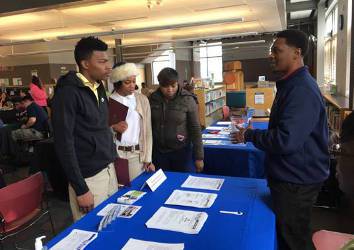
Hundreds of teens flocked to the Washington Park Library Wednesday afternoon to participate in the Milwaukee Public Library’s Northside teen job fair. Over 15 employers and organizations such as Summerfest, City Year Milwaukee and the Milwaukee County Zoo had booths at the fair, many companies hiring summer interns or employees.
The Milwaukee Public Library regularly holds two job fairs for teens every spring, one on the Northside and one on the Southside. The library also held resume writing workshops and mock interview sessions leading up to the fair.
Elizabeth Lowrey of the Milwaukee Public Library helped organize the job fair. She said the library reaches out to many of the employers and organizations who were present at the event.
“We try to listen to the community, and what we heard is that teens need jobs and good experiences,” said Lowrey. “We are trying to make sure that teens have opportunities for them to learn and to grow.”
The teen job fair was held during spring break for the Milwaukee Public School System.
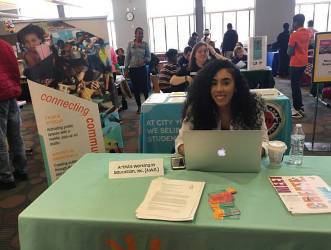
Tatiana Diaz, the Youth Arts Specialist for Artists Working in Education, came to the fair looking for summer interns. Artists Working in Education is a non-profit working to sponsor professional artists to help teach the youth in Milwaukee.
“The inner city is underserved when it comes to careers and education,” said Diaz. “So, us coming to them makes it easier.”
Another organization that was present at the event was the Milwaukee Social Development Commission, a Community Action Agency that serves low-income families in Milwaukee County. The SDC came to the fair to provide information about their programs, such as youth recreation opportunities and job preparation services.
The Goodwill Workforce Connection Center was also present. They attend multiple job fairs in the area every week, and often hire individuals in the community as young as age 16.
“I came here to stay active for the summer and to find a job that will keep me off the streets,” said Marcus, a high schooler from Milwaukee. “No one else will make me money, so I might as well get out there and work on my own.”







 The SC Bar Young Lawyers Division (YLD) is sponsoring its third annual “Your Big Idea” Scholarship Competition this spring. To enter, students must complete an application and answer one of five prompts about the First Amendment in an Instagram video. The submission deadline has been extended to April 13, 2018 at 5 p.m.





 “Segregation and poverty have created in the racial ghetto a destructive environment totally unknown to most white Americans. What white Americans have never fully understood but what the Negro can never forget—is that white society is deeply