THE CHICAGO CRUSADER — Did you know that there are 400,000 black men who have master’s degrees? I didn’t think so. That was just one of the many things I learned at a book signing and discussion of the newly released Guide for White Women Who Teach Black Boys.
Organized by RIISE, or Resources in Independent School Education founded and led by Gina Parker Collins, the event brought together independent school parents as well as educators and administrators to hear and participate in a powerful discussion.
Unfortunately, most of the narrative around black men is deficit focused, and the stereotype is what many believe.
The National Newspaper Publishers Association’s ESSA Awareness Campaign is focused on informing and engaging parents, educators, elected officials and opinion leaders about efforts and policies aimed at closing achievement gaps for students of color and low-income students.
Poverty is the worst form of violence. — Mahatma Gandhi
Poverty is like punishment for a crime you didn’t commit. — Eli Khamarov
Poverty is brutal, consuming and unforgiving. It strikes at the soul. — Charles M. Blow
Last August, I introduced the first column in a six-part series declaring that “poverty is not a character flaw,” but rather a math problem (and so much more). The math problems identified during the course of the series focused on America’s substantial inequities in employment, education, housing and transportation.
Then, in the final column, I began to explore the idea that, in addition to being a math problem, poverty is “so much more.” Poverty is an unrelenting assault on humanity, a wicked scourge that can have a decidedly detrimental effect on the health and wellness of those caught in its steely grasp.
In this new six-part series titled “We already know that poverty is a math problem. So, what else is it?” I will explore the impact that poverty has on the physical, psychological, emotional and spiritual well-being of people.
The series will conclude with an attempt to tackle Ruby K. Payne’s intriguing notion of the hidden rules among classes, which she describes as “the unspoken cues and habits of a group.” She adds that here in the United States, such a concept is often “recognized for racial and ethnic groups, but not particularly for economic groups.”
Still, before I begin to address these issues over the next couple of months, I would like to briefly discuss some of the inherently unique obstacles that people living in poverty face, which are generally unbeknownst to others. I am reminded of a passage from James Baldwin’s essay “Fifth Avenue, Uptown,” where he writes:
“Anyone who has ever struggled with poverty knows how extremely expensive it is to be poor, and if one is a member of a captive population, economically speaking, one’s feet have simply been placed on the treadmill forever.”
A half-century after these words were composed by the legendary writer and activist, New York Times Op-Ed columnist Charles M. Blow revisited Baldwin’s assertion, noting that while its “original intent” was related to monetary matters (namely paying more for lesser goods), he has personally “always considered that statement in the context of the extreme psychological toll of poverty.”
To his point, consider some of the decisions people in poverty make that others couldn’t bear to imagine, like choosing between buying food, paying the light bill, or purchasing prescription medications. In fact, the threat of unexpected costs or the potential of a personal or family crisis likely figures in every choice made by those below the poverty line.
The truth is that poor households don’t have the luxury of planning for the future. For those in poverty, sometimes the day’s only objective is to survive into tomorrow.
These are just some of the reasons that the life expectancy of someone who is poor is 10 to 15 years less than someone who is not. Or why many in poverty are forced to find more than one job, often working longer hours than most and performing back-breaking work for insufficient pay. Far too many of our fellow citizens live in substandard housing, can’t find or afford nutritious food, lack access to quality health care, and are consigned to underfunded public schools.
The stress of poverty, as demonstrated by a number of recent studies, plays havoc with the physiological, psychological, emotional and spiritual health of millions of Americans each and every day. Pure and simple, poverty is violence and it should not stand.
As Dr. King famously said upon winning the 1964 Nobel Peace Prize, “I have the audacity to believe that people everywhere can have three meals a day for their bodies, education and culture for their minds, and dignity, equality and freedom for their spirits.”
Yes, indeed.
Clarence Hightower is the executive director of Community Action Partnership of Ramsey & Washington Counties. Dr. Hightower holds a Ph.D. in urban higher education from Jackson State University. He welcomes reader responses to 450 Syndicate Street North, St. Paul, MN 55104.
[/media-credit] O.N.F.Y.A.H. African dance and drum ensemble.
MILWAUKEE COURIER — Thousands gathered at the Marcus Center of Performing Arts on Sunday, Jan. 14 to celebrate the life of Dr. Martin Luther King, Jr. From 1 pm to 3 pm, local elected and community leaders gave speeches on Dr. King’s legacy, and Milwaukee Public School students delivered speeches and displayed artwork inspired by Dr. King.
Other than Atlanta, Milwaukee is the only other city that has celebrated Dr. King’s birthday since 1984. Each year, Milwaukee Public Schools students in grades K-12 participate in an art, essay and writing contest that honors Dr. King’s legacy. This year’s theme was “take a stand for truth and justice.”
[/media-credit] Milwaukee Flyers Tumbling Team.
MPS Superintendent Dr. Darienne Driver was one of the communityleaders who spoke this day.
“We have had 5,000 students participate in the preliminary contest, and 56 won,” she said. “Our young people are finding ways to get active in our community.”
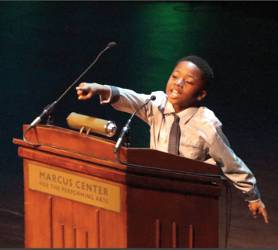
Amir Johnikin, grade 3, was the first place speech winner for the 3-4thgrade category. He attends Elm Creative Arts Elementary School. Without a paper in his hand, he was one of the first to share his entire essay on stage. He stated that the same streets that Dr. King marched were the same streets where his father’s life was taken. He also mentioned African Americans like Sandra Bland, who died at the hands of police officers.
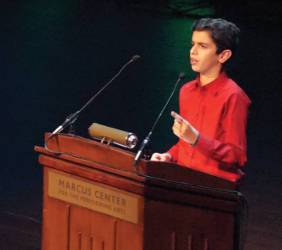
[/media-credit] Ameen Atta, winner of the 9-10th grade speech category speaks against the racism he has experienced as a Muslim.
“King had a dream that people of all races would co-exist in peace,” he said. “I challenge you to stand up for what you believe in, I challenge you to stand up for justice, and I challenge you to stand up for truth.”
Tenth grader Ameen Atta feels especially passionate about the theme when it comes to Islam. Atta won first place in the 9-10th grade speeches category.
“As a Muslim, I stand against violent, senseless acts against Islam,” he said.
He also said that it is “disgusting” to hear “hateful remarks and proposals by leaders of our community.”
“If it’s African Americans, more police. If it’s Hispanics, build a wall. If it’s a Muslim, travel ban,” he said. “But if it’s none of the above, even if the person is the deadliest mass shooter in the history of our country, the only proposal is to send thoughts and prayers to the victim.”
[/media-credit] Amir Johnakin, winner of 3-4th grade speech category challenges the audience to stand up for justice.
Mayor Tom Barrett was one of the first to speak when the event began. He believes that although Dr. King has helped bring social and racial justice to our country today, our current president is not doing so.
“Rather than having an individual who is appealing to our better angels, we have someone who is not appealing to our better angels but to our lesser angels,” he said.
In addition to contest winners, Milwaukee Tumblers, O.N.F.Y.A.H, United Indians of Milwaukee and Latino Arts Strings performed during the multi-cultural salute portion. After the event ended, the art winners were honored in a reception at the Bradley Pavilion.
OAKLAND POST — Laney College’s latest tiny home prototype will house two homeless students beginning this spring semester.
Laney College carpentry presents the Pocket House at Capitol Hill. Right to left: Digital fabrication instructor Marisha Farnsworth, Laney student Kim Gordon, Congressperson Barbara Lee, Laney students Daniel Ticket, Miguel Vega, and Rick Rothbart.
Laney’s carpentry department has achieved success building tiny homes. They won a contest hosted by Sacramento Municipal Utility District for a tiny home they built in 2016. Councilmember Abel Guillén spearheaded a collaboration between the City of Oakland and their department with an $80,000 grant to Laney carpentry to build a tiny home prototype for mass production.
The latest model of the Laney-made tiny homes is the Pocket House Model M. It was delivered to West Side Missionary Baptist Church by Martin Kauffman, a truck driver who donated his services.
Art Ramirez is an electrician who will also donate his services to get the tiny home’s water and electricity up and running.
Rev. Ken Chambers said the 200-member Interfaith Council of Alameda County supports this project, and has a goal to house 1,000 people this year.
But the first step is to work with Laney coordinators to interview and select students in need of the home each semester. The parking lot the tiny home sits in is already a safe car park, and Chambers is taking steps toward being able to pay a stipend to the selected students for overseeing the lot. The church will also offer access to health and employment services.
Chambers hopes to create a system that can be replicated throughout Oakland and have a deep impact on the unsheltered communities it holds.
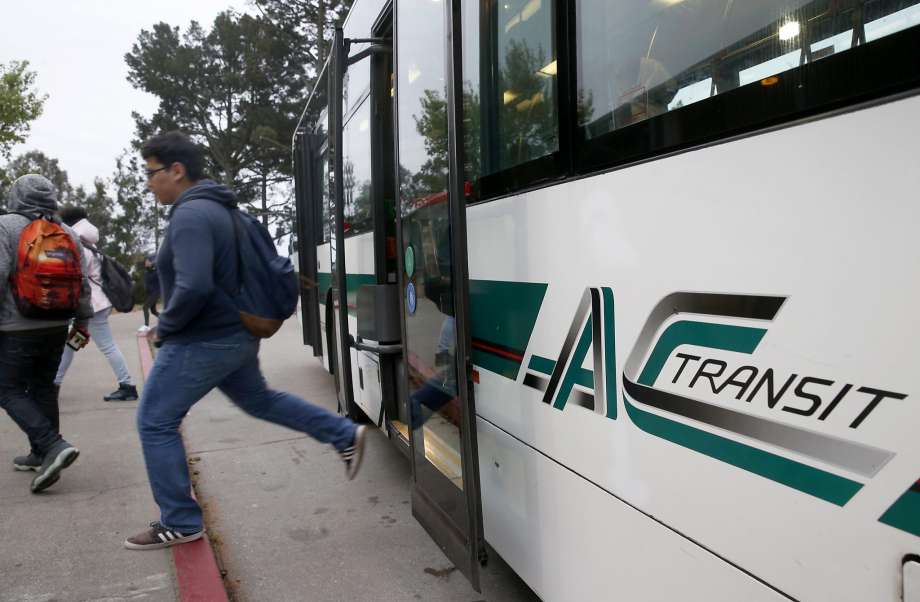
THE OAKLAND POST — The Oakland Unified School District and AC Transit have announced that bus transportation service to Montera Middle School, Skyline High School and Community Day School will be extended through June 2019.
“This extension gives our families assurance of both agencies’ commitment to support their transportation needs and to find solutions together,” said Board of Education Member Nina Senn.
Finding a longer-term solution will take time and an extension into 2019 gives us breathing room to do so,” she said. “We are very grateful for AC Transit’s and our state legislators, Senator Nancy Skinner, Assemblymembers Rob Bonta and Tony Thurmond’s … partnership and collaboration as we work through this process.”
Said AC Transit Board President Elsa Ortiz, “AC Transit is proud of our decades-long partnership with OUSD and honored to know that our service will remain a passport for East Bay students.
“In collaboration with OUSD, we devoted the past year to developing cost savings that minimized changes to ‘school-tripper’ bus lines, while working with stakeholders on the financial commitments that now protect supplementary bus service through the close of next school year,” she aid.
Twenty-five African American high school students from Atlanta are heading to Harvard this summer as part of the Harvard Debate Council’s residential summer program.
The Art Institute of Atlanta, where the surprise announcement was made, awarded the students $10,500 in scholarship money to attend the prestigious program. An additional $88,000 needs to be raised to support the students’ tuition, room and board, and travel. Donate here.
DALLAS POST TRIBUNE — AUSTIN, Texas — Texas Appleseed, a public interest justice center, is accepting scholarship applications as part of its Diversity Legal Scholars program, aimed at diversifying the legal profession. The program helps low-income students of color expand their law school options through a scholarship that covers the full cost of a Kaplan (LSAT) preparation course, valued at about $1,299 per scholar.
The scholarship is offered three times a year, corresponding with LSAT test dates. Key dates are below:
Round 1: Accepting applications now. The application deadline is February 12, 2018. Scholarship recipients would take the LSAT on June 11, 2018.
Round 2: Accepting applications starting May 14, 2018. The application deadline is June 4, 2018. Scholarship recipients would take the LSAT September 8, 2018 or November 17, 2018.
Round 3: Accepting applications starting August 1, 2018. The application deadline is September 5, 2018. Scholarship recipients would take the LSAT January 26, 2019.
Scholarship recipients must be Texas residents and apply to take the LSAT on the designated date that corresponds to their application round. Additional requirements and details can be found at www.texasappleseed.org/diversity-legal-scholars.
According to the latest figures from the Bureau of Labor Statistics, only 4.4 percent of all lawyers in 2016 were Black, 4.7 percent were Asian, and Latinos comprised 5.6 percent of all attorneys. Texas Appleseed has awarded hundreds of Diversity Legal Scholars scholarships since its inception to give applicants a better shot at fulfilling their dreams of law school and entering the legal profession.
VOICE & VIEWPOINT — In describing his runaway hit “Hamilton,” actor and playwright Lin-Manuel Miranda said, “It’s this incredible way to explore how history isn’t told.” For students in San Diego City Schools and surrounding areas, this thought-provoking notion took center stage with their participation in eduHam, an innovative educational program coordinated with the Tony-winning play’s run at the San Diego Civic Theatre, which provided nearly 3,000 students entrée to a special matinee performance on January 11, including a lively Q & A session with some of the cast members, and, for some, the opportunity to perform their own original creative pieces—songs, rap, poetry, scenes, monologues—before an audience of their peers.
The Hamilton Education Program, or eduHam, is a multi-week program for high school students studying American history in Title 1 schools, culminating in an all-day field trip to the theatre. Hoover High School was one of 46 schools taking part in the special event. Students earned their spot at the coveted affair by participating in class activities and/or after school and Saturday sessions during which they researched extensively, studied primary sources provided by the philanthropic Gilder Lehrman Institute of American History in conjunction with the producers of “Hamilton,” and let their imaginations go full throttle to create individual projects that were informative and entertaining. Connections to current events are not lost on these thoughtful and curious students, adding dimension to their learning experience.
On a recent afternoon, three of the participating students from Hoover, Alexis Harnage, Edy Canaca, and Lilia Ruvalcaba, gathered in the classroom of ELA teacher Kristiana Riego de Dios in anticipation of the big day and shared thoughts on how the project had stimulated new learning experiences that helped them look at history in new and different ways.
“I thought it was cool that people were combining history and the arts because usually you see history as more academic, and dance and art as different,” said 11th grader Harnage. The use of contemporary music—hip hop and rap—along with the more traditional genres of R & B and jazz was a hook for the high school junior, who plays an instrument herself, part of a rigorous curriculum that includes AP US History. Harnage, at 17, is articulate and focused, a self-described overachiever who said she drew on prior knowledge of George Washington, supplemented with extensive research to create a rap about our founding father and his role as a revolutionary leader in America’s road to independence. Her hard work paid off, as her project, which she wrote and performed with fellow Hoover 11th grader Bernard Drake, was one of only 15 selected for presentation at the Thursday event. “What I learned is that every leader, every president sets a tone for how they will lead the country. George Washington was widely respected as the first president of the United States and as a leader. I constantly make the connection with our first president of the United States vs. our current president Donald Trump, because I know there is controversy as to whether he is a good president or not. What you put out and what you do for the people of the country will stick around for a really long time.”
Edy Canaca, whose AP US History teacher Ellen Towers describes as “a consummate learner, was drawn to the duel between Aaron Burr and Alexander Hamilton. The 11th grader created a poem, which he and two of his classmates acted out. Prior to his research, Canaca was not aware of the outcome of the duel, which Burr won when Hamilton chose to shoot his gun in the air. “But it still ended badly for Burr,” Canaca concluded, “and I’m pretty sure he regretted it. Destroying his enemy actually made it worse for him and he could not advance politically.” In his research, Canaca made an important discovery as to discrepancies in how history is told. “Every source says something different. It’s not always accurate and there are people who change it up. They always tweak it, depending on their perspective.”
Lilia Ruvalcaba, who loves writing poetry, found a fascinating subject in Abigail Adams. “When we look at history, we see a lot of men, and in our history class, we learned about the politics, but we didn’t really learn her side.” Ruvalcaba’s poem, written from the perspective of Adams, who was both wife of President John Adams and later the mother of 6th president John Quincy Adams, explores the woman’s role as intellectual confidante, but one who, as a product of the times, remained largely behind the scenes. Lilia is soft-spoken but delivers a powerful message in her observations about women’s roles that is especially timely. “One of the things she said that stands out to me,” said the 16-year-old, “was ‘Remember us ladies.’ That’s a significant line and important even today.”
“This is a story about America then, told by America now,” writer/producer Miranda has said. AP History teacher Towers, who worked with de Dios as eduHAM coordinator on the Hoover campus, encouraged inquiry in her students as they drew facts from their primary sources and at the same time humanized the historical figures they read about. “My focus since I’ve gotten into history is telling the untold story or telling the story from a different perspective,” she says. “It’s nice to see people thinking about history as a multi-dimensional and multi-perspective idea. I think in the back of every history teacher’s mind is ‘who have we missed and how can we bring them forward without being dishonest.’”
This point is not lost on Harnage, who adds, “Being African American, I sit in a lot of history classes and know that it is Eurocentric. When it comes to African Americans and the struggle of our people and what we have to overcome, I don’t hear about that in school that often, and I don’t necessarily think that it’s the teacher’s fault because I think that they are just teaching the curriculum. But,” she adds, “when I think about how history is told, I think that certain types of history are overtold and other types of history or other perspectives of history or types of people are undertold or not told at all.”
Projects like eduHAM can narrow this learning gap. And by casting African Americans and Hispanics in the “Hamilton” production, Miranda highlights the diversity of people who were there and not in the shadows, Towers says, “And,” adds De Rios, “why can’t a person of color play Hamilton or Aaron Burr? Who is to say that color has to define your role?”
Who indeed?
On the big day, when 2,833 high school students—the largest eduHAM ever—filled the seats of the San Diego Civic Theatre, love, laughter, and gratitude was palpable. “This is an honor,” said Hoover 11th grader Bernard Drake after his performance with student Harnage. “It’s amazing to me how an assignment for a class can lead to you seeing a performance of ‘Hamilton.’ Working towards a goal this way is very rewarding. It pushed me to do my best and I know will lead to even greater things.”
And, as Karli Dinardo, “Hamilton” cast member advised, “No dream is too big. Learning is endless. No matter how hard, throw yourself into the deep end and surround yourself with people who are positive, who encourage and nurture your dreams.”
Where you send your child toschool is one of the most important decisions you can make.
The new school quality data released by the state shows several public schools making great progress with Oakland children.
But before I get to the schools showing the most progress, let me offer a disclaimer.
No number can fully capture a school’s story of success. So take these insights as starting points and do your homework.
Now is the time to research and apply to schools in open enrollment.
All of the information below can be found on the Oakland Unified School District’s website.
We have never had more options, easier ways to enroll, or more information about schools, so we need make the best choices we can.
Check out this list of schools making significant gains in English language arts, math and graduation rates, as well as those that stand out for serving Black and Latino* students exceptionally well:
Elementary schools gaining in math and English
Aspire Monarch*
Francophone Charter school
Madison Park*
Manzanita SEED
Glenview
Middle Schools gaining in math and English
West Oakland Middle School+
American Indian Public Charter+
Claremont*
Epic Charter*
Oakland Charter *
K-8 Schools gaining in math and English
Greenleaf*
Ascend*
Melrose
American Indian Model School+
Hillcrest+
6-12 Schools gaining in math and English
Coliseum College Prep*
Aspire Golden State*
Aspire Lionel Wilson*
Madison Park*
Bay Area Technology Prep+
High Schools with academic gains and increasing graduation rates
MetWest*+
Leadership Public Schools R and D
ARISE*
Oakland Charter High*
Envision*+
Knowledge is power. So take advantage of your options and the information available. There are still enrollment fairs coming up from OUSD and Enroll Oakland before the enrollment deadlines. Your children are counting on you to do the best by them, and that starts with making informed choices.


 By Robin White Goode, blackenterprise.com










 The scholarship is offered three times a year, corresponding with LSAT test dates. Key dates are below: