
By Aaliyah Amos
Word in Black
Tiyana Scarlett carried the weight of her incarceration in silence for years. Released in 2017, she buried her guilt until 2024, when she joined Ritual4Return, a New Jersey program that uses art to help formerly incarcerated people heal.
“It wasn’t until I started the classes at Ritual4Return, that I realized my story actually needed to be heard,” she recalls.
The brainchild of Kevin Bott, a Rutgers University alumnus and NYU-trained theater educator, Ritual4Return’s 14-week program, which alternates between men’s and women’s cohorts, uses drumming, storytelling and ritual to help participants reclaim their lives — and stories — after incarceration.
Rooted in Creativity and Community
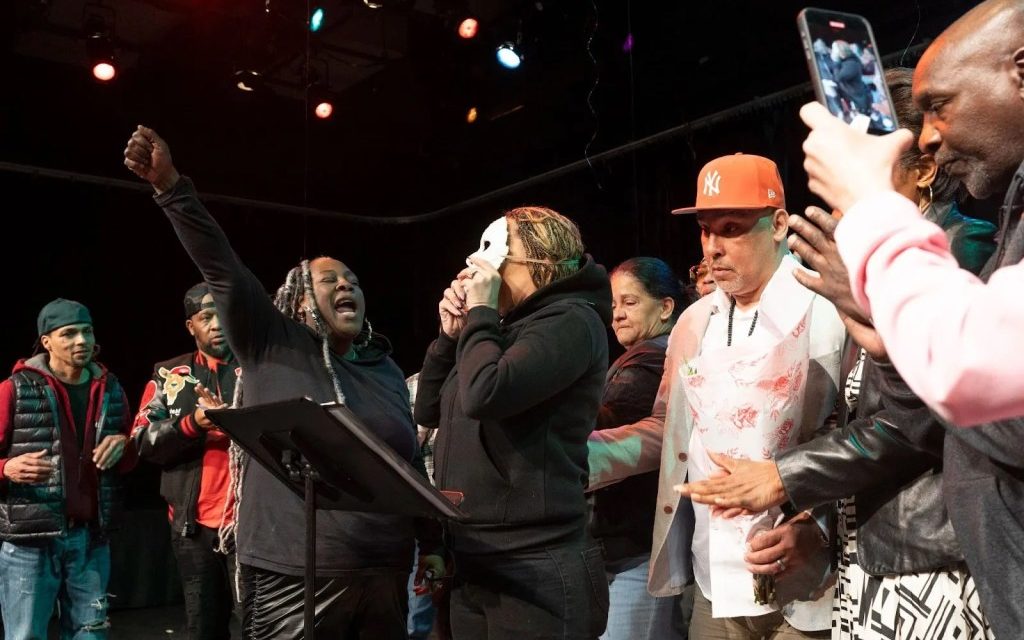
Anyone — community members, participants’ families, friends, as well as Rutgers-Newark students and faculty, can attend a Ritual4Return performance. But there’s one requirement. Attendees don’t just watch. They participate.
Performing creates an “experience for the participants and the community,” Bott explains.
Rooted in community, restoring the social contract and the idea of transformative justice, the ritual ceremony requires the community to be on their toes — ready to respond and support the participants.
Attendees arrive early for a pre-show workshop, “and we do some exercises that help them connect” through storytelling and learning their roles in the ritual, Bott says.
Audience members learn the parts they are meant to play in the ritual, which means learning a call-and-response sequence or the songs the participants sing during the performance.
“Rather than watch or spectate,” Bott says, “you’re bearing witness.”

Healing the 95%
Bott launched Ritual4Return in 2009. In 2006, while a doctoral student in educational theater at New York University, he began working with Rehabilitation Through The Arts to teach theater in prisons in New York. The organization recently inspired the movie “Sing Sing,” which highlights the importance of rehabilitation programs in carceral institutions.
The need for healing-based reentry programs is certainly there. According to the Bureau of Justice Statistics, “at least 95 percent” of all people incarcerated by the state “will be released from prison at some point.”
Bott says, “The problem is on the other side, when 95 percent of people are going to come home, there is nothing to re-elevate them.” That’s where programs for post-incarceration healing and support, like Ritual4Return, can help.
To encourage participation, participants who are community members are given a financial stipend or three college credits through NJSTEP for students.
The initiative recently secured a $15,000 matching grant from the New Jersey Council for the Humanities to support the next cohorts. A new women’s cohort starts on May 4, and is open to all women who have been incarcerated, regardless of how long they have been on the outside. Botts also says the process of expanding Ritual4Return nationally will start this summer through a training camp taking place in July at Rutgers-Newark.
As for Scarlett, now, she can’t stop telling her story — through performances, podcasts, and even at her church.
“Healing is a journey (so) never put a period where a comma is supposed to be,” she says.
This article was originally published by Word in Black. See the original story at this link: https://wordinblack.com/2025/04/healing-scars-incarceration-one-performance-at-a-time/
The post Racial Healing: Healing the scars of incarceration, one performance at a time appeared first on AFRO American Newspapers.