By Roy S. Johnson
Historic 16th Street Baptist Church did not wait. It never did. Not in its infancy — founded 152 years ago in the belly of segregation. It didn’t wait to become the soul-saving spirit and bedrock of a Birmingham community facing hatred every day.
For generations, like myriad Black churches in growing cities nationwide, it did not wait to inspire and provide — and not solely for those who walked through its doors dressed in their best seeking peace and purpose amid a world that thought the worst of them.
In 1890, one of its earliest pastors, Rev. William R. Pettiford, founded the Alabama Penny Savings Bank as its members and neighbors were denied access to white banks. It was the first Black-owned financial institution in the state, and, for more than a quarter century, it remained a wealth-building lifeline for Birmingham’s Black residents.
“Rev. Pettiford used to say, ‘You can’t just stay within your walls,’” shares Ted Debro, a member of 16th Street Baptist for more than three decades and past chair of its board of trustees. “’You’ve got to reach outside to serve the community, to develop that community.’”
You can’t wait.
Not then, and not now.
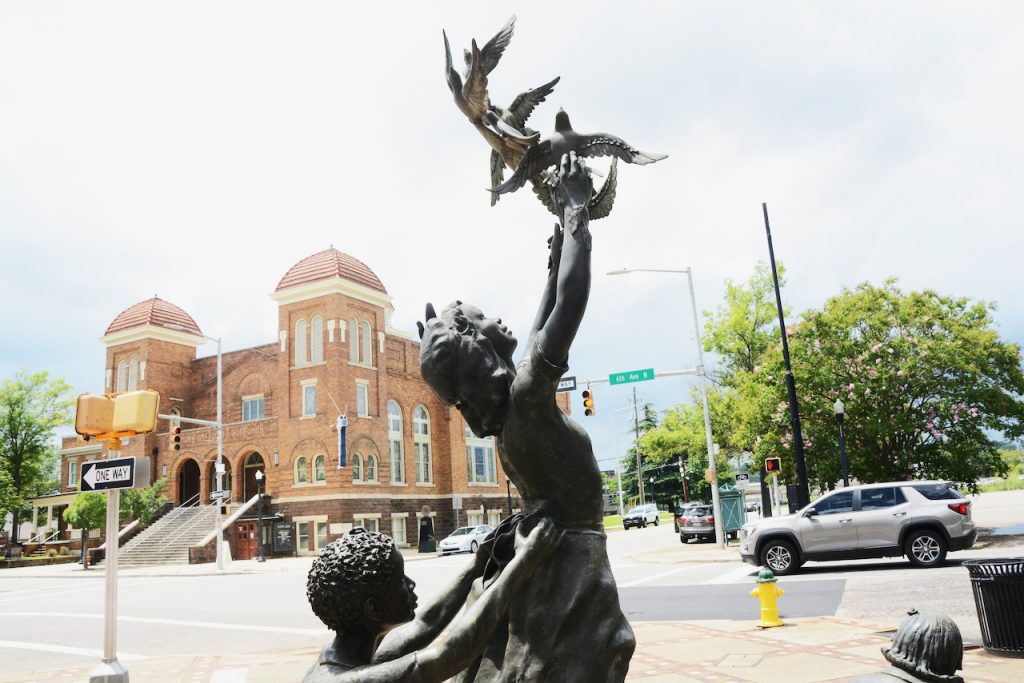
Not with 16th Street Baptist standing regally on the corner of 16th Street and Sixth Avenue North as one of the most significant historical sites in the nation, a twin-towered beacon in Birmingham’s hallowed yet anemic Civil Rights District.
It is more than a church. It is a unique place where history happened, history that changed our city, our state and our nation.
It is a testament to the young lives lost to hate there in 1963, and to brave young heroes who marched in the face of hate’s fire houses and police dogs across the street in Kelly Ingram Park.
It is a place that, like the entire civil rights district, deserves to be elevated and supported by a comprehensive, focused public and private effort to again become a catalyst for change — this time as a tourism magnet that would spark long-overdue economic development for Birmingham and the region.
Instead, block after block surrounding the distinguished church sits idle and ignored. Lots are empty and void and buildings are wheezing ghosts of their past, deteriorating beyond repair.
And the church’s venerable yet worn and aged neighbor — the 33-year-old Birmingham Civil Rights Institute — is months into pondering a plan for restoration and revival. For “reimagining,” that’s its word.
So many seem to be waiting as the district remains a quilt of unfulfilled promise.
16th Street Baptist Church is not among them. It is not waiting for any of that to change.
“We are pushing and really trying to do things in the district,” Debro says.
Unfortunately, they are largely pushing alone.
In April, the church broke ground on a 13,000 square-foot education and visitors center that is rising on church-owned land adjacent to the parsonage on Sixth Ave North. The center will be an extension of the popular space in the church’s basement that conveys the dynamic history of the church and the community it once surrounded, and of exhibits in the parsonage highlighting former pastors who led the church’s growth as a community pillar of faith and fight.
“We’re trying to show how religion has played a part in people’s lives,” Debro says, “We’re creating spaces to encourage collaboration and drive community progress, for people to dialogue and have a chance to discuss what they experienced when they came through the church and how they can go back and make impactful changes in their lives and communities.
“Civil Rights is just a part of what we have done,” he adds, “but religion created the environment of sharing and building the community.”