By Karen Heslop
You may have heard about the benefits of using castor oil in your hair and on your skin, but which one should you use? There are currently two different types of castor oil available, and since they’re both supposed to be good for you, it helps to know what makes them different so you can choose carefully.
Both castor oil and black castor oil come from castor seeds. When placed through the extraction process, these seeds release a vegetable oil that contains icinoleic acid (80–85%), oleic acid (7%), linoleic acid (3%), palmitic acid (2%), and stearic acid (1%). The first difference between the two forms of castor oil starts with how they’re produced. With regular castor oil, manufacturers use what is known as a cold extraction process.
In this case, the seeds are put through a hydraulic press, and the temperature isn’t allowed to pass 50 degrees C, as higher temperatures would allow certain impurities to dissolve in the oil. The castor oil that’s received from this process is generally clear and can be used for medicinal purposes. If the impurities aren’t a concern, manufacturers can directly press the castor seeds to receive a form of castor oil that can be used for industrial processes.
The manufacturing process for black castor oil is different from that of regular castor oil. Before the extraction step, the seeds are roasted and ground into a paste. This paste is then boiled in water to release the resulting oil. The ash from roasting gives the oil its distinctive dark color and raises its pH. This process is said to have originated in Jamaica.
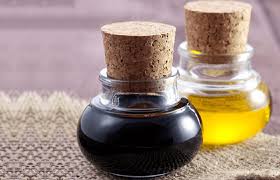
However, the differences between regular castor oil and its black alternative don’t stop with how they’re processed. The extraction methods result in differing properties as well. While the regular castor oil is clear to light yellow, black castor oil is dark brown to black. The light-colored version is generally not as thick as black castor oil, and the aroma tends to be lighter. Finally, the pH of regular castor oil usually falls between 4.5 and 5.5. Black castor oil, on the other hand, is typically more alkaline because of the ash from baking. As such, its pH can be between 8 and 9.
Interestingly, while a lot of the black castor oil that’s available uses the Jamaican process of manufacture, there is a Haitian variation. While the beans are still roasted, the seeds are processed without the ash. It results in an oil that’s darker than the regular castor oil, but the pH falls between 7 and 8.
The answer to this can vary depending on your skin. According to the experts in the skincare industry, all three possible types of castor oil can have different properties that may make them better suited to varying uses. For example, regular castor oil has a high ricinoleic acid content with a lower pH than the black variants.